Trading Psychology: Master Your Mind to Master the Markets
Trading Psychology: Master Your Mind to Master the Markets
Complete guide to trading psychology: what it actually means beyond vague mindset advice, the five mental traps that cost traders the most money, and the practical systems (pre-trade checklists, emotion tags, daily loss limits, weekly reviews) that turn psychological awareness into measurable performance improvement. Every technique is paired with journal tracking methods so you can see the data, not just feel the difference.
class SampleComponent extends React.Component {
  // using the experimental public class field syntax below. We can also attach
  // the contextType to the current class
  static contextType = ColorContext;
  render() {
    return <Button color={this.color} />
  }
}
Last Updated: May 12th, 2026
Trading psychology is the study of how cognitive biases, emotional reactions, and mental habits affect trading decisions and performance. The core challenge is that the human brain evolved for survival, not for markets. Loss aversion makes traders hold losers too long and cut winners too short. Pattern recognition bias creates false confidence after small samples. Recency bias causes overreaction to the last few trades. The five mental traps that cost traders the most money are revenge trading, FOMO (fear of missing out), overconfidence after winning streaks, loss aversion, and analysis paralysis. Each trap has a specific data signature in your trading journal and a practical fix: pre-trade checklists, emotion tags, daily loss limits, and structured weekly reviews. When traders tag their trades by emotional state and compare the results, planned entries consistently outperform emotional entries by 20 to 40 percentage points in win rate and 1.0 to 2.0 points in profit factor.
Roughly 80% of trading performance comes down to psychology. Not strategy, not technical analysis, not finding the perfect indicator. The traders who make money consistently are not the ones with the best setups. They are the ones who can execute their plan without letting fear, greed, or ego hijack their decisions.
That is not a motivational quote. It is a measurable reality. When you track your trades and tag them by emotional state, the data tells a clear story: planned trades outperform emotional trades by a wide margin. Traders who tag "FOMO entry" trades in their journal typically see win rates 20 to 30 percentage points lower than their planned entries. The setups are not different. The execution is. This pattern shows up consistently across every market and every trading style. For a deeper look at the four specific types of emotional trades and how to stop them, see the guide on emotional trading.
This guide breaks down what trading psychology actually means (beyond vague "mindset" advice), the specific mental traps that cost traders money, and the practical systems you can build to trade with a clear head. No abstract theory. Just the patterns that show up in real trading data and the techniques that work to fix them. If you want the reading list that goes deeper on each concept, the trading psychology books guide reviews eight books with specific journal tracking methods for each.
What Is Trading Psychology and Why Does It Matter?
Trading psychology is the mental and emotional dimension of trading that determines whether a trader can consistently execute their plan. It is not "thinking positive" or "believing in yourself." It is the study of how your brain's natural wiring conflicts with what profitable trading requires.
Your brain evolved to avoid losses, seek certainty, follow the crowd, and react to threats. Every one of those instincts works against you in the markets.
Loss aversion makes you hold losing trades too long (hoping they will come back) and cut winners too short (locking in gains before they disappear). Research from behavioral economics shows that losses feel roughly twice as painful as equivalent gains feel good. On a $50,000 account risking $500 per trade, a $500 loss hurts more than a $500 win feels rewarding, which means your brain will do irrational things to avoid realizing losses. Tracking your planned risk-reward ratio versus your actual exits shows exactly how loss aversion distorts your results. If your planned target is 2R but your average winner closes at 0.8R, loss aversion is cutting your profits by 60%.
Pattern recognition bias makes you see setups that are not there. Your brain is wired to find patterns, even in random noise. After three winning trades on a specific setup, your brain tells you it "always works," even if your actual sample size is too small to draw any conclusion. This is why data matters more than feelings. A setup needs 30 or more trades before you can evaluate it with any statistical confidence. Anything less is noise. The guide on finding your trading edge covers the exact sample sizes needed to validate each part of your strategy.
Recency bias causes you to overweight your last few trades. After two losses, everything looks like a bad trade. After two wins, you feel invincible. Neither feeling is based on your actual long-term data. This is why a structured trade review process matters. Weekly reviews force you to look at 20 or more trades instead of fixating on the last two.
Understanding these biases is the first step. Building systems to counteract them is the second.
What Are the Five Mental Traps That Cost Traders the Most Money?
Trap 1: Revenge Trading
Revenge trading happens after a loss (or a series of losses) when you take impulsive trades trying to "make it back." The emotional need to recover overrides your trading plan, and you start taking lower-quality setups with larger position sizes.
What it looks like in practice: You lose $400 on a clean setup that just did not work. Instead of moving on, you immediately enter another trade without waiting for your criteria to be met. You size up because you need a bigger win to recover. That trade also loses. Now you are down $900 and taking a third trade with even worse judgment.
What the data shows: Traders who track revenge trades consistently see 25 to 40% lower win rates on those entries compared to their planned trades. The average loss on a revenge trade is typically 1.5 to 2x larger than a normal losing trade because of the oversizing. On a $50,000 account, a single revenge trading spiral can cost $1,500 to $3,000 in a single session. Over a month of occasional revenge spirals, the total damage often exceeds $5,000, which is 10% of the account wiped out by one behavioral pattern.
How to fix it: Set a hard daily loss limit and walk away when you hit it. If your average daily P&L swing is $500, set your limit at something like $600 to $750. When you hit it, close your platform. No exceptions. The market will be there tomorrow. For a complete breakdown of the revenge trading cycle and the specific journal tags that catch it early, see the dedicated guide on revenge trading.
Trap 2: FOMO (Fear of Missing Out)
FOMO trading hits when you see a stock moving without you. It is already up 5%, the chat room is going crazy, and you chase the entry at the worst possible level because you cannot stand watching it go higher without you in it.
What it looks like in practice: SPY gaps up 1% at the open. You did not have it on your watchlist, but everyone on social media is posting gains. You buy at 9:35 AM, right as the opening drive exhausts itself. By 10:00 AM you are down 0.5% and wondering why you entered.
What the data shows: FOMO entries are almost always late entries. Late entries have worse risk/reward because you are buying closer to the move's exhaustion point. The stop loss is wider (because the logical stop is further away from a late entry), and the remaining upside is smaller. When you filter your journal by "FOMO" tags and compare r-multiple results, FOMO trades typically average -0.5R to -1.0R per trade, while planned entries average +0.3R to +0.8R. The gap is not close.
How to fix it: Only trade setups that are on your pre-market watchlist. If it is not on the list, it does not exist. This one rule eliminates 90% of FOMO trades. Write your watchlist in your Notebook before the market opens, and hold yourself accountable to it. For a deeper breakdown of FOMO patterns and the specific triggers that cause them, see the full guide on FOMO trading.
Trap 3: Overconfidence After Wins
A winning streak feels amazing, and that is exactly when it is most dangerous. After five green days in a row, your brain tells you that you have "figured it out." You start sizing up, trading more frequently, and taking setups you would normally skip. This is what the trading tilt framework calls "win tilt," and it is just as destructive as loss tilt because it leads to the same outcome: oversized positions in low-quality setups.
What it looks like in practice: You have had your best week ever, up $3,000 on a $50,000 account. On Friday, you double your position size because you are "on fire." You also add two new setups you have not tested because everything feels like a winner. By the following Wednesday, you have given back $2,200.
How to fix it: Your position sizing rules should not change based on recent results. Define your risk per trade (1% of account, or whatever your rule is) and stick to it regardless of whether you are on a hot streak or a cold streak. Hot streaks end. Your risk management should not. Use the position size calculator to set your size before every trade based on your stop distance, not on how you feel about the last five trades.
Trap 4: Loss Aversion (Holding Losers, Cutting Winners)
This is the most universal trading psychology problem. You hold your losers hoping they will recover ("it is just a pullback"), and you sell your winners too early because you are afraid of giving back the gain.
What it looks like in practice: You enter AAPL at $185 with a target of $190 and a stop at $183. The trade hits $188 and you sell for a $3 profit because "a bird in the hand." Meanwhile, your losing trade in MSFT is down $4 from your entry, well past your stop, and you are still in it because "it is oversold and should bounce."
The result: small wins and large losses. Over time, your average winner is $300 and your average loser is $600. Even with a 60% win rate, you are losing money. This math is why profit factor matters more than win rate alone. A 60% win rate with a 0.5:1 reward-to-risk ratio produces a profit factor of 0.75, which means you are losing $0.25 for every $1.00 risked. The win rate looks good. The account balance does not.
How to fix it: Use hard stops. Enter them the moment you enter the trade, before your emotions have time to interfere. If your stop is $183, set the actual stop order at $183. Do not make it a "mental stop" that you can negotiate with yourself when the price gets there. Track your planned versus actual exits in your journal. After 30 trades, compare your planned R targets to your actual R results. If there is a consistent gap, loss aversion is the cause.
Trap 5: Analysis Paralysis
The opposite of impulsivity: you see a valid setup, it meets all your criteria, and you freeze. You start looking for reasons NOT to take the trade. "What if the Fed says something?" "What if this resistance holds?" "Let me check one more indicator."
By the time you decide to enter, the move has happened without you. And that missed opportunity often leads directly to FOMO on the next move. This creates a destructive cycle: paralysis leads to missed trade, missed trade leads to FOMO entry, FOMO entry leads to loss, loss leads to more paralysis. Breaking any one link in that chain stops the entire cycle.
How to fix it: Pre-define your entry criteria so specifically that the decision is binary. If the setup meets criteria A, B, and C, you take the trade. Period. Writing this down in your trading plan as a Strategies definition (where you can track results per strategy) takes the decision out of the moment. The data shows whether the setup works. Your job is to execute, not to second-guess.
How Do You Build Psychological Resilience as a Trader?
Abstract advice ("be disciplined" or "control your emotions") does not work because it does not give you anything to do. Real trading discipline is not a personality trait. It is a system. Here is the concrete system that turns awareness into measurable improvement.
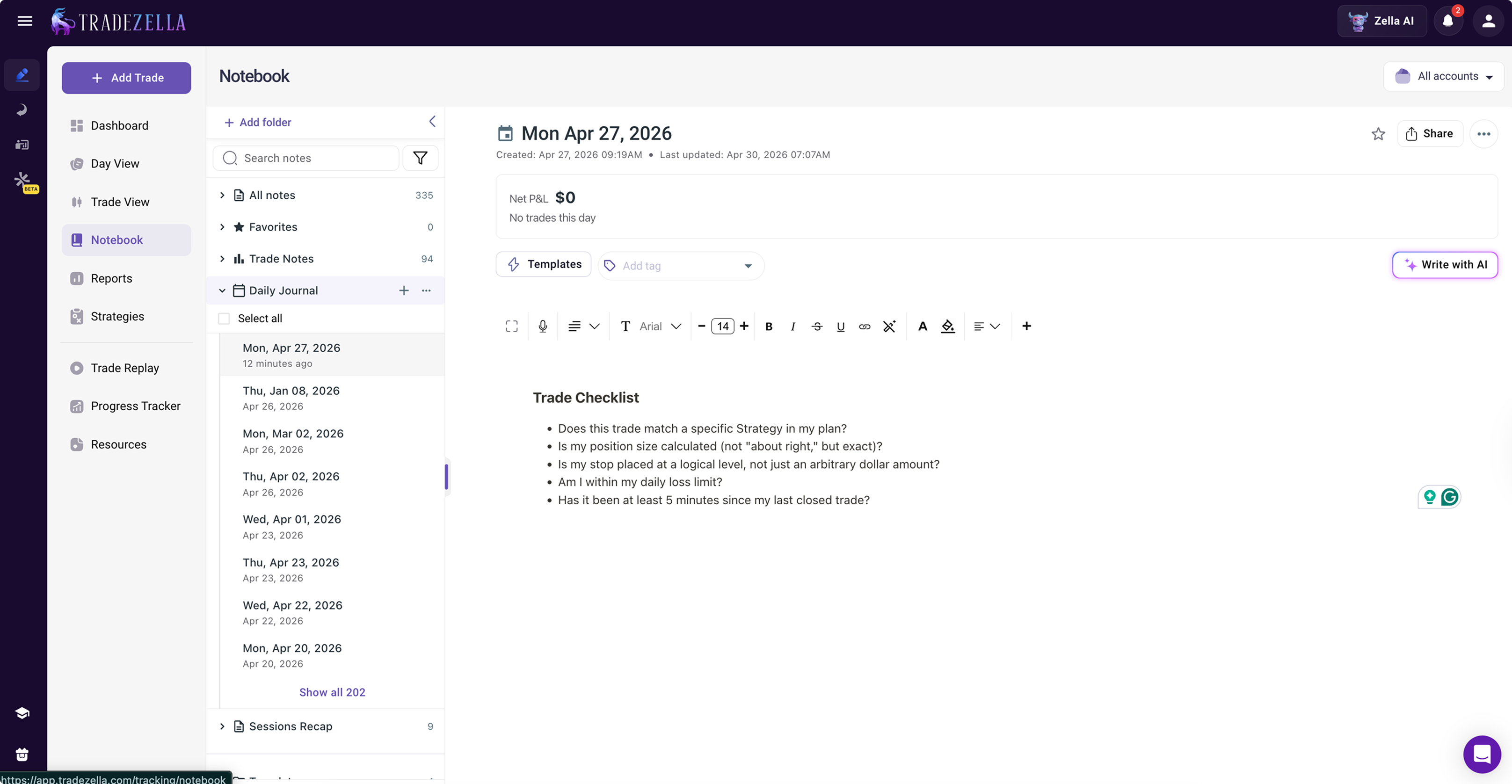
The Pre-Trade Checklist
Before every trade, run through a 30-second checklist:
Is this setup on my watchlist or in one of my Strategies?
Does it meet all my entry criteria (not just some of them)?
Where is my stop, and is my position sized so that hitting the stop loses no more than my per-trade risk limit?
Am I entering this trade because of my plan, or because of something I saw on social media, a chat room, or a P&L screenshot?
If the answer to #4 is anything other than "my plan," I do not take the trade.
This checklist takes seconds, and it catches 80% of emotional entries before they happen. Write it in your Notebook before the session starts. TradeZella's Notebook keeps your checklist, watchlist, and daily plan in one place so you do not need to switch between apps. The act of writing the plan creates a commitment that is harder to override than a mental intention.
TradeZella Notebook
The Emotion Tag System
This is where tracking and psychology intersect. Every trade gets an emotion tag in your journal.
Create tags like: "Planned Entry," "FOMO," "Revenge Trade," "Oversize," "Patient," and "Forced." Tag honestly. Nobody sees this but you.
In TradeZella, your Tags report shows your best and worst performing tags side by side, with win rate, total P&L, and average R-multiple for each tag. After 30 days of honest tagging, you will see something like this: your "Planned Entry" tags run at 58% win rate with a 1.6 profit factor, while your "FOMO" tags sit at 31% with a 0.4 profit factor. That is a gap of $200 to $400 per trade on a $50,000 account. Over 100 trades, the difference between planned and emotional entries can exceed $20,000. This is why trading habits tracking matters. The data makes the invisible cost of emotional trading visible.
TradeZella Tags
What to do: Create emotion tags today and start applying them to every trade. After 30 trades with honest tags, pull up the Tags report. The numbers will tell you exactly how much your emotional trades are costing you, in dollars. For the complete tagging framework including setup tags, quality tags, and emotion tags, see the guide on how to build a trade journal with the right fields and review process.
The Daily Loss Limit
Set a maximum dollar amount you are allowed to lose in a single day. When you hit it, you are done. Close the charts, close the platform, go do something else.
The daily loss limit does not prevent all emotional trading, but it prevents the worst kind: the spiral where one bad trade leads to five bad trades leads to blowing up a week's worth of gains in an afternoon. This is the same pattern that causes overtrading: a loss triggers frustration, frustration triggers revenge entries, revenge entries trigger oversizing, and oversizing blows through your weekly profit in a single session.
Most successful day traders set their daily loss limit at 1.5 to 2x their average winning day. If you average $500 on green days, your limit should be somewhere around $750 to $1,000. On a $50,000 account, a $1,000 daily loss limit (2% of account) gives you room for normal variance while preventing catastrophic spirals. For a complete framework on setting daily, weekly, and monthly limits, see the drawdown management guide with its 3-tier protocol.
The Weekly Review (Where Psychology Meets Data)
Every week, spend 20 to 30 minutes reviewing not just your P&L, but your psychological patterns.
Open your Notebook in TradeZella and answer these questions:
How many trades this week were planned versus emotional? (Check your tags.)
What was my biggest emotional moment this week, and did I handle it well?
Did I follow my daily loss limit every day?
Is there a time of day where I consistently make emotional trades? (Check the Day and Time report.)
What to do: Create a "Weekly Review" template in your Notebook with these four questions. Fill it out every Sunday. Over a month, you will build a record of your psychological growth that is just as valuable as your P&L curve. This weekly review is the foundation of the structured trade review process. The combination of data analysis and written reflection builds self-awareness faster than either one alone. For a complete walkthrough of what to review and how to turn findings into action, see the guide on how to analyze your trading performance across five core metrics.
How Does Data Help Manage Trading Emotions?
Gut feelings are unreliable. Your brain remembers your biggest win vividly and forgets the 10 mediocre trades that followed. It tells you "I always lose on breakouts" based on two recent losses, ignoring the 15 breakout wins from the previous month.
Data fixes this. When you can pull up your actual numbers, filtered by tag, by setup, by time of day, by day of week, emotions lose their power. You are not arguing with a feeling. You are looking at a fact. This is the difference between hoping your psychology improves and measuring it. A win rate filtered by emotion tag is a psychology score, not a trading metric. A profit factor comparison between planned and emotional trades is a behavioral report card.
This is why the combination of journaling and analytics matters so much for trading psychology. The journal captures what you were thinking and feeling. The analytics show what actually happened. When those two things are side by side, self-deception gets a lot harder.
In TradeZella, you can filter your Calendar view to show only trades with specific tags. Looking at a month of "Revenge Trade" tags on the Calendar, seeing red day after red day, creates a visceral understanding that no amount of self-talk can match.
What to do: Filter your Calendar view by your worst emotion tag (usually "Revenge Trade" or "FOMO"). Look at the colors. Count the red days. Then do the same filter for "Planned Entry" or "A+ Setup." The visual contrast between the two will change how you think about impulsive trading. This calendar exercise is one of the most powerful psychological interventions available because it bypasses rationalization. You cannot argue with a calendar full of red. For traders going through an extended losing period, the losing streak protocol provides a graduated response system (from normal variance through emergency stop) that prevents the emotional damage from compounding.
How Do Common Trading Mistakes Connect to Psychology?
Most trading mistakes are not technical. They are psychological. A trader who enters without a stop is not lacking knowledge about stop losses. They know where the stop should go. The problem is an emotional one: placing the stop makes the potential loss feel real, and the brain resists that.
The five mental traps in this article do not operate in isolation. They cascade. A loss triggers frustration. Frustration triggers revenge trading. Revenge trading leads to oversizing. Oversizing leads to overtrading. Overtrading blows through the daily loss limit. Each trap feeds the next one. This is why a single unchecked emotional trade at 9:45 AM can turn a $200 loss into a $2,000 loss by noon.
The fix is systematic, not motivational. Pre-trade checklists stop FOMO and analysis paralysis at the entry point. Daily loss limits stop revenge trading and overtrading at the session level. Emotion tags make the entire pattern visible in your data so you can identify which trap costs you the most money and fix that one first. This data-driven approach is what separates real trading discipline from wishful thinking.
Key Takeaways
Trading psychology accounts for roughly 80% of trading performance. Strategy matters, but execution matters more. The gap between planned trades and emotional trades is 20 to 40 percentage points in win rate across most trader journals.
The five biggest mental traps are revenge trading, FOMO, overconfidence, loss aversion, and analysis paralysis. Each has a specific data signature in your journal and a practical, systematic fix.
A pre-trade checklist (30 seconds per trade) catches most emotional entries before they happen. Five questions, written in your Notebook before the session, create a commitment that is harder to override than a mental intention.
Emotion tagging creates hard data on the cost of emotional trades. After 30 trades, the numbers speak for themselves. On a $50,000 account, the difference between planned and emotional trades can exceed $200 per trade.
Daily loss limits prevent the worst damage from emotional spirals. Set your limit at 1.5 to 2x your average winning day. When you hit it, you are done for the day.
Weekly reviews that combine data and self-reflection build real psychological resilience over time. Four questions, 20 to 30 minutes, every Sunday.
Data beats feelings. When you can see your actual numbers by emotion tag, self-deception gets much harder. Filter your Calendar by your worst tag and count the red days.
Frequently Asked Questions
Can trading psychology be learned, or is it a natural trait?
Trading psychology is a skill you can develop, not a personality trait you are born with. It is about building specific habits and systems that prevent emotional interference. Traders who consistently use checklists, loss limits, and data-driven reviews improve their emotional control measurably within 30 to 60 days, regardless of their natural temperament. The key is consistent tracking: tag every trade with an emotion label and review the data weekly.
How long does it take to improve trading psychology?
Most traders see meaningful improvement within 30 to 60 days of consistent tracking and tagging. The key word is consistent. You will not fix revenge trading by journaling once a week. But if you tag every trade honestly for 30 days and review the data weekly, you will have clear evidence of your patterns and a roadmap for improvement. The first breakthrough usually comes around week three, when you start catching emotional entries before you take them.
Is trading psychology more important than strategy?
For most traders, yes. A mediocre strategy executed with discipline outperforms a great strategy executed emotionally. If you have a strategy with a genuine edge but you keep overriding it with impulse trades, the problem is not the strategy. Fix the psychology first, then optimize the strategy. The data usually confirms this: traders who tag their trades see that planned entries outperform emotional entries on the same setups by 20 to 40 percentage points in win rate.
What is the fastest way to stop revenge trading?
Set a daily loss limit and make it non-negotiable. Write the number down, commit to it before the market opens, and close your platform the moment you hit it. Combine this with tagging every suspected revenge trade in your journal so you can see the cumulative cost over time. The combination of a hard rule (the limit) and visible data (the tags) works faster than willpower alone. Most traders see a significant reduction in revenge trades within two to three weeks of implementing both.
Should I meditate or use breathing exercises before trading?
Some traders find meditation helpful, but it is not required and it is not sufficient on its own. What works better for most people is a structured pre-market routine: review your watchlist, write your plan in your Notebook, set your daily loss limit, and run through your checklist. This routine anchors you to your plan, which is more practical than trying to clear your mind. If meditation helps you get into a focused state before the routine, use it as a supplement, not a replacement for systems.
What is the most common trading psychology mistake?
The most common psychology mistake is not tracking emotional trades at all. Traders know they make impulsive entries, but without tagging those trades in a journal, they underestimate both the frequency and the cost. When traders start tagging, they typically discover that 20 to 35 percent of their trades are emotional, and those trades account for 60 to 80 percent of their losses. The simple act of making the pattern visible in data is often enough to start changing the behavior.
How do I know if my psychology is hurting my trading?
Compare your backtest or paper trading results to your live trading results. If your strategy performs significantly better in backtesting (where there is no emotional pressure) than in live trading, psychology is the gap. Another indicator: filter your journal by time of day. If your results are strong in the first two hours and deteriorate sharply after that, fatigue and emotional wear are likely the cause. A third check: look at your average winner versus average loser. If your average loser is more than 1.5 times your average winner, loss aversion is distorting your exits.