class SampleComponent extends React.Component {
  // using the experimental public class field syntax below. We can also attach
  // the contextType to the current class
  static contextType = ColorContext;
  render() {
    return <Button color={this.color} />
  }
}
Prop Firm Trading: Complete Guide to Getting Funded (2026)
You’ve probably heard the pitch: trade with someone else’s capital, keep most of the profits, and finally escape the limitations of a small personal account. Prop firms promise exactly this. It’s more nuanced than that:
The opportunity is real: funded traders access $25K–$200K+ in capital they didn’t have to save
The rules are strict: daily loss limits, drawdown caps, and consistency requirements filter out most participants
Data-driven traders succeed: knowing your stats (win rate, drawdown patterns, best setups) gives you a concrete edge in evaluations
This guide breaks down exactly how prop firm trading works, what separates traders who get funded from those who don’t, and the tools that make the difference.
The numbers are sobering. Industry estimates suggest 80-90% of traders never pass their first prop firm evaluation. The culprit? Breaking risk management rules, emotional decision-making, and the inability to document what's actually working in their trading.
TradeZella gives traders preparing for prop firm evaluations something they've never had: a complete record of their trading discipline across every account. With automated journaling that syncs with platforms like MetaTrader, NinjaTrader, and DXtrade, you can track multiple evaluations simultaneously and identify the exact patterns that lead to success or failure.
By the end of this guide, you'll understand how prop firms work, which ones fit your trading style, the rules you'll need to follow, and how to build the documented track record that separates funded traders from failed evaluations.
In This Guide
TL;DR: Most traders fail prop firm evaluations not from bad strategies but from discipline breakdowns and poor risk management documentation. TradeZella's multi-account tracking and 50+ analytics reports help you identify exactly when and why discipline fails, so you can pass evaluations and manage multiple funded accounts without violations.
What is Prop Firm Trading?
Prop firm trading (proprietary trading firm trading) is a funding model where traders demonstrate their skills through an evaluation process, then trade the firm's capital while keeping 70-90% of profits. Unlike traditional retail trading where you risk your own money, prop firms absorb the downside risk in exchange for a share of your gains. The model has democratized access to significant trading capital for skilled traders who lack the personal funds to trade meaningfully.
The industry has evolved dramatically since 2020. Traditional prop firms required traders to work in physical offices. Today's online prop firms let you trade from anywhere, with evaluations conducted through demo accounts that simulate real market conditions. The barrier to entry dropped from six-figure minimums to evaluation fees starting around $100.
TradeZella integrates directly with the platforms prop firms use most, MetaTrader 4 & 5, DXtrade, TradeLocker, and NinjaTrader. When you connect your evaluation account, every trade automatically syncs to your journal. You see real-time drawdown tracking, daily P&L against your limits, and can tag trades with notes about your mental state. Instead of manually calculating whether you're approaching your max daily loss, TradeZella shows you exactly where you stand at any moment.
Why Prop Firm Trading Is Worth Considering
Access to Capital Without Personal Risk
The math of trading with a $500 account is brutal. Even if you're a skilled trader pulling 10% monthly returns, that's $50. After a few months, you're still nowhere close to trading for a living. The frustration of having strategy but no capital to make it meaningful drives traders to take excessive risks, which usually ends in blown accounts.
Prop firms flip this equation entirely. A $100,000 funded account with the same 10% return produces $10,000 in profit. Keep 80% of that, and you've made $8,000. The opportunity cost of personal capital disappears because you're trading someone else's money.
Drawdown tracking becomes essential once you're funded. Monitoring your equity curve in real-time shows exactly how close you are to maximum drawdown limits. TradeZella calculates these risk metrics automatically, no spreadsheet gymnastics required, so you can focus on trading while the platform tracks rule compliance.
Proof of Skill Creates Real Opportunities
Here's something most traders don't consider: a verified track record from a prop firm is proof of competence that opens doors beyond just that firm's capital. 100,000+ active traders use TradeZella to document their performance, and many share these records with mentors, trading communities, and potential investors.
TradeZella's Playbooks feature lets you standardize your approach and track performance by strategy. You can show exactly which setups work, which market conditions favor your edge, and how your risk management holds up over hundreds of trades.
Structured Accountability Improves Performance
Trading alone is psychologically brutal. Without external accountability, it's easy to bend your own rules, skip journal entries when you lose, and convince yourself that "this time is different." Prop firm rules impose the discipline that most traders struggle to maintain on their own.
The daily loss limits and profit targets create guardrails. You can't revenge trade after a bad morning because the rules physically stop you. Many traders discover they perform better under these constraints than they ever did with complete freedom.
A good trading journal amplifies this structure by making rule compliance visible. TradeZella lets you review trades with tick-by-tick replay and track which emotional states precede your worst decisions.
How Prop Firm Trading Works
Prop firm trading follows a straightforward path: prove your skills, get funded, trade profitably, and keep most of the money. But the details matter enormously. Understanding the mechanics helps you choose the right firm and prepare properly.
Stage 1: The Evaluation Process
Most prop firms require you to pass one or two evaluation phases before receiving funded capital. You pay a fee (typically $100-$500 depending on account size), receive a demo account with simulated capital, and must hit profit targets while respecting strict risk rules.
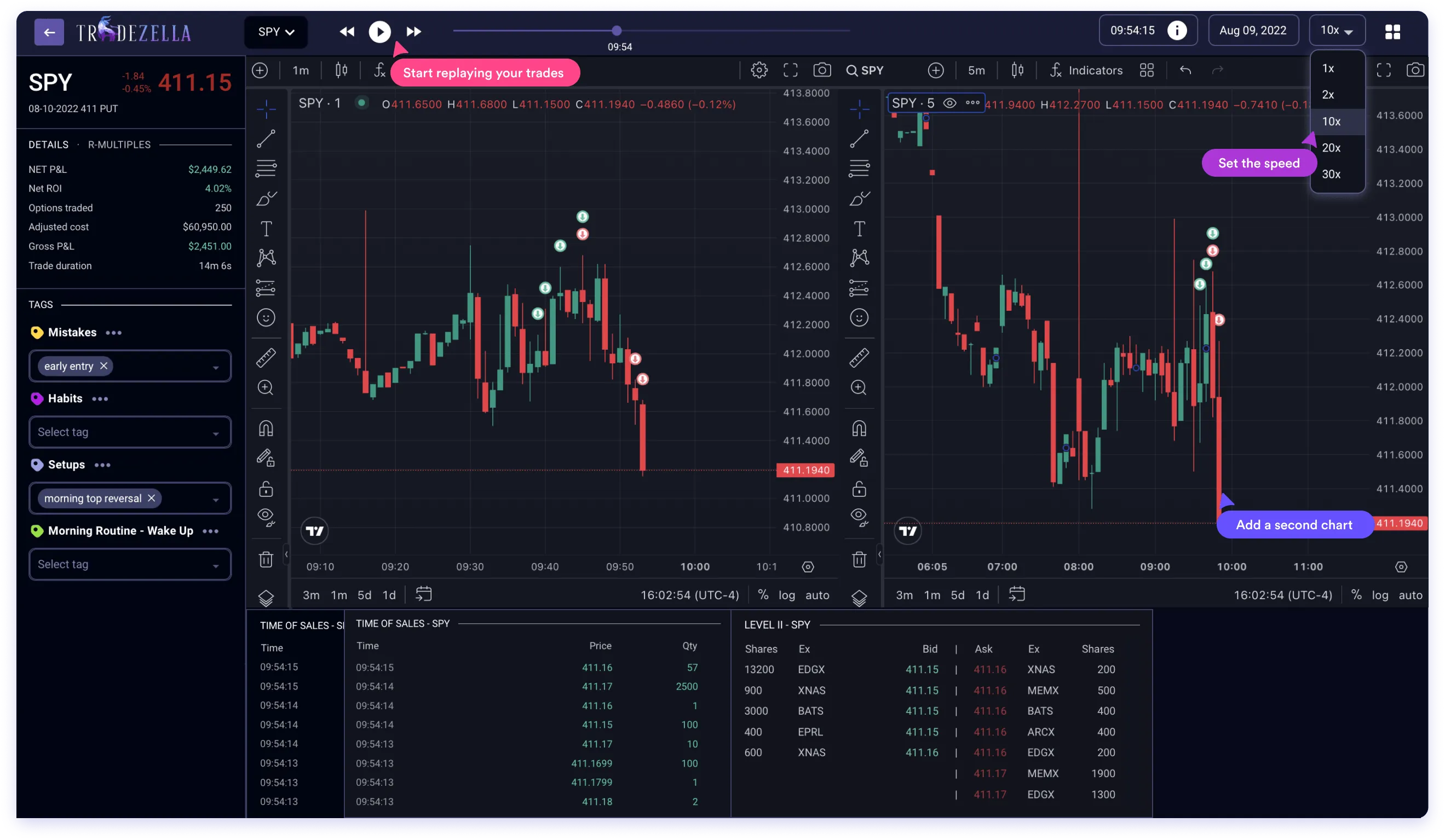
TradeZella connects to your evaluation account and tracks every trade automatically. You can see your progress toward profit targets, monitor daily and total drawdown, and identify patterns in your trading that might cause problems. The Running P&L visualization shows exactly where you stand at any moment during your trading day.
Stage 2: Funded Account Management
Pass your evaluation and you receive a funded account, still technically a demo account, but your profits become real payouts. The risk rules remain identical or sometimes become stricter. Most firms require consistent trading for a minimum period before your first withdrawal.
Profit splits typically range from 70-90%, with some firms offering scaling programs where your split increases as you prove consistency. Withdrawal schedules vary from bi-weekly to monthly, with some firms requiring minimum profit thresholds before payout.
Managing a funded account requires different psychology than passing an evaluation. The pressure shifts from hitting targets to protecting capital. Key funded account challenges:
Loss aversion intensifies: real money on the line changes behavior even if it’s the firm’s capital
Risk of playing it too safe: some funded traders become so cautious they can’t generate meaningful returns
Rule fatigue: maintaining strict discipline over months without the evaluation deadline is harder than passing the evaluation itself
Consistent performance tracking is what keeps funded traders on course. Seeing your stats in real time prevents both over-caution and recklessness.
Stage 3: Scaling and Multiple Accounts
Successful prop traders rarely stop at one account. The standard strategy is to run multiple funded accounts across different firms, diversifying your capital allocation and protecting against any single firm's payout issues.
Managing five or more funded accounts manually is a nightmare. Each firm has different rules, different platforms, and different payout schedules. One oversight, trading during a restricted news window, exceeding a position size limit, can cost you months of work.
TradeZella consolidates all of this into a single dashboard. Connect accounts across platforms and see unified analytics for your entire prop trading operation. Strategy tagging reveals which approaches work best on which accounts, and notes on each account help you remember firm-specific rules.
Major Prop Firms Compared
Choosing the right prop firm depends on your trading style, capital goals, and risk tolerance. Here's how the major players stack up:
Prop Firm
Evaluation Fee (100k)
Profit Split
Max Daily Loss
Max Total Loss
Profit Target
Payout Frequency
FTMO
$540
80-90%
5%
10%
10% (Phase 1), 5% (Phase 2)
Bi-weekly
The Funded Trader
$499
80-90%
5%
10%
10% (Phase 1), 5% (Phase 2)
Bi-weekly
TopstepTrader
$165/month
90%
Varies by combine
Trading combine rules
Step-based
Weekly
Apex Trader Funding
$167
90%
Trailing drawdown
Trailing drawdown
$6,000 (100k)
Twice monthly
MyFundedFX
$499
80%
5%
8%
8% (one-phase option)
Bi-weekly
When tracking multiple firms in TradeZella, you can tag each account by firm and see performance breakdowns. Over time, this reveals which firm's rules best suit your trading style, data that helps you decide where to focus future evaluations.
Best Practices for Passing Evaluations
Trade Smaller Than You Think You Should
Most evaluation failures happen because traders size positions for profit targets instead of drawdown limits. You're not trying to make as much money as possible, you're trying to not lose too much while eventually hitting your target.
Calculate your position size based on surviving your worst reasonable losing streak, not on maximizing returns from winners. If your daily loss limit is $500 and you typically see 3-4 losers in a row during drawdowns, each losing trade should cost no more than $100-125.
TradeZella's drawdown tracking visualizes your equity curve against firm limits. Review how close past sessions came to violation and adjust your sizing accordingly. Many traders discover their "normal" sizing would have violated rules multiple times, better to learn this in analytics than during a live evaluation.
Practice Under Evaluation Conditions First
Don't attempt a paid evaluation until you've passed a mock evaluation on your own terms. Trade a demo account with identical rules for at least 2-4 weeks, tracking everything in TradeZella as if the evaluation were real.
Review your mock evaluation data ruthlessly. Did you stay within daily loss limits every single day? Did you hit the profit target within the time allowed? What percentage of your trades followed your documented playbook?
TradeZella's backtesting feature covers 11+ years of historical data, letting you verify your edge before risking even demo money. Combine backtesting with forward-testing in mock evaluations for genuine confidence before paying for the real thing.
Schedule Trades Around Your Proven Best Times
Not every hour of the market suits your trading style. Some traders excel during London open, others during US session overlap, and many struggle during low-liquidity periods.
TradeZella's time-based performance reports show exactly when you trade best. You might discover your win rate is 72% between 9-11am EST but drops to 45% after lunch. Armed with this data, you can schedule your evaluation trading during proven profitable windows.
Prop firm rules don't require you to trade all day. A focused 2-hour session with high-probability setups beats an 8-hour grind through marginal opportunities. Your analytics tell you which approach your trading history supports.
Keep Detailed Notes on Every Trade
The traders who pass evaluations consistently share one habit: they document obsessively. Not just the entry and exit prices, but why they took the trade, what they were thinking, how they felt, and what they'd do differently.
TradeZella's tagging system and note feature make this easy. You can add screenshots, tag emotional states, and link trades to specific playbook setups. Over time, this creates a searchable database of your trading decisions.
When you fail an evaluation, this documentation tells you exactly why. Instead of vague "I need more discipline," you have specific data: "I violated my plan 14 times during news events, losing $1,847 on trades that weren't in my playbook."
Common Mistakes That Kill Evaluations
Ignoring the Daily Loss Limit Until It's Too Late
The most common evaluation killer isn't a bad strategy, it's losing track of your daily drawdown. Traders focus on their total P&L and forget that one catastrophic day ends everything, even if the week or month is profitable.
The pressure of evaluation trading affects judgment. A morning loss feels recoverable, so you size up to "make it back quickly." Two more losses, and you've violated your daily limit before lunch. Game over.
TradeZella's Prop Firm Sync tracks your drawdown usage across accounts, making your current risk exposure visible at a glance. If you've lost half your allowed daily amount, your trading session is over, period.
Trading Outside Your Documented Strategy
Evaluations create urgency that tempts traders into "opportunity" trades outside their edge. You see a setup that looks good but doesn't match your playbook. You take it anyway because you need the profit target.
These improvised trades have statistically lower win rates than planned trades for almost every trader. TradeZella's strategy breakdown reports prove this with your own data. Trades tagged as "playbook" versus "discretionary" show dramatically different outcomes.
Before each evaluation trade, check your playbook. If the setup doesn't match, don't take it. The patience to wait for your edge is worth more than any single opportunity.
Failing to Adapt Rules Across Different Firms
Each prop firm has quirks in their rules. Some restrict trading during news events. Some have specific position sizing limits. Some calculate drawdown differently than you expect.
Traders who pass one firm's evaluation often fail another's, not from skill issues but from rule misunderstandings. They assume all prop firms work the same and don't read the fine print.
When managing multiple accounts in TradeZella, create separate playbooks or notes documenting each firm's specific restrictions. Review these before trading each account. The five minutes spent confirming rules prevents the weeks lost to avoidable violations.
FAQ
What is prop firm trading and how does it work?
Prop firm trading is a model where you trade a company’s capital after passing an evaluation, keeping 70–90% of profits. Here’s how the typical process works:
Choose a firm and plan: evaluation accounts range from $10K to $200K+ in simulated capital
Pass the evaluation: hit the profit target without breaching daily/overall drawdown limits
Get funded: trade real capital with the same risk rules, keeping the majority of profits
Scale up: some firms increase your allocation as you demonstrate consistency
Most firms charge a one-time evaluation fee ($50–$500+ depending on account size). The appeal: access to larger capital without risking your own money beyond the evaluation fee.
How much money do you need to start prop firm trading?
You can start prop firm trading with as little as $50–$200 for smaller evaluation accounts. Typical costs by account size:
$10K account: $50–$150 evaluation fee
$25K–50K account: $150–$300 evaluation fee
$100K+ account: $300–$500+ evaluation fee
Many firms offer discounts and resets. Budget for 2–3 evaluation attempts as part of your learning cost, since most traders don’t pass on their first try.
Why do most traders fail prop firm evaluations?
The primary reason traders fail prop firm evaluations is violating risk rules rather than lacking profitable strategies. The most common failure causes:
Breaching daily loss limits: one bad day of revenge trading can end an evaluation
Overtrading: taking low-quality setups to hit profit targets faster
Moving stop-losses: widening stops under pressure violates risk parameters
Ignoring drawdown tracking: not knowing where you stand relative to limits until it’s too late
Automated drawdown tracking is essential. Knowing your exact remaining margin in real time prevents the violations that end most evaluations.
What's the difference between evaluation and instant funding prop firms?
The two main prop firm models differ significantly in structure and cost:
Evaluation firms: require passing 1–2 challenge phases before funding. Lower fees, higher profit splits (80–90%), but you must prove consistency first
Instant funding firms: provide capital immediately with no evaluation. Higher fees, lower initial profit splits (50–70%), but faster access to funded trading
For most traders, evaluation firms offer better long-term value if you can pass. Instant funding works best for experienced traders who need capital quickly and have already proven their edge elsewhere.
Can you trade multiple prop firm accounts simultaneously?
Yes, many professional prop traders manage 5–10+ funded accounts across different firms simultaneously. Key considerations:
Each account has independent rules: different drawdown limits, profit targets, and restricted instruments
Risk of correlation: the same losing trade can breach limits on multiple accounts if you’re taking identical positions
Tracking complexity: without consolidated analytics, blind spots develop quickly
Unified analytics across all accounts is critical. TradeZella’s supports unlimited trading accounts with a single performance dashboard.
How do prop firms make money if traders keep most of the profits?
Prop firms generate revenue through several channels:
Evaluation fees: the primary income source, from traders who don’t pass (estimated 80–90% of participants)
Profit sharing: keeping 10–30% of successful traders’ profits
Reset/retry fees: additional charges for traders who fail and want to try again
Add-on services: education packages, scaling plans, premium features
The model is sustainable because the majority of evaluation fees cover payouts to the minority of successful traders. Legitimate firms are transparent about these economics.
What happens if you violate prop firm rules on a funded account?
Violating rules on a funded account typically results in immediate termination and loss of that account’s balance. Common consequences by violation type:
Daily loss limit breach: instant account termination, no recovery
Restricted instrument trading: may receive a warning or termination depending on the firm
Holding through restricted events: trading during news blackouts can trigger violations
Unlike evaluation accounts, funded accounts cannot be reset. The capital is gone. This is why automated rule tracking and real-time alerts are essential for funded traders.
How does TradeZella help with prop firm trading specifically?
TradeZella supports prop firm traders with several purpose-built features:
Automated journaling: syncs trades across 500+ broker integrations including all major prop firm platforms
Real-time drawdown tracking: monitors your position against daily and overall loss limits
50+ analytics reports: break down performance by setup, time, instrument, and market conditions
Strategy Playbooks: document and track each approach separately to see which ones pass evaluations
The platform is designed for the specific tracking needs of evaluation and funded account management.
Key Takeaways
Prop firm trading offers genuine opportunity for skilled traders to access meaningful capital without personal financial risk. The catch is that skill alone isn't enough, you need documented discipline, proper risk management, and the ability to perform under evaluation pressure.
The traders who consistently pass evaluations and maintain funded accounts aren't necessarily better at predicting markets, they're better at documenting their process, following their rules, and learning from data instead of gut feelings.
Ready to build the track record that gets you funded?