Built for
Instruments: Stock/Futures
Trading Style: Scalping/Day Trading
Strategy Overview
This strategy is based on understanding how the market behaves like an auction each day. By analyzing the previous day’s price action and recognizing where the price found value (the auction area), you can anticipate directional moves during the next session.
It follows a top-down approach: the daily chart sets the directional bias, while the 5-minute chart is used for execution. Trades are only taken when both timeframes align in the same direction, using tools like moving averages and price structure to define the edge.
The key setup occurs when price returns to the auction zone and rejects it in the direction of the trend, often during the first hour of the session, when volume and volatility are highest. This strategy emphasizes market sentiment, structure, and simplicity.
While it’s mainly used for stocks, the same principles can be applied to indices and crypto, any market with a strong intraday range and clear price behavior. It’s clean, rule-based, and designed to keep traders on the right side of the market.
Strategy Rules
Timeframes
- Daily chart: Sets directional bias.
- 5-minute chart: Execution timeframe.
- Both timeframes must show a trend in the same direction (down for shorts, up for longs).
Trend Alignment
Use moving average (e.g., 21/50 MAs ) only to confirm trend direction.
- For longs: The price must be above the moving averages in both timeframes.
- For shorts: The price must be below the moving averages in both timeframes.
- MAs are used to visually confirm alignment, not as trade signals.
Directional Bias
Determined by the previous day’s daily candle. If the prior day closed strongly bearish, the next day’s bias is short. If bullish, the bias is long.
Auction Zone
- Look for zones of congestion (value area) on the 5-min chart where price previously consolidated or found balance.
- Price returning to this zone provides a potential setup if it rejects the area in the direction of the trend.
Open and Gap Context
- At the open, identify:
- Are we gapping up or down?
- Are we opening inside or outside of the previous day’s range?
- This adds important context to the auction and sentiment.
Wait for Alignment
- The daily chart must show a clear 45-degree trend.
- 5-minute chart must mirror the daily trend and be aligned with the moving average direction.
- Avoid setups where the daily and intraday charts are conflicting.
Entry
- Enter when price retests the auction zone and shows a rejection candle.
- Entry is made immediately after candle confirmation.
Stop Loss
- Place the stop loss just beyond the structure's high/low of the setup candle.
- For shorts, above the rejection candle high.
- For longs, below the rejection candle low.
Target
- Use a minimum 2:1 risk-to-reward ratio.
Time of Day
- Focus on the first hour after the open.
- Avoid trading in the middle or late session unless conditions clearly align.
No Trade Conditions
- If the daily and 5-minute trades are not aligned, skip the trade.
- If the auction structure is messy or sentiment is unclear (e.g., conflicting news headlines), stay out.
- If price does not retest the auction zone or quickly sells off at the open without structure, skip.

Pros and Cons of the Strategy
This model is designed to deliver high-quality, repeatable setups — but like any trading method, there are key things to understand before using it.
Note: The cons listed here aren’t disadvantages. They are things to be aware of — important characteristics that require patience, discipline, and proper management to make the strategy work effectively.
Proy
- Simple and rule-based: Easy to follow with clear trend and zone criteria.
- Rule-based: Removes emotion and overthinking.
- Specific Time Window: Focused on the first hour of the trading session.
- Trading with trend: Always aligned with higher timeframe direction.
- Fractal – HTF Alignment: Strategy works across timeframes (e.g., monthly → daily, daily → 5-min).
Cons(Things to Be Aware Of and Manage)
- Limited R/R: Most trades target 2:1; doesn’t allow big R-multiples unless modified.
- Courage required: You must trust the setup and act quickly.
- Patience needed: Many days will have no trade if the criteria aren’t met.
- Must be a good loser: High composure is needed to accept losses without hesitation.
- Speed: Execution must be fast — trades often trigger in seconds after the open.
Trade Breakdown
- Daily Bias: SPY was in a clear downtrend on the daily chart, with price trading below the 21 EMA.
- SPY opened with a gap down, opening below the previous day’s close. This added to the bearish sentiment, suggesting sellers remained in control from the prior session.

Auction Zone
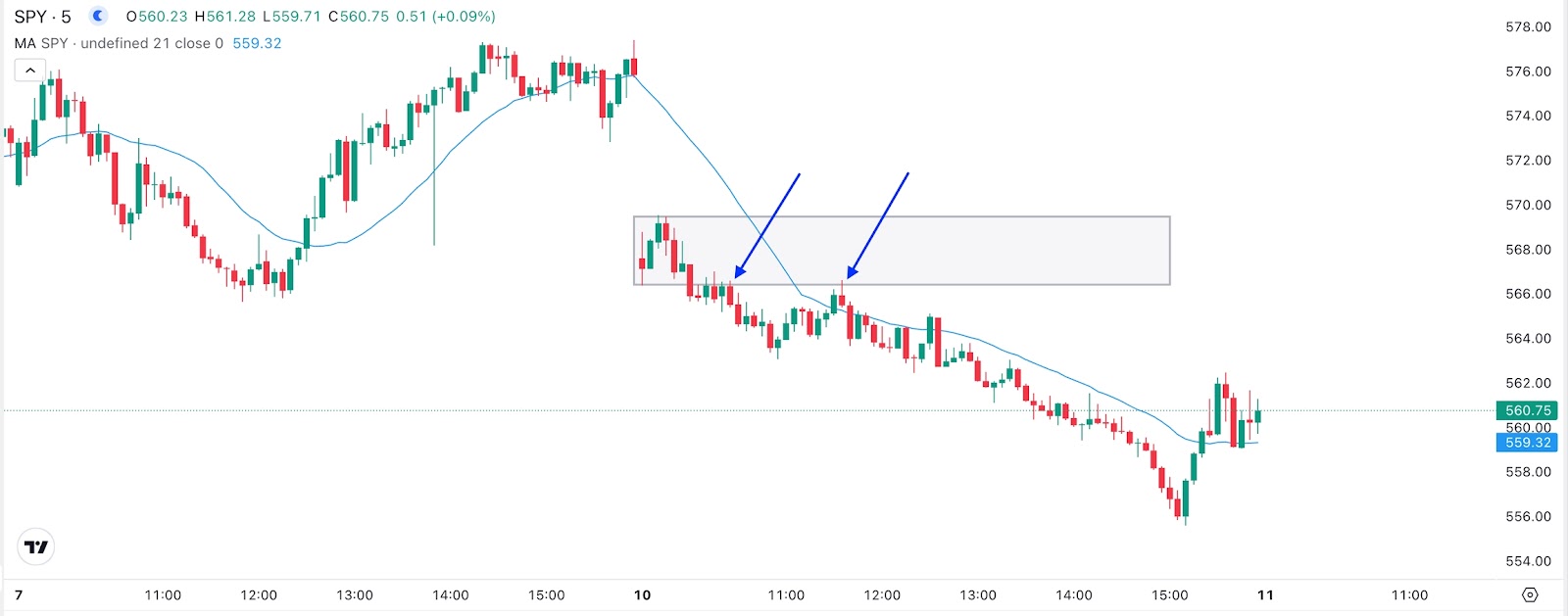
- On the 5-minute chart, price formed a clean consolidation area after the open.
- This zone became the auction zone — a place where short-term buyers and sellers had found a temporary balance.
- SPY broke down from this zone shortly after it formed, confirming trend continuation.
First Trade – First Retest
After SPY dropped out of the early range, it came back up to the same area (the auction zone). At that point, the trend was still clearly down, and the price was still below the 21 EMA.
When the price reached the zone again, it made a clear rejection candle — it went into the zone but then closed below it.
- Entry: A short trade was taken as soon as that candle closed.
- Stop Loss: Placed just above the high of that candle.
- Target: A 2:1 reward compared to the risk.
Second Trade – Second Retest
If you missed the first trade, SPY gave another opportunity:
Later on, the price went back up to the same zone a second time but failed again to break through. It made another rejection candle, just like before, showing that sellers were still in control.
- Entry: Another short trade was taken after this second rejection candle closed.
- Stop Loss: Place just above the height of this new candle.
- Target: Same 2:1 reward was hit again as the price dropped once more.
How to Backtest This Auction Market Theory Strategy
The fastest way to test this Auction Market Theory strategy is with TradeZella's automated no-code backtesting. Define your rules in plain English, hit run, and TradeZella runs them across 11+ years of historical data in seconds, then shows you every individual trade along with your win rate, profit factor, and expectancy instantly, without you stepping through a single chart. It is the quickest way to see whether the setup holds up before you risk a dollar.
You can also test it manually by replaying the market bar by bar. Set up your Daily and 5-minute charts with moving averages the way you trade live, and replay the session bar by bar through the first hour. Set your directional bias from the previous day's candle, mark the auction zone where price found balance, and wait for price to retest and reject that zone in the direction of the trend. When the rejection candle confirms, place your trade with automatic position sizing and drag your stop and target directly on the chart for a 2:1 setup. Every backtested trade gets logged automatically with your entry, exit, position size, and P&L. Add notes on what you saw, tag mistakes, and review the session the same way you would a live trading day. After 30 to 50 trades, you can see your win rate, profit factor, and expectancy on this specific setup. Manual replay is the best way to build screen time and a real feel for the setup.
When you start trading live, import your live trades into TradeZella, the AI trading journal that does the journaling for you. Your backtest results and live results live in the same platform, so you always know how the strategy performs in testing vs how it performs with real money, without switching between tools or maintaining separate spreadsheets.
Frequently Asked Questions
What is Auction Market Theory?
Auction Market Theory is the idea that the market behaves like an auction each day, constantly searching for a fair price where buyers and sellers agree to trade. The areas where price spends the most time become value, and the areas it moves through quickly show imbalance. By studying where the previous day found value, you can anticipate how price is likely to behave when it returns to those zones in the next session.
What is the Auction Market Theory strategy?
The Auction Market Theory strategy is a top-down day trading model that uses the Daily chart to set directional bias and the 5-minute chart to execute. You take trades only when both timeframes trend in the same direction and align with the moving averages. The core setup is price returning to a prior value area, or auction zone, and rejecting it in the direction of the trend, usually during the first hour of the session when volume and volatility are highest, targeting a minimum 2:1 reward-to-risk.
What is an auction zone, or value area?
An auction zone, or value area, is a region of congestion on the 5-minute chart where price previously consolidated and buyers and sellers found temporary balance. It represents where the market agreed on value. When price leaves that zone and later returns to it, the reaction at the zone tells you whether the trend is still in control. A clean rejection back in the direction of the trend is the setup this strategy waits for.
How many trades should I take per day with this strategy?
This strategy is built around the first hour after the open, so it favors one or two clean setups rather than constant trading. Many days will have no trade at all if the Daily and 5-minute charts are not aligned, if the auction structure is messy, or if sentiment is unclear. The edge depends on patience and on skipping any setup where the timeframes conflict or price does not retest the auction zone with structure.
What instruments work best for the Auction Market Theory strategy?
This strategy is mainly used for stocks, but the same principles apply to indices, futures, and crypto. It works best on any market with a strong intraday range and clear, readable price behavior, since the setup depends on identifying value areas and clean rejections. Markets that are thin or choppy make the auction structure harder to read and reduce the reliability of the setup.
Can I backtest the Auction Market Theory strategy?
Yes. You can test this strategy using TradeZella's backtesting with 11+ years of historical data. Replay sessions bar by bar across the Daily and 5-minute charts, set your bias from the previous day's candle, mark the auction zone, and wait for the retest and rejection in the direction of the trend before placing trades. Every trade logs automatically with entry, exit, position size, and P&L. Add notes, tag mistakes, and review the session the same way you would a live trading day. After 30 to 50 trades you can see your win rate, profit factor, and expectancy on this specific setup before risking real money.
What is TradeZella backtesting?
TradeZella backtesting lets you test a trading strategy against 11+ years of historical market data across forex, futures, stocks, and crypto, down to seconds-level timeframes. You can do it two ways. Replay the market bar by bar and place trades as if you were trading live, with your own timeframes, automatic position sizing, and stops and targets you drag right on the chart, and every trade logs automatically with entry, exit, size, and P&L. Or use automated no-code backtesting: define your strategy rules in plain English and the engine runs them across years of data in seconds, returning every individual trade it took with the exact setup drawn on the chart, so you see why each trade fired instead of just an equity curve. Zella AI then analyzes the results and flags what to fix.