


Built For
Instruments: Stocks/Options/Futures/Forex
Trading Style: Scalping/Day Trading/Swing Trading
Strategy Overview
This playbook is built on one principle: A trade is valid only when there is a clear and logical story behind it.
This story begins with liquidity, is confirmed by market behavior, and is executed only after price pulls back into a high-quality area.
The playbook applies to any market (stocks, futures, crypto, forex), any timeframe, and any trading style because it is based on how markets naturally move: they seek liquidity, create displacement, retrace, and continue.
A complete story contains three core components:
Liquidity Catalyst — something meaningful happens
This is the moment the market reveals information.
It may be:
- A sweep of equal highs/lows
- A break of a major support/resistance zone
- A break of a well-respected trendline
- A market structure shift (breaking the prior high/low of the trend)
- A sharp rejection from a significant level
A liquidity catalyst tells you the market has just changed behavior. Before this moment, the chart offers no reliable direction.
Displacement — the market reacts with strength
After the catalyst, you want to see a decisive move away from that area. This confirms that the liquidity interaction mattered.
This move creates:
- Clear direction
- A break in the previous trend
- A new range or swing structure
- A reason to expect a pullback
Without meaningful displacement, there is no evidence that the market intends to move.
Retracement Into a Logical Area — the actual entry
The first move after a catalyst is rarely the entry. It is the reaction. You enter on the retracement.
The retracement may return to:
- A broken support/resistance level
- A retested trendline
- A fair value gap
- An order block
- A moving average used as dynamic support/resistance
The retracement gives:
- A controlled stop placement
- A better risk-to-reward profile
- A clear invalidation point
- A calmer entry compared to chasing momentum
When price returns to this area with confluence, the trade becomes valid.
Strategy RULES
These rules outline exactly how to apply the Universal Playbook with consistency and precision.
No Liquidity Catalyst, No Trade
A trade only begins when price interacts with a major liquidity level in a meaningful way.
If the market is moving quietly with no sweep, break, or structural disruption, there is no valid setup. You wait until the market gives you a clear catalyst.
A Strong Reaction Must Follow the Catalyst
A sweep, break, or test of liquidity means nothing unless the market shows decisive follow-through. You must see evidence that the catalyst mattered. This often appears as:
- Clear displacement
- A noticeable shift in price behavior
- A break in the prior swing structure
Without this reaction, the market has not committed to a direction, and the story is incomplete.
Entries Are Taken Only on the Retracement
You do not enter during the first impulsive move away from liquidity. The initial reaction is where volatility is high, and traders are trapped.
A valid entry occurs only when the price retraces into a logical zone, such as:
- A broken support or resistance level
- A fair value gap
- A previous swing level
- A trendline retest
If the price continues without offering a retracement, the setup does not qualify. Your job is to wait for the trade — not to chase it.
Invalidation Must Be Clear and Objective
Every valid trade has a precise point where the story fails. Your stop must sit beyond the level that proves the narrative wrong. If that level breaks, the trade is invalid, and you exit without hesitation.
- No wide stops out of fear
- No arbitrary “breathing room.”
- No stops based on option pricing
Stops are always defined by price structure, nothing else.
A Trade Requires Technical and/or Fundamental Confluence
No trade is taken based on a single signal. A complete story must be supported by multiple factors working together.
Confluence may include:
- Key support/resistance
- Structure shift
- Trendline break
- Divergence
- Higher-timeframe alignment
- Macro conditions, seasonality, or significant news
When several elements point in the same direction, the trade idea becomes valid.
Missing a Trade Is Not a Mistake
If your retracement zone is never reached, the market did not fulfill your criteria.
You do not chase. You do not adjust the entry out of fear of missing out. You simply move on.
A trade that violates your rules is far more damaging than a trade you never took.
Manage the Trade According to the Story, Not Emotion
Your profit targets should align with the narrative, typically focusing on:
- Liquidity pools
- Prior highs or lows
- Imbalance fills
- Areas where traders are trapped or forced to act
Markets move from one liquidity zone to the next.
Your exits should reflect that logic — not impulse, fear, or the desire to “protect” profits prematurely.
You allow the story to play out, and you exit when your narrative says the move is complete.
Pros and Cons of the Strategy
This playbook is designed to deliver high-quality, repeatable setups — but like any trading strategy, there are key things to understand before using it.
Note: The cons listed here aren’t disadvantages. They are things to be aware of — important characteristics that require patience, discipline, and proper management to make the strategy work effectively.
Swing Trading — Pros and Cons
Pros
- More Deliberate Decision-Making: Swing trading gives you time to analyze the chart calmly. You can build a complete narrative using higher timeframes, liquidity, and fundamentals without rushing.
- Less Emotional Pressure: Swing trades do not activate the constant “fight-or-flight” response that day trading often triggers. This reduced stress helps traders avoid impulsive decisions.
- Easier to See the Bigger Picture: Higher-timeframe structure is cleaner and more reliable. Liquidity levels, trend strength, and macro conditions are easier to interpret.
- Works Well with Fundamental Context: Seasonality, macro events, drawdown levels, and major market cycles all support swing trades. You can combine technical and fundamental storytelling effectively.
- Less Temptation to Overtrade: Because swings take time to form, you cannot take 10 trades in a single day. This naturally limits the amount of impulsive entries.
Cons
- No Control Over After-Hours Price Movement: Stocks and options can gap overnight. Price may open far beyond your intended stop, which increases risk.
- Options Pricing Is Not Exact: Greeks, implied volatility, and time decay distort the P&L. Your stop and target must be based on the underlying chart, not the option premium.
- Holding Period Creates Uncertainty: Because trades last days or weeks, traders may overthink or exit too early.
- Story Can Change Slowly, but Significantly: Macro news, political events, or unexpected headlines can affect swing trades even when the technical story is valid.
Day Trading — Pros and Cons
Pros
- No Overnight Risk: Positions are closed before the market shuts, so you avoid overnight gaps and unexpected news.
- Frequent Opportunities: Intraday liquidity sweeps, structure shifts, and reactions occur often. This provides many chances to apply the Universal Playbook.
- Immediate Feedback: You see quickly whether your story is correct.This speeds up learning when executed with discipline.
- Clear Interaction With Intraday Liquidity: The market sweeps highs/lows, manipulates levels, and displaces aggressively within a single session — ideal behavior for this framework.
Cons
- Requires Rapid Story-Building: You must identify liquidity, confirm displacement, and plan the retracement in minutes — sometimes seconds. This is difficult for newer traders.
- High Emotional Pressure: The brain remains in a survival state during fast price movements. This increases the likelihood of panic exits, revenge trading, or overtrading.
- Easier to Take “Lookalike” Trades: Many intraday moves mimic real setups but lack higher-timeframe context. Beginners often mistake these for valid trades.
- Mistakes Compound Quickly: A single session can contain several losing trades if discipline slips. This makes emotional control critical.
- Lower Timeframes Add Noise: Without higher-timeframe context, lower-timeframe setups often fail. The story becomes harder to see, making execution inconsistent.
Trade Breakdown
S&P 500 Trendline Break & Retest
Context
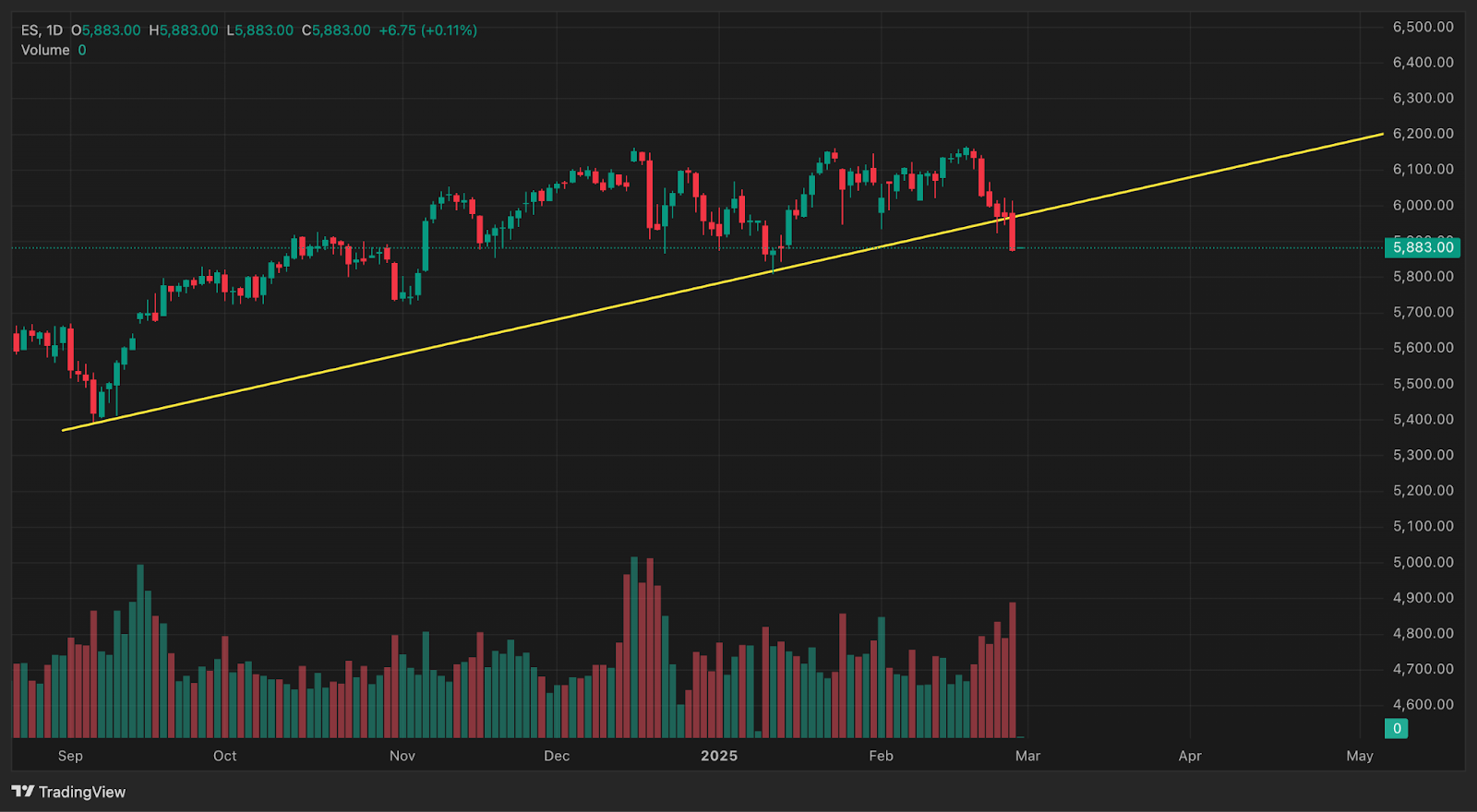
The S&P 500 was in a clear post-election uptrend, respecting a well-defined trendline. While the trend held, there was no trade.
Liquidity Catalyst
Price broke the trendline that had acted as structural support. This break signaled a change in market behavior and initiated the trade narrative.
Reaction
After the break, the price showed bearish follow-through and lost the most recent higher low. This confirmed a market structure shift and validated the catalyst.
Entry
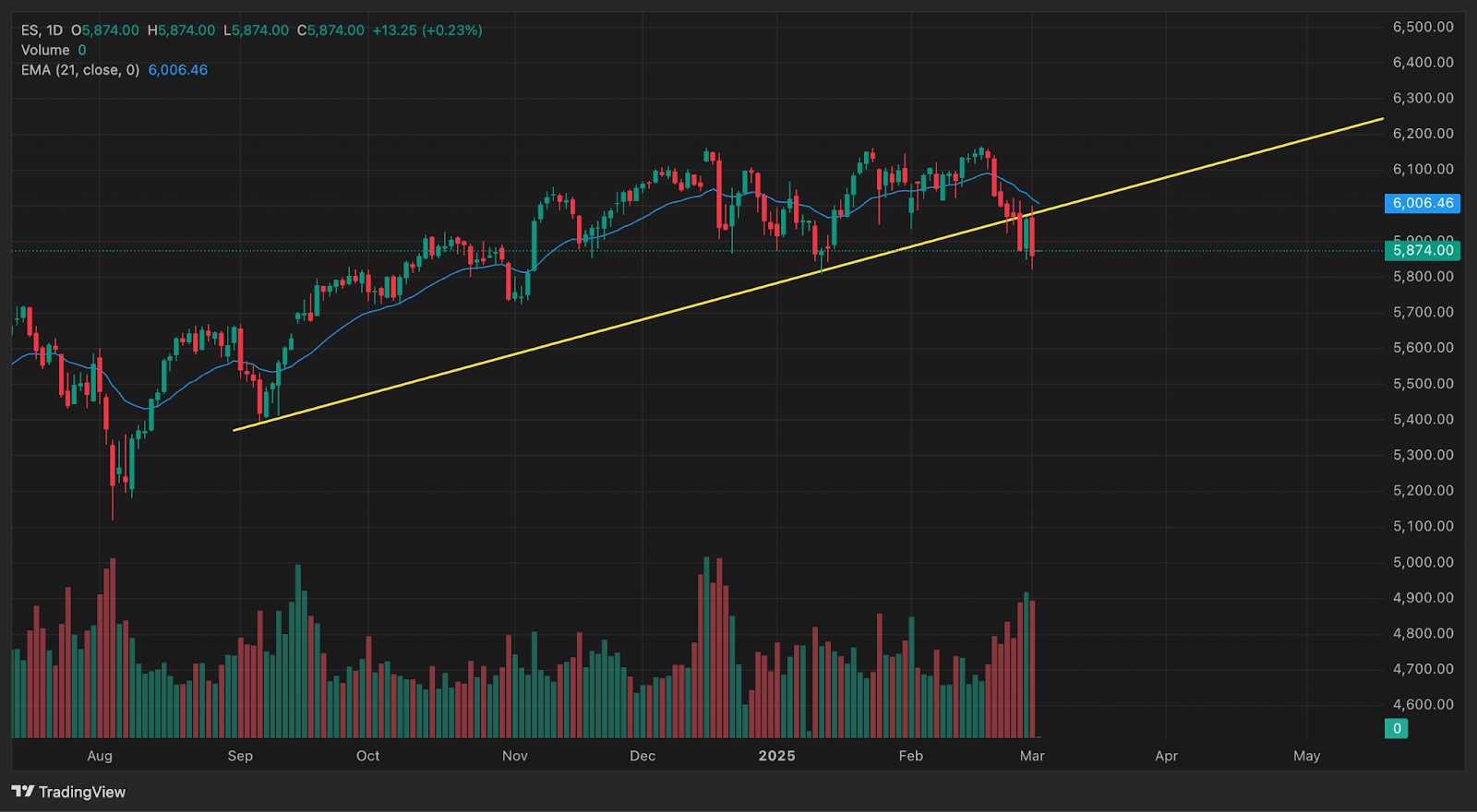
Price retraced back toward the broken trendline. The 21 EMA aligned with the retest, creating a confluence zone where former support and dynamic resistance overlapped. A short was taken at this retracement.
Invalidation
The trade was invalid if the price reclaimed the trendline and held above the 21 EMA.
Targets
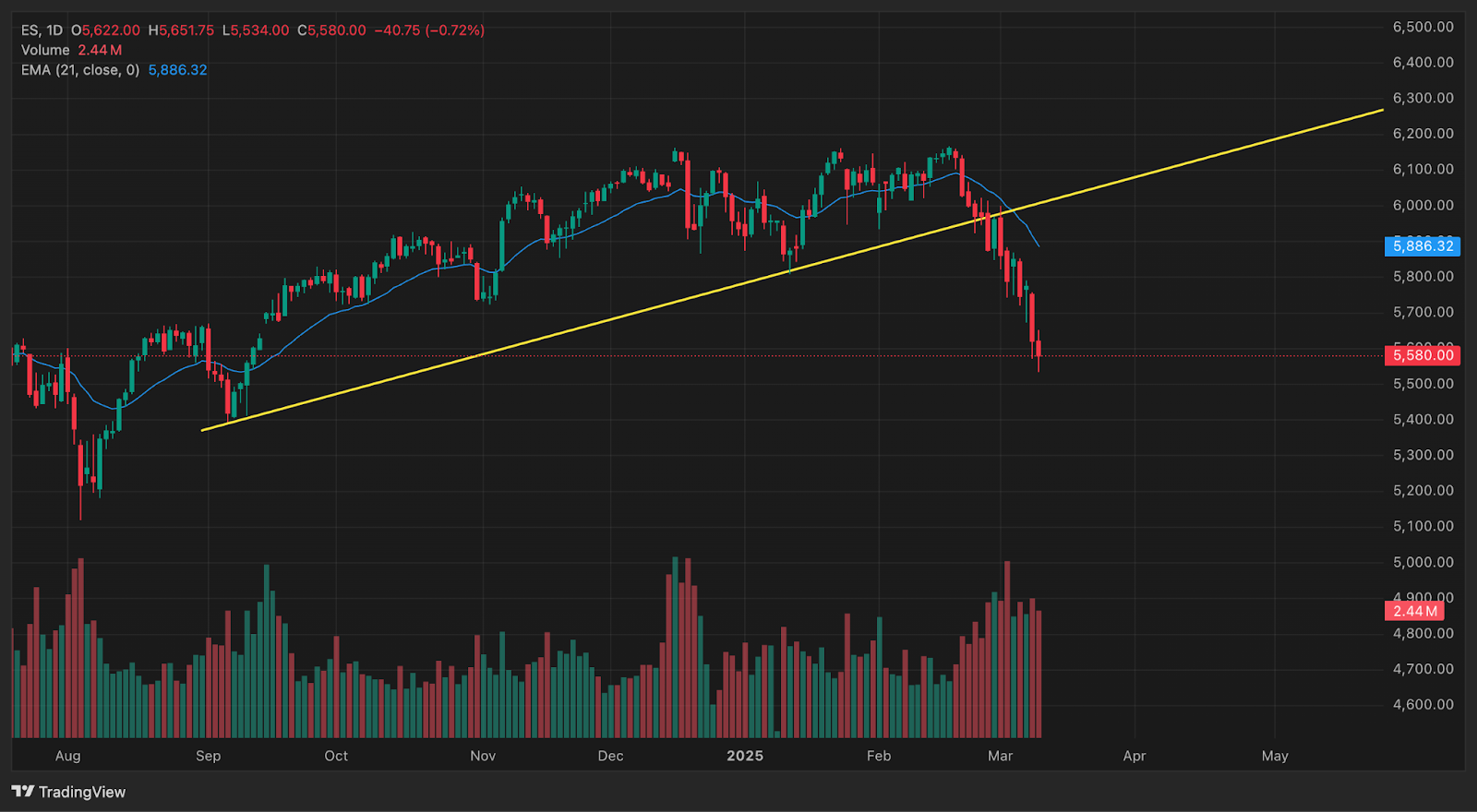
Targets were set at prior internal lows and lower liquidity levels.
Execution Logic
Liquidity was broken, structure shifted, price retraced into the trendline + 21 EMA resistance, and the trade was executed from that zone.
How to Backtest This Universal Strategy
The fastest way to test this Universal Strategy is with TradeZella's automated no-code backtesting. Define your rules in plain English, hit run, and TradeZella runs them across 11+ years of historical data in seconds, then shows you every individual trade along with your win rate, profit factor, and expectancy instantly, without you stepping through a single chart. It is the quickest way to see whether the setup holds up before you risk a dollar.
You can also test it manually by replaying the market bar by bar. Load 11+ years of historical data, set up your charts the way you trade live, and replay price bar by bar across any market or timeframe you trade. Wait for the liquidity catalyst, a sweep, a break of a key level or trendline, or a market structure shift, then confirm decisive displacement away from that area. Mark your logical retracement zone, a broken level, a fair value gap, an order block, or a moving average, and only enter when price returns there with confluence. Place your stop beyond the level that proves the story wrong and target the next liquidity pool. Use automatic position sizing and drag your stop and target directly on the chart. Every backtested trade gets logged automatically with your entry, exit, position size, and P&L. Add notes on the catalyst, displacement, and confluence, tag mistakes, and review the same way you would a live trade. After 30 to 50 trades, you can see your win rate, profit factor, and expectancy on this specific setup. Manual replay is the best way to build screen time and a real feel for the setup.
When you start trading live, import your live trades into TradeZella, the AI trading journal that does the journaling for you. Your backtest results and live results live in the same platform, so you always know how the strategy performs in testing vs how it performs with real money, without switching between tools or maintaining separate spreadsheets.
Start Backtesting This Strategy Using TradeZella
Frequently Asked Questions
What is the Universal Strategy?
The Universal Strategy is a trading framework built on one principle: a trade is valid only when there is a clear and logical story behind it. That story begins with liquidity, is confirmed by market behavior, and is executed only after price pulls back into a high-quality area. It works on any market and any timeframe because it is based on how markets naturally move, seeking liquidity, creating displacement, retracing, and continuing. A complete story has three parts: a liquidity catalyst, displacement, and a retracement into a logical area.
What is a liquidity catalyst?
A liquidity catalyst is the moment the market reveals information and changes behavior. It can be a sweep of equal highs or lows, a break of a major support or resistance zone, a break of a well-respected trendline, a market structure shift that breaks the prior high or low of the trend, or a sharp rejection from a significant level. Before this moment the chart offers no reliable direction, so without a catalyst there is no trade.
What is displacement, and why do you enter on the retracement?
Displacement is a decisive move away from the catalyst area that confirms the liquidity interaction mattered, creating clear direction, a break in the previous trend, and a reason to expect a pullback. The first impulsive move is the reaction, not the entry, because that is where volatility is highest and traders get trapped. You enter on the retracement back into a logical zone, like a broken level, a fair value gap, an order block, or a moving average, which gives a controlled stop, a clear invalidation point, and a better reward-to-risk.
What counts as confluence in this strategy?
No trade is taken on a single signal. A complete story needs multiple factors pointing the same direction. Confluence can include key support or resistance, a structure shift, a trendline break, divergence, higher-timeframe alignment, and macro conditions, seasonality, or significant news. When several of these elements line up at your retracement zone, the trade idea becomes valid. If only one factor is present, the story is incomplete and you stay out.
What markets and timeframes does this strategy work on?
The framework applies to stocks, options, futures, and forex, across scalping, day trading, and swing trading, because it is based on universal market behavior rather than a specific instrument. Swing trading on higher timeframes gives cleaner structure and more time to build the story, while day trading offers frequent intraday liquidity sweeps and faster feedback but requires rapid story-building and stronger emotional control. The same three-part story applies in every case.
Can I backtest the Universal Strategy?
Yes. You can test this strategy using TradeZella's backtesting with 11+ years of historical data across stocks, futures, forex, and crypto. Replay price bar by bar, wait for the liquidity catalyst and displacement, then enter only on the retracement into a logical zone with confluence, placing your stop beyond the level that invalidates the story. Every trade logs automatically with entry, exit, position size, and P&L. Add notes, tag mistakes, and review the same way you would a live trade. After 30 to 50 trades you can see your win rate, profit factor, and expectancy on this specific setup before risking real money.
What is TradeZella backtesting?
TradeZella backtesting lets you test a trading strategy against 11+ years of historical market data across forex, futures, stocks, and crypto, down to seconds-level timeframes. You can do it two ways. Replay the market bar by bar and place trades as if you were trading live, with your own timeframes, automatic position sizing, and stops and targets you drag right on the chart, and every trade logs automatically with entry, exit, size, and P&L. Or use automated no-code backtesting: define your strategy rules in plain English and the engine runs them across years of data in seconds, returning every individual trade it took with the exact setup drawn on the chart, so you see why each trade fired instead of just an equity curve. Zella AI then analyzes the results and flags what to fix.