Day Trading for Beginners: How to Start, What to Trade, and What It Actually Takes
Day Trading for Beginners: How to Start, What to Trade, and What It Actually Takes
Day trading just got more accessible. The PDT rule is gone, micro futures cost $12.50 per tick, and you can start with a fraction of what used to be required. This guide covers which market to pick, how much capital you actually need, which strategies work for beginners, and the risk management rules that keep you in the game long enough to learn.
class SampleComponent extends React.Component {
  // using the experimental public class field syntax below. We can also attach
  // the contextType to the current class
  static contextType = ColorContext;
  render() {
    return <Button color={this.color} />
  }
}
Last Updated: August 05, 2026
Day trading is the practice of buying and selling financial instruments within the same trading day, closing every position before the market closes. In 2026, day trading is more accessible than ever. The pattern day trader rule was eliminated in June 2026, dropping the minimum equity requirement from $25,000 to $2,000 for margin accounts. Micro futures contracts let you trade the S&P 500 for $1.25 per tick. And platforms like TradeZella import trades from 500+ brokers and use Zella AI to tag, review, and journal every session automatically.
But accessibility and profitability are different things. Studies consistently show that 72% to 95% of day traders lose money. The ones who survive share a pattern: they start small, track everything, and treat the first six months as tuition, not income.
This guide is for people who have decided they want to day trade and need the practical details. Which market. How much capital. Which strategies actually work for beginners. And the risk rules that keep a small account alive long enough to learn something.
What Is Day Trading?
Day trading means opening and closing positions within a single trading session. You go home flat. No overnight risk, no gap surprises, no waking up to find your position moved 3% against you while you slept.
That distinguishes it from swing trading strategies, where you hold for days or weeks, and position trading, where you hold for months. The tradeoff is speed. Day traders make more decisions in a single morning than most swing traders make in a month. More decisions means more opportunities to be right, but also more opportunities to be wrong, and more opportunities for your psychology to break down.
Day trading is not investing. Investors buy assets they believe will appreciate over years. Day traders don't care about the long-term direction of anything. They care about the next 30 minutes, the next 2 hours, or the next session close. The edge comes from reading short-term price action, managing risk precisely, and compounding small advantages over hundreds of trades.
The PDT Rule Just Changed. What Does That Mean for You?
For over two decades, the pattern day trader rule was the biggest barrier to entry for new day traders. If you made more than three day trades in a rolling five-business-day window in a margin account, your broker flagged you as a "pattern day trader" and required $25,000 in equity. Fall below that threshold and your account got locked.
On June 4, 2026, FINRA eliminated the PDT rule entirely.
The $25,000 minimum is gone. The "pattern day trader" designation no longer exists. Brokers no longer track your day trade count against a threshold. The new Rule 4210 framework replaces the old system with something simpler: your buying power is now tied to your actual margin exposure, not an arbitrary dollar minimum.
What this means in practice:
The minimum for a margin account drops to approximately $2,000 (the standard FINRA margin minimum)
You can execute as many day trades as your margin supports, with no count limit
Brokers have until October 2027 to fully implement the new system, so some are still rolling out changes
Individual brokers may still set their own internal minimums above $2,000
This is genuinely a big deal for beginners. But lower barriers don't change the math. A $2,000 account risking 1% per trade means $20 of risk. That's enough to learn with real consequences, but it's a grind. Don't confuse "you're allowed to trade" with "you're ready to trade."
How Much Money Do You Need to Start Day Trading?
The honest answer: more than the minimum, less than you think.
The regulatory floor for a margin account is $2,000. But trading at the minimum means your position sizes are tiny, commissions eat a larger percentage of each trade, and one bad day can put you below the threshold. A better starting point depends on which market you choose.
Stocks: $5,000 to $10,000. At $5,000, risking 1% per trade gives you $50 of risk. That's 50 shares of a $20 stock with a $1 stop, or 10 shares of a $100 stock with a $5 stop. Workable, not comfortable. At $10,000 you have room to take 2-3 positions without maxing out your buying power.
Futures (micro contracts): $2,000 to $5,000. Micro E-mini S&P 500 (MES) contracts cost $1.25 per tick. A 10-point stop on one MES contract is $50 of risk. On a $5,000 account risking 1%, that fits perfectly. Micro Nasdaq (MNQ) is $0.50 per tick. Futures have no PDT considerations and never did, plus you get favorable 60/40 tax treatment under Section 1256.
Forex: $500 to $2,000. Micro lots (0.01) on EUR/USD mean roughly $0.10 per pip. You can trade with very small risk, though the learning curve around sessions, spreads, and swap costs is steep.
Crypto: $500 to $2,000. Exchanges like Coinbase and Bybit let you trade fractional positions. Markets are open 24/7, which sounds like an advantage until you realize it means you can revenge trade at 3 AM.
Whatever your starting capital, the rule is the same: risk no more than 1% per trade. On a $5,000 account, that's $50. On $10,000, that's $100. This isn't conservative. It's survival math. At 1% risk, you can lose 20 trades in a row and still have 82% of your account. At 3% risk, twenty consecutive losses leave you with 54%. The difference between learning a lesson and losing your capital is risk per trade.
Which Market Should Beginners Day Trade?
Four markets are realistic for beginners. Each has tradeoffs.
Stocks
Stocks are familiar. Everyone knows what Apple and Tesla are. That familiarity makes the learning curve feel less steep because you're trading companies you recognize, not abstract instruments. With the PDT rule gone, stocks are now fully accessible to small accounts for the first time in two decades.
The challenge: individual stocks can be erratic. Earnings announcements, analyst upgrades, FDA approvals. A stock can gap 15% overnight on news you had no way to predict. Sector rotation can make yesterday's momentum leader today's laggard. And with thousands of stocks to choose from, beginners often waste time scanning instead of trading.
Best for: traders who want to focus on individual company catalysts, gap plays, or sector momentum.
Futures (Micro Contracts)
Micro futures are probably the best innovation for beginner day traders in the last decade. The Micro E-mini S&P 500 (MES) tracks the same index the professionals trade, but at one-tenth the size. One point of movement equals $5 on MES versus $50 on the full ES contract. Volume on micro contracts now accounts for over 45% of all equity index futures volume. Liquidity is no longer a concern.
Futures trade nearly 24 hours a day, five days a week. There's one instrument to focus on (most beginners stick with MES or MNQ), so you're not wasting energy scanning. Margin requirements are lower than stocks. And there's no PDT rule and never was.
The downside: futures move fast. A 20-point MES move happens in minutes during volatile sessions. That's $100 on one contract. If you're not disciplined about stops, futures will teach you expensive lessons quickly.
Best for: traders who want to focus on one or two instruments, trade early mornings, and learn price action on index futures.
Forex
Forex is the world's largest market by volume. Major pairs like EUR/USD trade 24 hours a day, five days a week, with tight spreads. Micro lots make position sizing precise. And the session structure (London open, New York overlap, Asian consolidation) creates repeatable patterns.
The challenge: forex pairs are driven by macro economics, central bank decisions, and geopolitical events. A surprise rate decision from the ECB can blow through your stop in milliseconds. Spreads widen during off-hours. And swap costs (overnight interest) matter if you accidentally hold past rollover.
Best for: traders who want 24/5 access, care about macro analysis, or live in time zones where US market hours don't work.
Crypto
Crypto markets never close. You can trade Bitcoin at midnight on a Sunday. That flexibility attracts beginners, but it also means there's no forced break. The 24/7 schedule amplifies every psychological trap: FOMO at 2 AM, revenge trades after dinner, oversized positions because you're bored on a Saturday.
Volatility is higher than any other market. A 5% daily move on Bitcoin is unremarkable. That means bigger opportunities and bigger drawdowns. Regulation is still evolving. Exchange downtime, liquidity gaps on altcoins, and smart contract risks add layers of complexity that don't exist in traditional markets.
Best for: traders comfortable with high volatility who want weekend access and are already familiar with crypto markets.
Our recommendation for most beginners: Start with micro futures (MES or MNQ). One instrument, deep liquidity, small tick value, no PDT, tax-efficient. You can always expand to stocks, forex, or crypto once you've proven you can manage risk on a single product.
Factor
Stocks
Futures (Micro)
Forex
Crypto
Minimum Capital
$2,000 (margin) $5,000–$10,000 recommended
$2,000–$5,000 Lowest practical minimum
$500–$2,000
$500–$2,000
PDT Rule
Eliminated June 2026
Never applied
Never applied
Never applied
Market Hours
9:30 AM–4:00 PM ET (pre/after-hours available)
Nearly 24 hours Sun 6 PM–Fri 5 PM ET
24 hours Mon–Fri
24/7 Including weekends
Risk Per Tick/Point
Varies by stock price $0.01 per share
MES: $1.25/tick MNQ: $0.50/tick
Micro lot: ~$0.10/pip Mini lot: ~$1.00/pip
Varies by position size High volatility
Tax Treatment
Short-term capital gains (ordinary income rate)
Section 1256 60% long / 40% short
Section 1256 60% long / 40% short
Short-term capital gains (ordinary income rate)
Instruments to Scan
Thousands Scanner required
1–2 contracts MES and MNQ
7–10 major pairs Focus on 2–3
Hundreds of coins Stick to BTC/ETH
Volatility
Moderate (individual stocks can be high)
Moderate (controlled by position size)
Low to moderate (major pairs)
High 5%+ daily moves common
Best For Beginners?
Good choice post-PDT Familiar instruments
Top recommendation Focused, low cost, tax-efficient
Good for non-US hours Steeper learning curve
Only if already familiar 24/7 = psychology risk
How Do You Choose Your First Day Trading Strategy?
New traders make a common mistake: they try to learn five strategies at once. They watch a YouTube video about VWAP bounces on Monday, try opening range breakouts on Tuesday, and switch to mean reversion by Thursday. By Friday they have no data on any of them because they never gave one strategy enough trades to evaluate.
Pick one strategy. Trade it for 30 to 50 trades. Then look at the data. Here are four strategies that work for beginners, ranked by complexity.
1. Opening Range Breakout
Wait for the first 15 or 30 minutes of the session to establish a range. Buy a break above the range high. Sell a break below the range low. Stop goes on the opposite side of the range.
Why it works for beginners: the rules are mechanical. You know your entry, stop, and target before the trade happens. There's no interpretation required. On a $10,000 account with $100 risk, if the opening range on MES is 4 points ($20), you can trade 5 MES contracts with a stop at the range low.
2. Momentum/Trend Following
Find an instrument that's moving strongly in one direction with above-average volume. Enter on a pullback to a short-term moving average (like the 9 EMA on a 5-minute chart). Stop below the pullback low. Target 2:1 or trail your stop.
This is the core of most successful day trading. You're not predicting reversals. You're joining a move that's already happening. On stocks, this often means trading the top 3-5 movers on your scanner by 9:45 AM. On futures, it means trading with the prevailing direction of the session.
3. Gap and Go
When a stock gaps up significantly on news or earnings, the gap and go strategy looks to buy the first consolidation pattern after the open. You're trading the continuation of the gap, not trying to fade it. This strategy requires a scanner and fast execution, but the rules are clear and the setups are easy to identify.
4. Chart Pattern Breakouts
Bull flags, ascending triangles, and other trading patterns create defined entries and stops. Wait for the pattern to form, enter on the breakout, stop below the pattern low. These require more screen time and pattern recognition, so they're slightly more advanced, but the risk is always defined.
Whichever strategy you choose, write it down as a trading plan before your first trade. Define exactly what qualifies as a setup, where you enter, where your stop goes, and where you take profit. If you can't describe your strategy in three sentences, it's not defined enough to trade.
What Does Day Trading Risk Management Look Like?
Risk management is what keeps beginners in the game long enough to become intermediate traders. It's not optional. It's not something you add later once you're profitable. It's the foundation everything else sits on.
Here are the four rules every beginner day trader needs from Day 1:
Rule 1: Risk 1% Per Trade (Maximum)
On a $5,000 account, that's $50 per trade. On $10,000, it's $100. This determines your position size. If your stop loss is 10 points away on MES ($50), and your max risk is $100, you can trade 2 contracts. If your stop is 20 points away, you trade 1 contract. Use a Position Size Calculator to get the math right before every trade.
Rule 2: Set a Daily Loss Limit
Decide the maximum you'll lose in a single day before you start trading. A good starting point: 3x your risk per trade. On a $10,000 account risking 1%, your daily loss limit is $300. Hit that number and you're done for the day. No exceptions. No "one more trade to get it back." This single rule prevents the revenge trading spiral that blows up more beginner accounts than bad strategy.
Rule 3: Use Hard Stops, Not Mental Stops
A mental stop is a promise you make to yourself that you'll exit at a certain price. The problem: when price gets there, you'll talk yourself out of it. "Maybe it'll come back." It usually doesn't. Place your stop order in the platform the moment you enter the trade. Read our guide on stop loss strategies for the five methods that work.
Rule 4: Limit Your Trade Count
Beginners should take 1-3 trades per day. That's it. More trades means more commissions, more emotional exposure, and more chances to deviate from your plan. The best session for a beginner is often one good trade and then closing the platform. Overtrading is the number one killer of new accounts because it compounds every other mistake.
For a complete framework, our day trading risk management guide and risk management pillar article cover every layer in detail.
How Should Beginners Practice Before Going Live?
The best argument against opening a funded account on Day 1: you don't know what you don't know. And what you don't know costs money.
Here's a realistic three-phase approach:
Phase 1: Paper Trading (2-4 Weeks)
Every major broker offers a demo or paper trading mode. Trade your chosen strategy with fake money but real market data. The goal isn't to "prove" the strategy works. It's to learn the mechanics: how to place orders, how to set stops, how fills work, and how to manage a position once you're in it.
Paper trading has limits. You won't feel the emotions. You won't hesitate on entries or hold losers past your stop. But it teaches execution mechanics, and that matters.
Phase 2: Small Size Live Trading (4-8 Weeks)
Trade with real money, but at the smallest size possible. One share of stock. One MES contract. One micro lot of forex. The goal is to introduce real emotions at a scale where mistakes cost $10, not $500.
This is where you'll discover who you actually are as a trader. Paper trading Marcus is calm and disciplined. Real-money Marcus moves his stop, doubles his size after a win, and panic-sells on the first red candle. Phase 2 is about confronting that gap.
Phase 3: Graduated Sizing
Once you have 30+ trades at small size, look at the data. If your win rate and profit factor are consistent with your strategy's expectations, increase to 50% of your target size. After another 30 trades, move to 75%. Then full size.
This approach mirrors how backtesting transitions to live trading. You can also use trade replay to practice execution on historical data, reviewing past sessions bar by bar to build pattern recognition without risking capital.
What Mistakes Do Beginner Day Traders Make?
The same ones, over and over. Here are the five that cost the most money, with dollar examples on a $10,000 account.
Mistake 1: No Plan, No Edge
Trading without a written plan means you're making decisions in real time based on emotion. A trader who "just watches the chart and feels it out" is gambling. Write down your setup criteria, risk rules, and daily limits before you open the platform. Every morning.
Mistake 2: Oversizing Positions
A $10,000 account risking 3% per trade instead of 1% means $300 at risk instead of $100. Three consecutive losers at 3% risk puts you down $900, or 9% of your account. At 1% risk, those same three losers cost $300, or 3%. The difference between a bad week and a bad month is position size.
Mistake 3: Revenge Trading
You lose $100 on a clean setup. Instead of accepting it, you take an unplanned trade to "make it back." That trade loses another $150 because you entered without a setup, sized too large, and didn't use a stop. Now you're down $250 and emotional. The next trade is even worse. This cascade (loss → frustration → revenge trading → overtrading) is described in detail in our common trading mistakes guide. It's the single most expensive behavioral pattern in day trading.
Mistake 4: Trading the Wrong Hours
For US stocks and futures, the highest probability trading happens between 9:30 and 11:00 AM ET. The midday session (11:30 to 2:00) is typically low volume, choppy, and mean-reverting. Most beginners lose money in the midday because they're bored and take low-quality setups. Trade the open. If nothing sets up by 11:00, close the platform.
Mistake 5: No Journal, No Data
If you're not tracking every trade, you can't improve. You'll repeat the same mistakes because you don't have data showing you what's broken. After 50 untracked trades, all you have are vague memories and a smaller account. After 50 tracked trades, you have setup performance, time-of-day data, and a clear picture of which behaviors are costing you money.
For a deeper breakdown, our day trading mistakes article covers ten specific errors with data signatures and dollar costs.
How Do You Track and Improve Your Day Trading?
Here's what separates the traders who survive the first year from the ones who quietly close their accounts: the survivors track everything and review it weekly.
A trading journal does two things. First, it creates accountability. When you know you'll review every trade on Sunday, you think twice before taking a garbage setup on Wednesday. Second, it creates data. And data reveals patterns your memory hides.
What to track per trade: entry price, exit price, position size, dollar risk, strategy name, setup quality grade (A, B, or C), and one sentence about why you entered. That's it. Takes 30 seconds if your journal auto-imports from your broker.
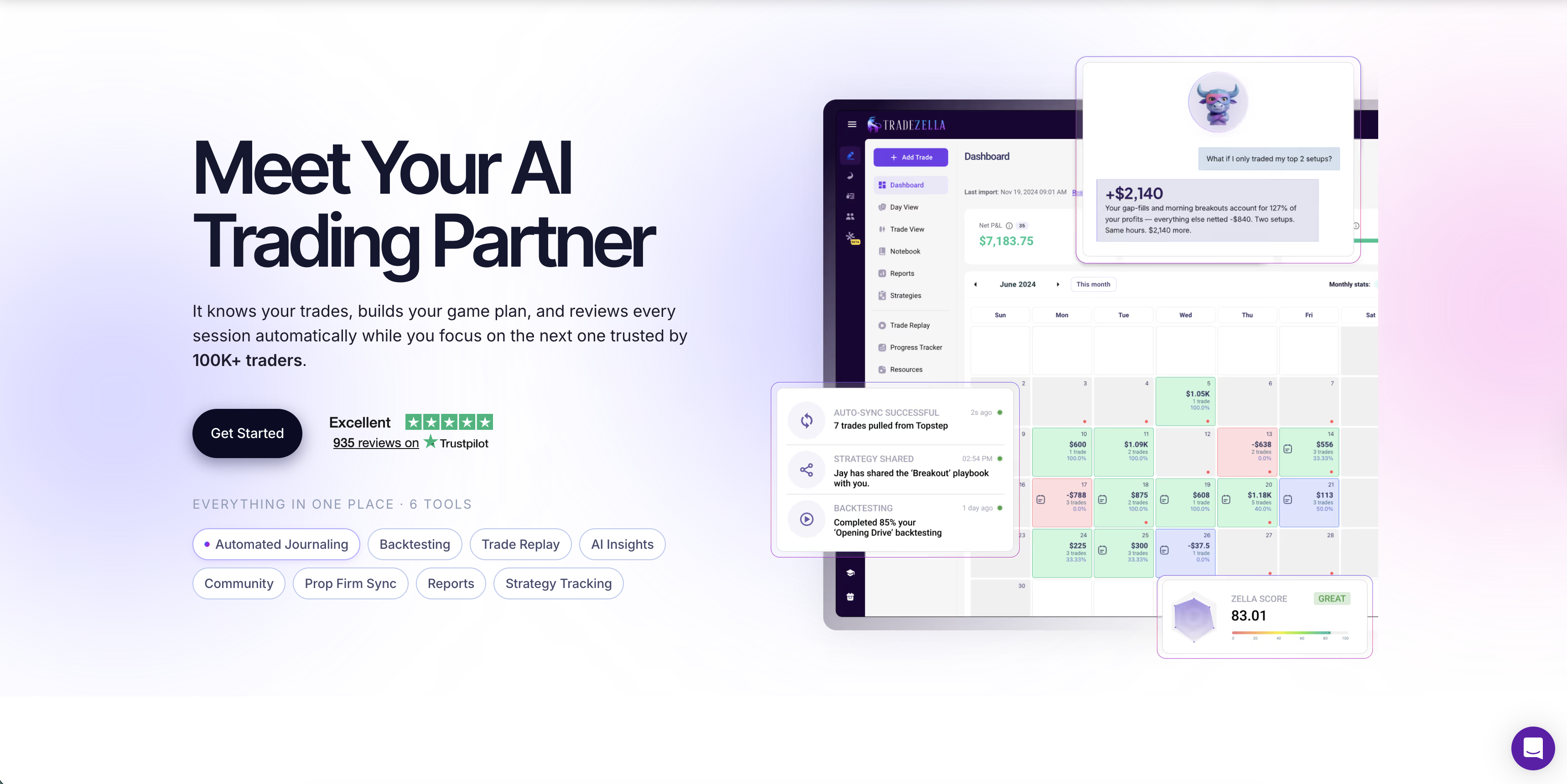
TradeZella imports trades from 500+ brokers automatically. Zella AI's Auto-Tagger agent applies tags based on rules you define (time of day, strategy, win/loss, R-multiple), and the Session Review agent compares your morning plan against your actual results at the end of each day. No manual logging. Our guide on the best trading journal for day traders compares five platforms if you want to evaluate options.
The weekly review is where improvement happens. Every Sunday, spend 30 minutes answering four questions:
Which strategy had the highest profit factor this week?
What time of day were my best and worst trades?
Did I follow my rules on every trade? (Check your Rule Adherence Score)
What's the one adjustment I'm making next week?
Your trading dashboard should show win rate, profit factor, and R-multiple distribution by strategy. Filter by time of day using the Day & Time report. Track habits with custom tags. Over 50 trades, this data reveals your trading edge, the specific conditions where your strategy actually works. Your trade review process is what turns raw screen time into genuine improvement.
Key Takeaways
The PDT rule was eliminated June 4, 2026. You no longer need $25,000 to day trade stocks. The new minimum is approximately $2,000 for margin accounts.
Micro futures (MES, MNQ) are the most beginner-friendly instruments. One point on MES equals $5. Deep liquidity, no PDT, favorable tax treatment.
Pick one strategy, trade it for 30-50 trades, then evaluate the data. Opening range breakouts and momentum/trend following are the most beginner-friendly approaches.
Risk no more than 1% per trade. Set a daily loss limit of 3x your per-trade risk. Use hard stops. These three rules keep you alive long enough to learn.
Track every trade from Day 1. Auto-import through your broker, tag by strategy and quality, and review weekly. The data tells you what's working before you have enough experience to feel it.
72% to 95% of day traders lose money. The goal for the first six months is not profitability. It's survival, education, and building a data set you can learn from.
Frequently Asked Questions
How much money do I need to start day trading in 2026?
The regulatory minimum for a margin account is approximately two thousand dollars after the PDT rule elimination in June 2026. However, a practical starting point is five thousand to ten thousand dollars for stocks, or two thousand to five thousand dollars for micro futures. These amounts allow you to risk one percent per trade while maintaining enough margin to take multiple positions.
Is day trading profitable for beginners?
Most beginners are not profitable in their first year. Studies show that seventy-two to ninety-five percent of day traders lose money overall. However, the traders who survive typically share common habits: they start with small position sizes, track every trade in a journal, follow strict risk management rules, and treat the first six months as a learning period rather than an income source.
What is the best market for beginner day traders?
Micro futures, particularly the Micro E-mini S and P 500 (MES), are the most beginner-friendly market. You focus on one instrument instead of scanning thousands of stocks, the tick value is small (one dollar and twenty-five cents per tick), liquidity is deep, and there are no pattern day trader restrictions. Micro futures also receive favorable tax treatment under Section 1256.
Do I still need $25,000 to day trade stocks?
No. The pattern day trader rule was eliminated on June 4, 2026. The twenty-five thousand dollar minimum equity requirement no longer exists. The new minimum for a margin account is approximately two thousand dollars under FINRA's updated Rule 4210. Some individual brokers may set their own higher minimums, so check with your specific broker.
What is the best day trading strategy for beginners?
Opening range breakouts are the most beginner-friendly strategy because the rules are mechanical and fully defined before the trade happens. You wait for the first fifteen or thirty minutes to establish a range, enter on a breakout above or below that range, and place your stop on the opposite side. No interpretation or pattern recognition is required.
How many trades should a beginner take per day?
One to three trades per day is ideal for beginners. More trades means more commissions, more emotional exposure, and more chances to deviate from your plan. Many successful day traders only take one or two high-quality setups per session. The best session for a beginner is often one good trade followed by closing the platform.
How long does it take to become a profitable day trader?
Most traders who eventually become profitable report that it takes six months to two years of consistent practice, journaling, and review. The timeline depends heavily on how quickly you build a data set (at least fifty trades per strategy), how disciplined you are about risk management, and whether you review your journal weekly to identify patterns in your performance.