What's the Best Trading Strategy? (Tested Answer for 2026)
What's the Best Trading Strategy? (Tested Answer for 2026)
Stop searching for a universal "best" strategy. Learn the data-driven framework 100,000+ traders use to discover which approach actually generates profits in their hands, not someone else's.
class SampleComponent extends React.Component {
  // using the experimental public class field syntax below. We can also attach
  // the contextType to the current class
  static contextType = ColorContext;
  render() {
    return <Button color={this.color} />
  }
}
What's the Best Trading Strategy? (Tested Answer for 2026)
You've searched "best trading strategy" probably more times than you'd like to admit. You've tried momentum plays, breakout setups, maybe even scalping during pre-market. Some worked for a week. Most didn't stick. And now you're back here, hoping this article finally gives you the answer.
Last updated: February 2026
Here's the uncomfortable truth that most trading content won't tell you: there is no universal "best" trading strategy. The question itself is broken. The traders consistently pulling profits aren't using some secret method the rest of us haven't discovered. They've found the strategy that works specifically for them, and they've proven it with their own data.
With over 20.5 billion trades journaled on TradeZella, one pattern emerges repeatedly: the traders who succeed aren't the ones who found the "perfect" strategy. They're the ones who used rigorous tracking to discover which strategy actually generates profits in their hands. By the end of this guide, you'll have a framework to find yours.
In This Guide
TL;DR: There's no universal "best" trading strategy,only the strategy that fits your personality, schedule, and risk tolerance while proving profitable in your hands. TradeZella's Playbook feature lets you tag, track, and compare multiple strategies side by side, so you can stop guessing and start trading what actually works for you based on your own performance data.
Why "Best Trading Strategy" Is the Wrong Question
The best trading strategy is whichever approach consistently generates profits for you specifically, proven through your own data, not someone else’s backtest. The characteristics of a genuinely profitable strategy include:
Positive expectancy over 50+ trades (not just a hot week)
Alignment with your personality: risk tolerance, time available, and decision-making speed
Measurable rules you can test and repeat consistently
Edge in specific conditions: no strategy works in all markets at all times
This guide breaks down every major approach, shows you how to test each one, and gives you the tools to determine which strategies actually make money in your hands.
The trading education industry has spent decades selling the idea of the perfect setup. Buy this course, learn this pattern, and profits will follow. But the traders who actually build consistent track records know the secret: they stopped searching for the "best" strategy and started testing to find their best strategy.
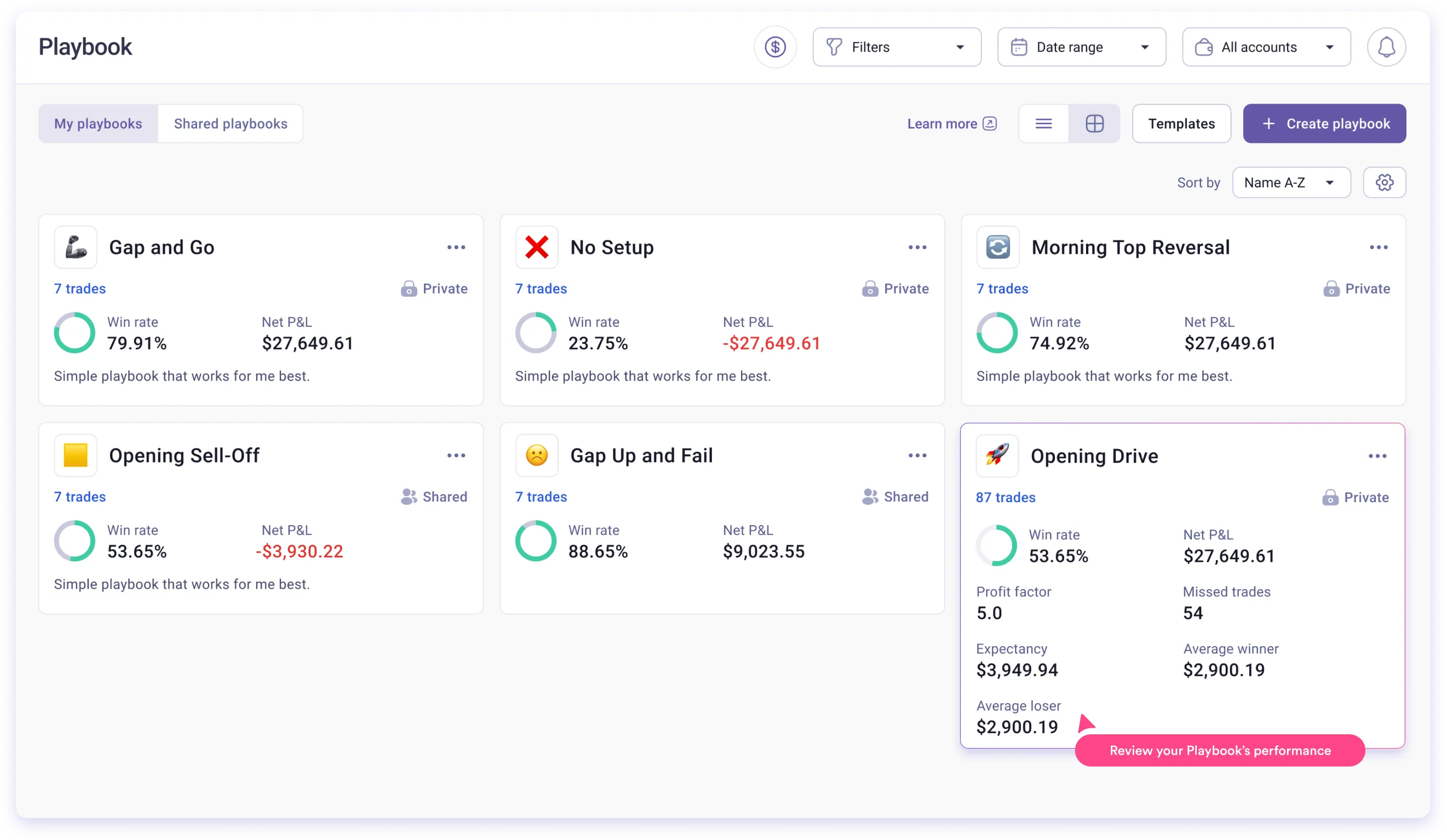
TradeZella's approach reflects this reality. Rather than prescribing one method, the platform gives you 50+ analytics reports to measure what's actually working. The Playbook feature specifically lets you tag trades by strategy type and compare win rates, profit factors, and expectancy across different approaches. Your data tells you your answer.
What Makes a Strategy "Best" for YOU
Personality Match: Why Your Psychology Determines Your Strategy
You know that feeling when a trade goes against you and you can't stop watching the screen? Or when you exit too early because you couldn't handle the heat? Your psychological makeup isn't a flaw to fix, it's a variable to work with.
Some traders thrive on quick decisions and rapid-fire execution. Others need time to analyze before pulling the trigger. A scalping strategy that requires split-second decisions will destroy someone who second-guesses entries. A swing trading approach that holds positions for days will torture someone who checks charts every five minutes.
Mistake tagging in your journal, labeling trades with notes like "FOMO," "overconfidence," or "early exit", helps you identify these patterns. After logging 30-50 trades in TradeZella, you'll see which psychological tendencies cost you money and which strategies trigger them least.
Schedule Fit: Trading Around Your Real Life
Here's a stat that rarely gets discussed: your available trading hours filter out most strategies before you even evaluate them. If you work a 9-to-5, day trading the US market open is probably off the table. If you're in a different time zone, your "optimal" sessions look completely different.
The wrong schedule match doesn't just reduce opportunities, it forces bad trades. Traders who can only check charts twice a day often jump into intraday setups that require constant monitoring. They get stopped out while away from the screen, then wonder why the "strategy doesn't work."
Time-based performance reports show exactly when you trade best. The data might reveal that your Tuesday morning setups have a 65% win rate while your Friday afternoon trades lose money consistently. That's not random, that's practical information about when your edge exists. TradeZella generates these reports automatically from your trade data.
Risk Tolerance: The Number That Changes Everything
Two traders can use identical entry criteria, identical targets, and lose completely different amounts. Why? Position sizing and stop placement reflect risk tolerance, and misaligned risk management will destroy any strategy's profitability.
A strategy with a 40% win rate can be highly profitable if winners are 3x larger than losers. But can you actually sit through losing 6 out of 10 trades? Many traders can't, regardless of what the math says. They'll abandon the approach after a string of losses that was entirely normal for the system.
Tracking your R-multiple (actual risk-reward on each trade) and drawdown patterns over time reveals not just whether a strategy is profitable, but whether you can actually execute it through the inevitable losing streaks. TradeZella calculates these automatically across every playbook.
Common Trading Strategy Categories
Before you can find YOUR best strategy, you need to understand the main approaches. Each has distinct characteristics that match different trader profiles.
Trend Following
You identify an established directional move and trade with it until it ends. Trend followers accept missing the beginning and end of moves in exchange for capturing the middle. Win rates are often lower (40-50%), but winners tend to be significantly larger than losers.
Best suited for: Patient traders comfortable with extended holding periods and lower win rates. Requires ability to let winners run without taking profits early.
Mean Reversion
You trade against extended moves, betting that price will return to an average. When a stock or currency spikes far from its typical range, mean reversion traders take the opposite direction expecting a snapback.
Best suited for: Traders who think probabilistically and can handle being "wrong" initially as positions move further against them before reversing.
Breakout Trading
You enter when price moves beyond a defined level (resistance, support, consolidation range) with the expectation momentum will continue. Breakout traders accept many false signals in exchange for catching the genuine moves.
Best suited for: Traders who can accept frequent small losses while waiting for the big wins. Requires strong pattern recognition and quick execution.
Momentum Trading
You buy what's already moving up and sell what's moving down, riding the wave of buying or selling pressure. Momentum traders believe strength begets strength in the short term.
Best suited for: Traders comfortable with fast-paced execution and quick reversals. Works well for those with time to monitor positions actively.
Scalping
You capture tiny price movements over seconds or minutes, accumulating many small profits throughout a session. Scalpers need excellent execution, tight spreads, and ironclad discipline.
Best suited for: Full-time traders with fast internet, direct market access, and the ability to maintain focus for extended periods. Not practical for most part-time traders.
How to Find Your Best Strategy
Step 1: Test Multiple Approaches in Demo
Paper trading gets a bad reputation because traders use it wrong. They either skip it entirely or trade demo so casually that results mean nothing. Used correctly, demo trading is your laboratory.
Commit to testing 3-4 different strategy types over 2-3 months. Trade each approach for at least 30 setups before evaluating. Track everything,entries, exits, reasoning, emotions, as if real money were on the line. TradeZella connects to demo accounts the same way it connects to live accounts, so your tracking infrastructure stays consistent when you go live.
Step 2: Journal Rigorously From Day One
Casual tracking produces casual results. You need systematic data collection to answer the question "which strategy actually works for me?"
Every trade needs: setup type, entry reasoning, exit reasoning, emotional state, mistakes made, and outcome. This sounds tedious until you realize it's the only way to separate luck from edge. A strategy that won 7 out of 10 trades might have been wrong on all of them,you just got lucky. The journal reveals the truth.
TradeZella automates the mechanical tracking (entry/exit prices, P&L, timing) while letting you add the contextual notes that matter. The Playbook tagging system ("breakout," "reversal," "news event") becomes your strategy categorization automatically.
Step 3: Analyze Which Actually Generates Profits for YOU
After 50+ trades per strategy type, the numbers tell a story. Not the story you hoped for, the story that's actually true.
Pull up side-by-side comparisons: which playbook has the highest win rate? Which has the best profit factor? Which has the smallest drawdowns? Now cross-reference with your notes: which strategy did you execute consistently without emotional interference?
The best strategy for you is the intersection of "mathematically profitable" and "psychologically executable." Sometimes those overlap. Sometimes they don't, and you need to adjust.
Real Trader Case Studies
Case Study 1: The Day Job Trader
Profile: Works 9-5 EST, can only trade pre-market and occasionally during lunch. Tried day trading initially but kept getting stopped out while in meetings.
Discovery process: Tested swing trading (2-5 day holds) and position trading (1-3 week holds) in parallel using TradeZella's playbook tracking.
Result: Swing trading showed 58% win rate with 2.1:1 average reward-to-risk. Position trading showed 52% win rate with higher average gains but more emotional stress from holding through volatility. Swing trading was "best" for this trader.
Key insight: Time-based analytics in TradeZella showed best performance on setups identified Sunday evening and entered Monday morning.
Case Study 2: The Former Scalper
Profile: Originally attracted to scalping because of the action and quick feedback. After 6 months, realized commissions were eating profits and the emotional toll was unsustainable.
Discovery process: Forced himself to test momentum trading on 15-minute charts instead of 1-minute charts. Tracked both approaches simultaneously for 60 days.
Result: Momentum trading (15-min) showed nearly identical win rate but 3x better profit factor due to larger average winners and reduced commission drag. Reviewing trade data helped identify that most scalping losses came from holding too long when trades went against him.
Takeaway: The switch wasn't about finding a "better" strategy,it was about finding one that fit his actual strengths (pattern recognition) while removing his weakness (micromanaging positions).
Case Study 3: The Prop Firm Candidate
Profile: Attempting to pass FTMO evaluation, needed documented consistency and strict risk management. Had blown two previous evaluations from overtrading.
Discovery process: Used TradeZella to track three different approaches across a 90-day practice period before attempting evaluation.
Result: Mean reversion setups on forex majors showed highest consistency (61% win rate) with smallest drawdown periods. Breakout trades had higher upside but also caused the account swings that had previously failed evaluations.
The lesson: "Best" for prop firm evaluation wasn't highest profit potential, it was lowest drawdown with sufficient profitability. The strategy that looked "boring" on YouTube was the one that passed the evaluation.
Strategy Selection Framework
Use this framework to evaluate which strategy type fits your situation. Score yourself honestly on each factor before committing to test a specific approach.
Factor
Questions to Ask
How It Filters Strategies
Available Time
How many hours can you actively trade per day? Can you monitor positions, or only check periodically?
Eliminates scalping and active day trading for part-time traders. Favors swing/position trading for limited schedules.
Psychological Tolerance
Can you handle losing 6 of 10 trades if winners are bigger? Do you need frequent wins for confidence?
High win-rate needs → mean reversion, scalping. Comfort with low win-rate → trend following, breakout.
Risk Capacity
What's your maximum acceptable drawdown? How much can you lose before it affects your decision-making?
Strict drawdown limits → mean reversion, smaller position sizing. Higher tolerance → trend following, momentum.
Decision Speed
Do you think quickly under pressure, or need time to analyze?
Fast decisions → scalping, momentum. Deliberate analysis → swing, position trading.
Capital Available
Do you have enough to weather normal drawdowns for your strategy type?
Pattern day trading rules, minimum position sizes, and commission impact all vary by strategy and capital level.
Best Practices for Strategy Discovery
Track Everything Before You Need It
You don't know which data point will matter until you're trying to diagnose a problem. The trade that "felt off" but you didn't note why? That's a missed pattern. The session where you were tired but traded anyway? That context disappears without documentation.
Automated tracking handles the mechanical data, entries, exits, P&L, timing, but the context is on you. Train yourself to add notes immediately after closing trades, not at the end of the week when you've forgotten the details.
Give Each Strategy a Fair Trial
Thirty losing trades in a row would shake anyone. But if you abandon a strategy after 10 losses, you'll never know if trade 11 started a winning streak that would have made the system profitable. Small samples deceive.
Commit to 50 minimum trades before evaluating any strategy. Set this rule before you start testing, not after losses make you want to quit. TradeZella's playbook tracking makes this easy, you'll see exactly how many trades you've logged per strategy, helping you resist the urge to judge prematurely.
Separate Strategy Performance from Execution Errors
A strategy with a 55% win rate might show 45% in your data because you keep making execution mistakes. Those are different problems with different solutions.
Use TradeZella's mistake tagging religiously. When you review a losing playbook, filter for trades where you followed rules perfectly versus trades where you deviated. A strategy that works when executed properly but fails when you override it isn't a bad strategy, it's an execution problem.
Review Weekly, Adjust Monthly
Daily performance fluctuates randomly. Monthly trends reveal truth. But if you only review monthly, you miss opportunities to course-correct.
Set a weekly 15-minute review: check your playbook stats, review flagged mistakes, note any patterns. Make actual changes to your approach only monthly, after enough data accumulates. TradeZella's dashboard supports this rhythm naturally, reports update automatically, so review is just looking, not calculating.
Common Mistakes When Choosing a Strategy
Copying Someone Else's "Best" Strategy
A trader you follow on Twitter shows their P&L and explains their setups. You copy them exactly. Six months later, you've lost money while they keep posting wins.
What happened? You have different psychology, different capital, different available hours, and different risk tolerance. Their strategy fits them. It was never designed for you. Start your search from your own constraints, not someone else's success story.
Switching Strategies After Every Losing Streak
Every strategy has losing periods. The traders who build lasting results pushed through those periods because they had data proving their approach works over larger samples.
If you switch strategies every time you hit a rough patch, you'll never accumulate enough data to know if ANY approach works for you. Set your evaluation rules before testing, commit to the sample size, and let the data decide, not your emotions after three losses.
Ignoring Time-of-Day and Market Conditions
A breakout strategy might crush it during high-volatility periods and bleed during consolidation. If you don't track when you trade and what conditions existed, you can't isolate whether the strategy fails or just fails in certain contexts.
TradeZella's time-based performance reports and the ability to tag trades by market condition solve this. Your "worst" strategy might actually be your best,during the right conditions.
FAQ
What is the best trading strategy for beginners?
No single strategy is universally best for beginners. The best approach is one simple enough to execute consistently while you build core skills. Key considerations for choosing:
Start with longer timeframes: swing trading (daily charts) gives you time to think without the pressure of quick decisions
Choose high-liquidity markets: major forex pairs, large-cap stocks, or index ETFs with tight spreads
Focus on one setup: master a single pattern like trend pullbacks before adding complexity
Paper trade first: 2-4 weeks of simulated trading to build execution habits
The goal is building your feedback loop, not finding a "magic" strategy. Start simple, track everything, and let 50+ trades of data guide your evolution.
How long does it take to find your best trading strategy?
Expect 3–6 months of systematic testing to identify which strategy genuinely works for you. The timeline depends on several factors:
Trading frequency: day traders collect enough data faster than swing traders
How many setups you test: testing one at a time is slower but gives cleaner signals
Market conditions: testing during low-volatility periods may delay results
Review consistency: traders who review weekly compress the learning curve significantly
Most traders take longer because they switch strategies after every losing week instead of collecting enough data to distinguish edge from noise. Fifty trades per setup is the minimum threshold for meaningful conclusions.
Can you be profitable with multiple trading strategies?
Yes, but only after mastering one first. Traders who spread attention across many strategies before proving any single one waste months of data collection. The recommended path:
Phase 1: trade one strategy for 50+ trades minimum with proven positive expectancy
Phase 2: add a second strategy only after the first is consistently profitable
Phase 3: track each strategy separately to see whether both hold edge independently
Many consistently profitable traders use just 2–3 core strategies covering different market conditions. The key is tagging each trade by strategy so your analytics show which ones actually make money.
Why do trading strategies that work for others fail for me?
Strategy performance is inseparable from the trader executing it. A strategy that works for someone else may fail for you because of differences in:
Psychology: your risk tolerance and emotional reactions affect execution
Available time: a scalping strategy requires constant screen time that swing traders lack
Capital and risk tolerance: position sizing looks different at $5K vs. $50K accounts
Execution speed: some strategies require split-second decisions that not everyone can make
This is why data on your execution matters more than backtest results from someone else’s system. Test every strategy with your own capital, track your results, and let the numbers, not someone else’s claims, determine what works for you.
How many trades do I need before evaluating a strategy?
Minimum 50 trades per strategy before drawing any conclusions, with 100+ trades preferred. Smaller samples are dominated by randomness. A strategy might show 70% win rate after 10 trades and 45% after 50, both results were always true, but the small sample hid reality. TradeZella tracks trade count per playbook automatically, helping you resist premature judgments.
Should I paper trade before going live with a new strategy?
Yes,but paper trade with the same discipline you'd use with real money. Demo trading fails when traders take it casually, executing trades they'd never risk real capital on. Use identical position sizes, follow your rules exactly, and log everything in TradeZella the same way you would with a live account. The data quality determines whether demo results translate to live trading.
How does TradeZella help compare different strategies?
TradeZella's Playbook feature lets you tag every trade by strategy type, then automatically calculates performance metrics for each playbook separately. You'll see win rate, profit factor, expectancy, average winner/loser, and drawdown per strategy side by side. The 50+ analytics reports can be filtered by playbook, showing not just IF a strategy works but WHEN and WHY it works or fails.
What's the difference between a trading strategy and a trading system?
A strategy defines the rules for entering and exiting trades. A system includes everything else that makes trading sustainable:
Strategy: specific entry signals, exit criteria, and setup conditions
Risk management: position sizing, max daily loss, portfolio allocation
Performance tracking: journaling, analytics, and review cadence
Execution rules: when to trade, when to sit out, pre-market routine
Most traders focus exclusively on strategy while neglecting the system around it. A mediocre strategy inside a strong system outperforms a great strategy with no supporting structure.
Key Takeaways
The search for the "best" trading strategy ends when you stop looking outward and start looking at your own data. The traders building consistent profits aren't using secret methods, they've identified which approaches fit their personality, schedule, and risk tolerance, then proven profitability with real trades.
Your best trading strategy already exists. You just haven't generated enough data to identify it yet. Start tracking, stop guessing, and let your own performance reveal the answer.