AI Trading Assistant vs AI Trading Agent: Which One Actually Improves Your Trading
AI Trading Assistant vs AI Trading Agent: Which One Actually Improves Your Trading
AI trading assistants answer questions when you ask them. AI trading agents tag your trades, review your sessions, and journal your day without you lifting a finger. This guide explains the difference, shows both tools side by side on the same trading day, and helps you decide which one your trading actually needs.
class SampleComponent extends React.Component {
  // using the experimental public class field syntax below. We can also attach
  // the contextType to the current class
  static contextType = ColorContext;
  render() {
    return <Button color={this.color} />
  }
}
Last Updated: May 29th, 2026
An AI trading assistant is a tool that answers your trading questions when you ask them, like ChatGPT or Claude. An AI trading agent is software that performs specific trading tasks autonomously, like tagging every trade, reviewing your session against your rules, and generating your pre-market plan, all without you having to ask. The key difference: assistants wait for your prompt, agents take action on your data automatically. For traders looking to improve consistently, agents eliminate the manual work that causes most traders to abandon their process within 60 days.
Every trader who has pasted a chart screenshot into ChatGPT and asked "what do you see?" has used an AI trading assistant. It answered. Maybe it gave a decent analysis. Then it forgot everything the next day.
That is what an assistant does. It answers when asked, and it stops when you stop asking.
An AI trading agent does something fundamentally different. It tags your trades the moment they close. It reviews your entire session against the plan you set that morning. It journals your day without you writing a single word. It remembers your risk per trade, your preferred setups, and the fact that you lose money on Wednesdays after 2 PM.
The distinction matters because most traders do not fail from a lack of information. They fail from a lack of execution on the process they already know works. Assistants give you more information. Agents execute the process for you.
This guide defines both tools, walks through the same trading day with each, and gives you a framework for deciding which one your trading actually needs.
What Is an AI Trading Assistant?
An AI trading assistant is any AI tool that responds to your questions about trading. You prompt it, it answers. You stop prompting, it stops working. Examples include ChatGPT, Claude, Google Gemini, and Copilot. Some trading platforms also offer chat-based AI features that fall into this category.
Assistants are good at certain things. They can explain what a profit factor of 1.8 means. They can walk you through trading patterns like ascending triangles. They can brainstorm a trading plan structure. They can analyze a screenshot if you paste one in.
But assistants have three fundamental limitations that prevent them from improving your trading consistently.
1. No Access to Your Data
An assistant does not know your trade history. It cannot tell you that your bull flag entries have a 62% win rate in the morning but only 38% after lunch. It cannot calculate your expectancy per setup because it has never seen your setups. Every conversation starts from zero.
On a $50,000 account risking $500 per trade, the difference between trading your best setup at your best time versus trading everything all day could be $3,000 to $5,000 per quarter. An assistant cannot show you that because it cannot see your data.
2. No Memory Across Sessions
You told ChatGPT yesterday that your max loss is $1,500 per day. Today it does not know that. You explained your Strategy rules for opening range breakouts last week. Gone. Every session is a blank slate.
This means every conversation requires re-explaining your context. Most traders stop doing this after the first few times because it takes too long. The result is that the assistant's advice stays generic rather than compounding with your history.
3. No Autonomous Action
The most important limitation: assistants do not do anything unless you ask. They do not tag your trades. They do not review your session. They do not flag when you broke your rules. If you forget to ask, nothing happens.
This is why using an AI assistant for trading feels productive in the moment but rarely translates to measurable improvement. The tool only works when you work it, and the whole point of AI should be removing that manual dependency.
What Is an AI Trading Agent?
An AI trading agent is software that performs specific trading tasks autonomously without you having to prompt it each time. You configure it once with your rules and preferences, and it executes those tasks on your completed trade data after every session. The key distinction from an assistant: an agent takes action on your data, not just answers questions about it.
Where an assistant waits for "What should I look for in my trades today?", an agent has already tagged every trade from your last session, compared your results to your morning plan, and flagged that you broke your risk management rules on two entries before you even open the app.
For a deeper look at how agents work in practice, see our full guide on AI trading agents.
What Agents Actually Do
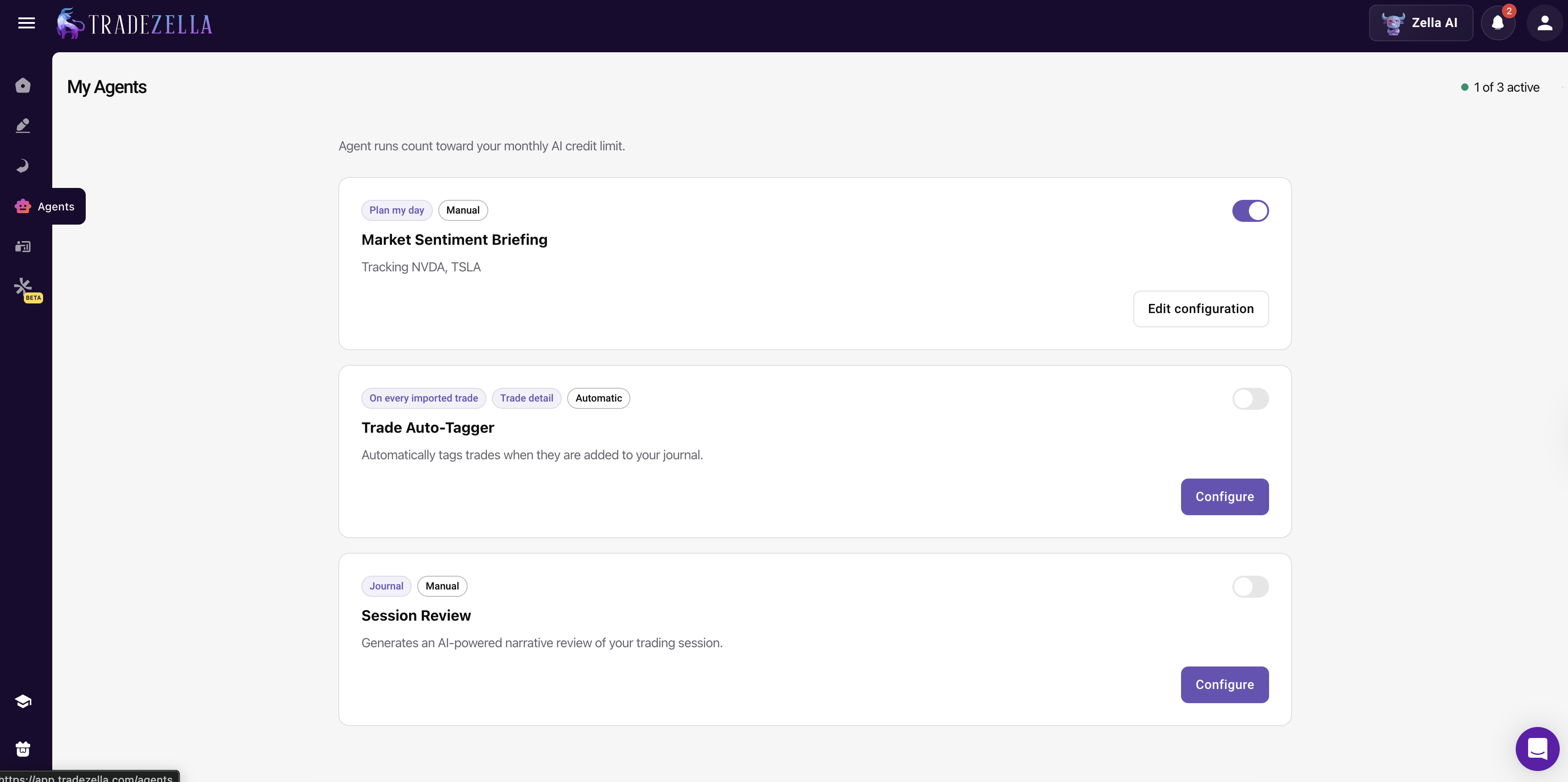
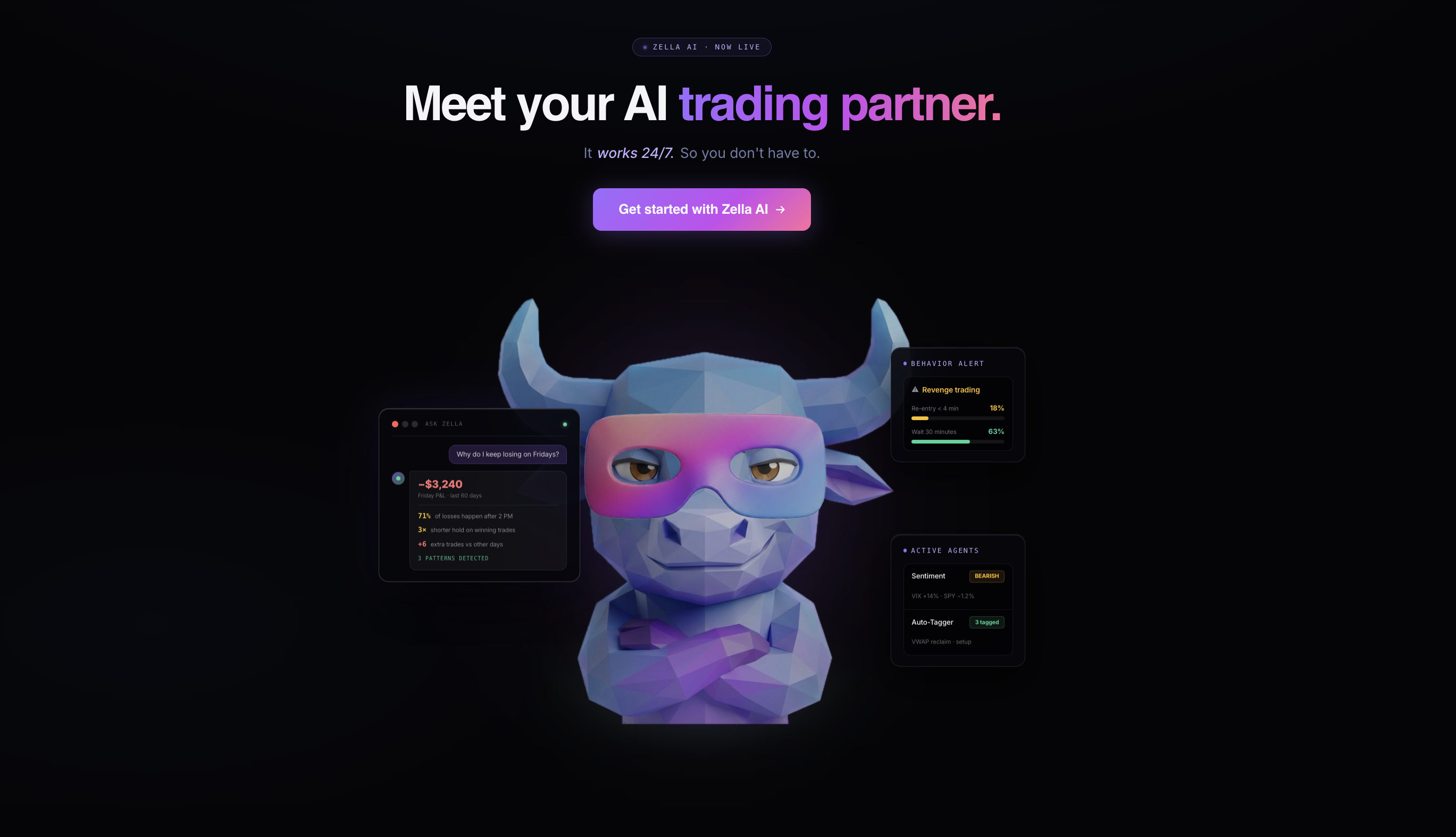
Zella AI, TradeZella's AI trading partner, operates through autonomous agents that each handle a specific part of your trading workflow:
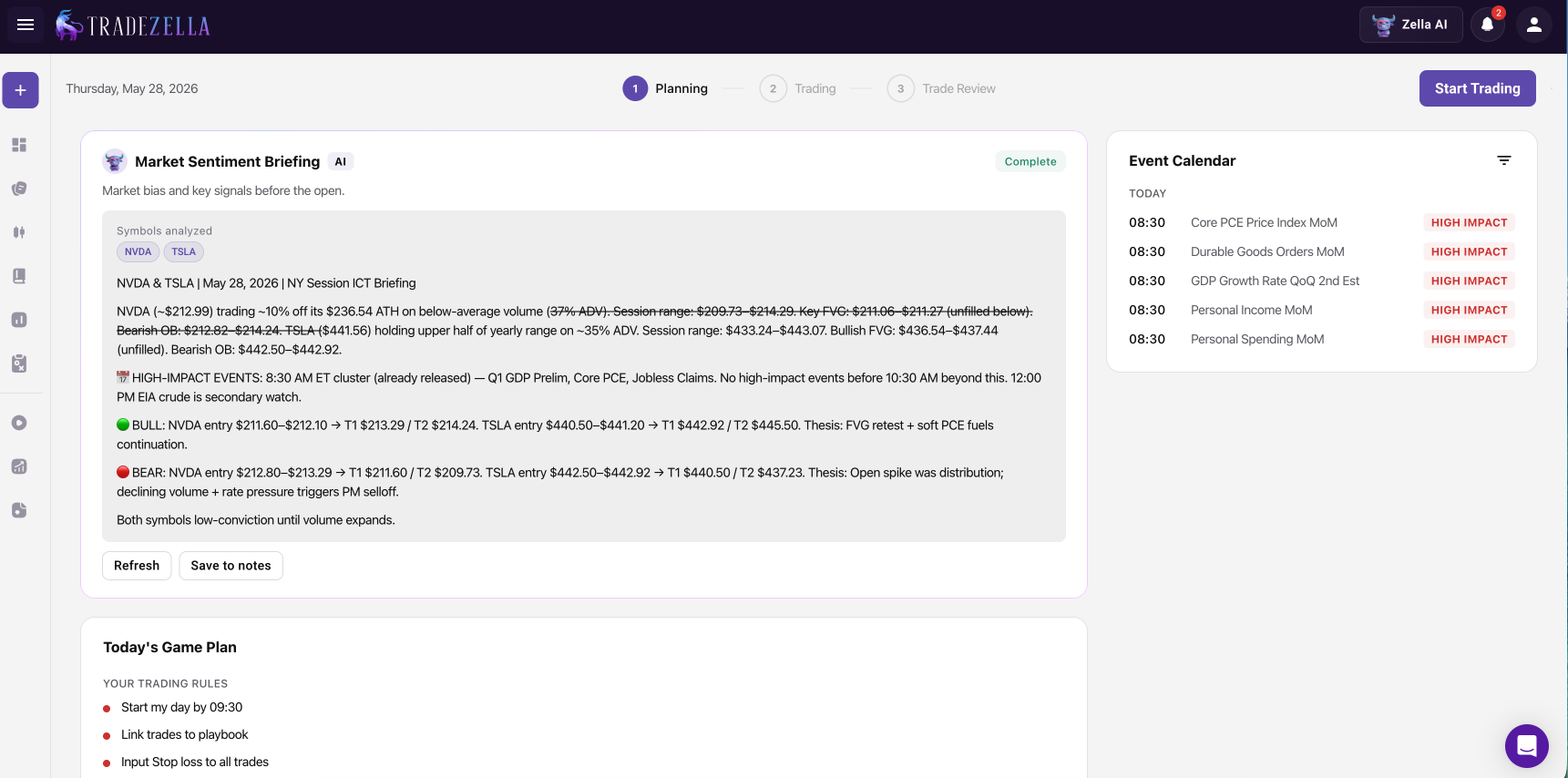
Market Sentiment Briefing. You configure this agent with how you trade: your style (ICT, order flow, price action), your instruments (ES, NQ, specific stocks, forex pairs), and what you look at (economic calendar, higher timeframes, FVGs, order blocks, supply and demand, trendlines). When you click "Start My Day," it generates a pre-market plan with scenarios based on your configuration. It is not pulling from a generic news feed. It creates plans based on how you told it you trade.
Auto Trade Tagger. You set up tagging criteria. Examples: tag trades that went 2R or higher, tag by entry timeframe, tag whether SMT divergence was present, tag supply and demand concepts, tag trades where rules were followed versus broken. The agent applies these tags automatically to every trade based on the criteria you define. This is how you build clean, consistent data without spending 20 minutes per trade on manual tagging.
Session Review. After you finish trading, this agent reviews your entire day. It compares your morning plan (from Start My Day) against your actual results. It checks whether you followed your rules, identifies what went well, flags what did not, and journals the entire session automatically. You customize what it emphasizes, whether that is rule adherence, deviations from your plan, sizing discipline, or emotional trading patterns.
More agents are coming. These three cover the daily workflow, but TradeZella is building additional agents for deeper analytics and pattern detection.
TradeZella AI Agents
The 3-Stage AI Taxonomy for Traders
Not all AI in trading is equal. There are three distinct stages, and understanding where your current tools sit determines whether AI is actually helping your results or just making you feel productive.
Stage 1: Manual (No AI)
Spreadsheets. Handwritten notes. Manual screenshots. This is how most traders still operate. It works at low volume, maybe 5 to 10 trades per week. But compliance drops below 40% within the first month for traders logging 3 or more trades per day. The friction kills the habit.
On a $50,000 account, traders at Stage 1 who stop journaling consistently miss an average of $2,000 to $4,000 per quarter in preventable losses because they never identify their worst patterns. If you have been through this, our comparison of trading journal software shows what dedicated tools offer over spreadsheets.
Stage 2: AI Assistant (Ask and Answer)
ChatGPT, Claude, Gemini. You paste a chart, ask a question, get an answer. Better than nothing, but the problems we covered above (no data, no memory, no action) mean the improvement ceiling is low. You are still doing all the work. The AI just answers faster than Google would.
Most traders who say "I use AI for my trading" are at Stage 2. They ask good questions and get good answers, but nothing changes in their actual process because the AI cannot touch their data or act on their behalf.
Stage 3: AI Agent (Autonomous Action)
This is where AI stops being a tool you use and becomes a partner that works alongside you. At Stage 3, the AI tags every trade, reviews every session, generates every plan, and writes back to your data. You configure it once and it runs after every session.
The jump from Stage 2 to Stage 3 is not about better answers. It is about eliminating the manual steps that cause traders to abandon their process. When your trades are tagged automatically, your sessions reviewed automatically, and your journal written automatically, the only thing left for you to do is trade and read what the agent found.
Zella AI operates at Stage 3. It is an AI trading tool that takes action on your data, not a chatbot that waits for your questions.
The difference between these two tools becomes concrete when you walk through the same trading day with each one. Here is what that looks like on a $50,000 account risking $500 per trade.
6:30 AM: Pre-Market Preparation
With an assistant: You open ChatGPT. You type "What are the key levels for ES today?" It gives you a generic response about support and resistance based on whatever it can see. It does not know you are an ICT trader. It does not know you focus on FVGs above the previous day's high. It does not know your max loss is $1,500. You spend 15 minutes re-explaining your context and prompting for something useful.
With an agent: You open TradeZella and click "Start My Day." The Market Sentiment Briefing agent already knows you trade ICT setups on ES and NQ, that you look at order blocks and FVGs on the 15-minute chart, and that your max position is 2 contracts. It generates 2 to 3 pre-market scenarios with your specific levels, entry criteria, and risk parameters. Time: 5 minutes to read the plan.
4:00 PM: Session Ends
With an assistant: You took 6 trades. You could paste screenshots into ChatGPT and ask for analysis, but that would take 10 to 15 minutes per trade. Most traders skip this entirely or do it for one trade and call it a day. The other 5 trades go unreviewed.
With an agent: Your trades synced automatically via TradeZella's broker import. The Auto Trade Tagger has already tagged all 6 trades: entry timeframe, setup type, whether rules were followed, whether the trade went 2R or more. The Session Review agent compares your morning plan against your actual results and journals the entire session. Time: 0 minutes of your effort. It happened automatically.
Sunday: Weekly Review
With an assistant: You would need to compile your trades manually, calculate your metrics, identify patterns, and then maybe paste a summary into ChatGPT to ask for insights. Realistically, fewer than 15% of traders actually do this every week.
With an agent: You open your analytics dashboard. Every trade from the week is tagged and categorized. You can filter by Strategy, by time of day, by rules-followed versus rules-broken. Your trade review process takes 30 minutes because the data is already organized. You spot that 4 of your 6 losing trades happened after 2 PM, and all 4 were trades where you deviated from your morning plan. That insight is worth $2,000 per month if you act on it.
The weekly cost of not reviewing your trades compounds. Over a quarter, unreviewed trading habits that cost you $200 per week add up to $2,600 in preventable losses. The agent makes the review happen whether you feel like doing it or not, because it already did the work.
Automatic. Auto-Tagger applies your criteria to every trade.
Session Review
Only if you paste data and ask for analysis.
Automatic. Reviews every session against your plan.
Pre-Market Planning
Generic. No knowledge of your trading style.
Personalized. Based on your style, instruments, and criteria.
Trading-Specific Skills
General knowledge. No depth in ICT, order flow, prop rules.
Built-in. ICT, order flow, book map, prop firm rules, VWAP.
Personalization Over Time
None. Cannot learn your patterns.
Compounds. More data = deeper pattern detection.
Daily Time Cost to You
30-60 min. Manual input for every question.
15 min. Read plan + review agent output.
Where Does ChatGPT Fit in This Framework?
ChatGPT is a Stage 2 AI assistant. It is an excellent general-purpose tool, and it is not built for the specific problem traders face.
ChatGPT is good at explaining concepts. If you want to understand what expectancy means or how to calculate a breakeven win rate, it will give you a clear answer. It can brainstorm Strategy ideas, help you write a trading plan, and analyze a chart screenshot.
But ChatGPT cannot access your TradeZella account. It cannot see that your ascending triangle trades have a 1.4 profit factor in the morning but 0.7 in the afternoon. It cannot tag your trades based on criteria you set. It cannot compare today's session to the plan you made this morning. It cannot remember that you told it your max loss is $1,500 per day, because tomorrow it will have forgotten.
This is not a criticism of ChatGPT. It is a recognition that general AI assistants and trading-specific AI agents solve different problems. Using ChatGPT for trading is like asking your accountant for a medical opinion. Smart person, wrong expertise, no access to your medical records.
For a detailed look at what AI coaching can and cannot do for traders, see our guide on whether an AI trading coach actually works.
What Makes Zella AI an Agent, Not an Assistant?
Zella AI is TradeZella's AI trading partner. It is not a chatbot that answers questions. It is an agent system that takes action on your trading data. Here is what separates it from every assistant on the market.
It Takes Action
Zella AI tags trades, generates session reviews, creates pre-market plans, and writes back to your data. When the Auto-Tagger runs, it applies your custom criteria to every trade automatically. When Session Review runs, it journals your entire day. These are not suggestions or answers. They are actions that change your data.
It Has Your Data
TradeZella imports trades from 500+ brokers. Every entry, every exit, every P&L number, every timestamp. Zella AI works on top of this data, which means its analysis is based on your actual results, not hypotheticals. When Zella AI tells you that Wednesday afternoons cost you $1,200 last month, it calculated that from your real trades.
It Remembers
Zella AI has memory across sessions. It remembers your name, your risk per trade, your preferred Strategies, your trading discipline rules. Every interaction makes the next one better. After 30 days, it knows your trading personality. After 90 days, it has enough history to spot seasonal patterns in your results.
It Has Trading-Specific Skills
Zella AI understands ICT concepts, order flow, book map analysis, prop firm rules, VWAP exhaustion, and breaker blocks. It speaks trader language because it was built for traders. Ask a general assistant about your SMT divergence setup, and you get a textbook answer. Zella AI knows what that setup looks like in your data because you tagged it.
It Tells the Truth
Zella AI pushes back when your data says you are wrong. If you think your best setup is bull flags but your data shows a 0.6 profit factor on bull flags and a 2.1 profit factor on trading patterns like ascending triangles, Zella AI will tell you. It does not validate. It shows you the data.
How Do I Know If I Need an Assistant or an Agent?
The answer depends on where you are in your trading and what problem you are trying to solve.
An AI assistant is enough if:
You trade fewer than 5 times per month and just want occasional answers to trading questions.
You are brand new to trading and still learning basic concepts like what a stop loss is or how risk management works.
You do not have trade data yet because you have not started trading live or on paper.
You need an AI agent if:
You trade regularly (3 or more times per week) and want to improve your results through data, not intuition.
You have tried journaling manually and stopped because it took too long.
You know you should review your trades but rarely do because the process is tedious.
You want to find your trading edge but cannot identify it from memory alone.
You trade funded accounts and need consistent rule adherence tracking.
Zella AI gives you both. The autonomous agents (Auto-Tagger, Session Review, Market Sentiment Briefing) handle the heavy lifting without you asking. But you can also ask Zella AI questions directly, the same way you would ask ChatGPT, except Zella AI answers with your actual trade data, remembers your previous conversations, and knows your trading style. Ask it "what is my best setup this month?" and it pulls the answer from your real trades. Ask it "why did I lose money last week?" and it shows you the specific patterns in your data. You get the convenience of an assistant and the power of an agent in the same tool.
What Are the Most Common Mistakes When Using AI for Trading?
Five mistakes account for most of the frustration traders experience with AI tools.
1. Treating an agent like an assistant. Some traders sign up for TradeZella, open Zella AI, and only use the chat. They never configure the Auto-Tagger, never set up Session Review, never customize Market Sentiment Briefing. They are paying for Stage 3 and using it at Stage 2. Configure the agents. Let them work.
2. Expecting real-time intervention. Zella AI agents work on your completed trade data after each session. They do not monitor your screen during the trading day or step in mid-trade. The value comes from the review after the session, not intervention during it. Plan before you trade (Market Sentiment Briefing), then review after (Session Review and Auto-Tagger).
3. Using an assistant when you need an agent. If you have been pasting charts into ChatGPT for three months and your results have not changed, the problem is not the quality of the answers. The problem is that answers without action do not move the needle. You need a tool that acts on your data.
4. Not giving the agent enough data. Zella AI compounds over time. With 10 trades, it can spot basic patterns. With 30 trades, it has enough data to calculate meaningful profit factor and win rate by setup. With 100 trades, it can identify time-of-day patterns, market condition dependencies, and behavioral cascades. The first week is useful. The first quarter is transformative.
5. Ignoring the output. The agent did the work. The session review is sitting there. The tags are applied. But if you never read the review or filter your analytics by the tags the agent created, you are right back where you started. Block 10 minutes every evening to read what the agent found. Block 30 minutes on Sunday for a weekly review.
What Can an AI Agent See That You Cannot?
The real power of an agent is not speed. It is pattern detection across hundreds of trades that no human brain can hold simultaneously.
Time-of-day patterns. Your morning trades (9:30 to 11:00 AM) might average +1.4R while your afternoon trades (1:00 to 3:00 PM) average -0.3R. On a $50,000 account risking $500 per trade, that afternoon habit costs you $150 per trade, or $1,500 per month if you take 10 afternoon trades.
Strategy drift. You started the month trading opening range breakouts. By week 3, half your trades are random entries that do not match any defined Strategy. An agent flags this because every trade is tagged against your Strategies. For more on how to build and test setups, see our guide on AI trade analysis.
Behavioral cascades. A loss leads to a revenge trade, which leads to oversizing, which leads to breaking your daily loss limit. This pattern shows up clearly in tagged data: trades tagged "Rules Broken" cluster after trades tagged "Loss." You might not notice it in the moment. The agent sees it in every session review.
Edge concentration. Out of 5 Strategies you trade, 2 account for 90% of your profits. The other 3 are break-even or negative. An agent surfaces this in the first 50 trades. Most traders who rely on intuition never discover it.
How Do I Set Up an AI Trading Agent?
Setting up Zella AI takes about 15 minutes. Here is the process.
Step 1: Connect your broker. TradeZella imports trades from 500+ brokers, including NinjaTrader, Tradovate, Interactive Brokers, and many more. Some brokers connect via API for automatic import. Others use CSV upload. Either way, your trade data flows into TradeZella so Zella AI has something to work with.
Step 2: Configure your agents. Set up the Auto-Tagger with your tagging criteria. Tell it what to tag: entry timeframe, setup type (breakout, pullback, reversal), whether SMT was present, whether rules were followed, R-multiple achieved. Set up Session Review with what you want it to emphasize: rule adherence, plan-vs-results comparison, sizing discipline. Set up Market Sentiment Briefing with your trading style, instruments, and what you look at pre-market.
Step 3: Trade normally. Nothing changes about how you trade. Your broker sends trades to TradeZella automatically (or you upload at end of day). The agents take over from there.
Step 4: Review the output. After each session, read what the agents found. The Session Review journals your day. The tags are applied. Your analytics are updated. Open your dashboard, filter by Strategy, review your trading habits, and identify what to improve. Use the Position Size Calculator to plan tomorrow's risk.
The daily workflow: broker sync, Start My Day (5 minutes), trade your session, agents process after close (0 minutes of your time), review agent output (10 minutes). Total daily AI time investment: 15 minutes. For the full daily workflow walkthrough, see AI trading agents.
Key Takeaways
AI trading assistants (ChatGPT, Claude, Gemini) answer questions when asked but have no access to your data, no memory, and take no autonomous action.
AI trading agents (Zella AI) tag trades, review sessions, generate plans, and journal your day automatically based on your completed trade data.
The 3-stage taxonomy: Manual (Stage 1), AI Assistant (Stage 2), AI Agent (Stage 3). Most traders are stuck at Stage 2.
The bottleneck for most traders is not information. It is process execution, which is exactly what agents automate.
Zella AI agents work on completed trade data after each session. They do not monitor your screen or intervene during live trading.
Agents compound over time. 30 trades for initial patterns, 100+ trades for deep behavioral insights.
Frequently Asked Questions
What is the difference between an AI trading assistant and an AI trading agent?
An AI trading assistant answers your questions when you ask them. You prompt it, it responds, and it stops working when you stop asking. An AI trading agent performs specific trading tasks autonomously without requiring a prompt each time. You configure it once with your rules and preferences, and it tags your trades, reviews your sessions, and journals your day automatically based on your completed trade data. The key difference is action: assistants give information, agents change your data.
Is ChatGPT a good AI trading tool?
ChatGPT is a good general-purpose AI assistant that can explain trading concepts, brainstorm strategy ideas, and analyze screenshots. However, it cannot access your trade data, does not remember your preferences across sessions, and cannot take autonomous action like tagging trades or reviewing sessions. For occasional questions, ChatGPT works fine. For consistent improvement based on your actual trading results, you need an AI agent that connects to your data, like Zella AI.
Can an AI trading agent place trades for me?
No. Zella AI does not place, modify, or cancel trades. It is not a trading bot or an execution algorithm. It works on your completed trade data to tag, review, analyze, and journal. The value comes from improving your decision-making process over time, not from automating trade execution.
How many trades does an AI agent need before it is useful?
An AI agent provides value from the first trade it processes, because it applies your tagging criteria and reviews the session against your plan. Pattern detection improves with more data. At 30 trades, your win rate and profit factor by setup are directionally accurate. At 50 trades, the data is solid. At 100 or more trades, the agent can identify time-of-day patterns, strategy drift, behavioral cascades, and edge concentration with high confidence.
Do AI trading agents work for swing traders?
Yes. Swing traders benefit from Session Review (comparing thesis versus outcome for each trade), Auto-Tagger (tagging by market condition, holding period, catalyst type), and Market Sentiment Briefing (weekly scenario planning). The review cadence shifts from daily to per-trade, but the agent framework works the same way. Agents process trades whenever they close, whether that is 6 times per day or 3 times per week.
What is Zella AI?
Zella AI is your newAI trading partner. It includes autonomous agents (Auto Trade Tagger, Session Review, Market Sentiment Briefing, with more coming) that perform specific trading tasks on your completed trade data. It has memory across sessions, trading-specific skills (ICT, order flow, prop firm rules), and the ability to push back with data when your results contradict your assumptions. TradeZella imports trades from 500+ brokers, and Zella AI is the intelligence layer that works on that data.
Should I use an AI assistant or an AI agent for prop firm trading?
An AI agent. Prop firm accounts have strict drawdown limits and rule requirements where small behavioral errors end evaluations. An assistant cannot track your proximity to daily loss limits or flag when you deviated from your plan on a funded account. Zella AI's Session Review checks rule adherence every session, the Auto-Tagger flags trades where rules were broken, and TradeZella's Prop Firm Sync imports evaluation account data automatically. For prop firm traders, the difference between Stage 2 and Stage 3 AI is often the difference between passing and failing.