How to Pass a Prop Firm Challenge: The Risk Management Framework That Funded Traders Actually Use 2026
How to Pass a Prop Firm Challenge: The Risk Management Framework That Funded Traders Actually Use 2026
Most traders fail prop firm challenges not because their strategy is bad, but because they blow through drawdown limits and daily loss caps. This guide walks through the exact 3-phase risk management framework, position sizing math, and challenge-tracking approach that funded traders use to pass evaluations.
class SampleComponent extends React.Component {
  // using the experimental public class field syntax below. We can also attach
  // the contextType to the current class
  static contextType = ColorContext;
  render() {
    return <Button color={this.color} />
  }
}
Last Updated: June 2, 2026
Prop firm challenges are not about finding winning trades. That's the mistake most traders make.
You'll spend hours perfecting your entry signals, studying price action, and optimizing your technical analysis. But here's the brutal truth: 70-80% of traders fail prop firm challenges not because their edge isn't real, but because they run out of capital before they can prove it. They hit a drawdown limit. They blow through a daily loss cap. They get liquidated by rules, not by market reality.
The traders who pass challenges aren't necessarily the ones with the highest win rates. They're the ones who survive the rules.
A prop firm sets rules specifically to find traders who can manage risk. Daily loss limits (typically 4-5%), maximum drawdown caps (8-12%), and profit targets force you to think like a professional. No revenge trading. No oversizing after losses. No "all-in" bets hoping to recover. These rules are almost identical to the risk management principles that profitable independent traders follow voluntarily.
The difference between passing and failing often comes down to position sizing, daily loss discipline, and understanding the three phases of a successful challenge: the setup phase (build a buffer), the survival phase (protect it), and the execution phase (hit your target).
This article walks through the exact risk management framework that prop firm traders use to pass evaluations. We'll also show you how to use TradeZella's Prop Firm Sync and Zella AI to track your challenge metrics, catch behavioral mistakes automatically, and get your entire session reviewed without manual journaling.
What Rules Do Most Prop Firm Challenges Have?
Before you can manage risk, you need to know the rules. Most prop firms operate on a similar structure, but the specifics matter. Know your firm's rules before you trade a single contract. If you're still choosing a firm, check out our prop firm trading guide for a full breakdown of the top firms and their rule structures.
Daily Loss Limits: Most firms set a daily loss cap at 4-5% of your starting capital. If you start with $25,000, your daily loss limit might be $1,000-$1,250. Once you hit that limit, you're locked out of trading for the day. This isn't a suggestion. It's a hard stop.
Maximum Drawdown: This is the total loss from your peak equity to your lowest point during the evaluation. Most firms cap this at 8-12%. Some firms use trailing drawdown instead of static drawdown, which means the floor rises as your equity grows. This distinction matters because a profitable week can still shrink your safety margin if you do not understand how trailing drawdown works.
Profit Targets: These are the numbers you need to hit to pass. Typical targets range from 8-10% of starting capital. Some firms offer tiered challenges: hit 8% on Phase 1, move to a higher account size with higher targets.
Time Limits: Many firms give you 30-60 days to complete a challenge. Trading every day isn't required. You can trade 5 days a week or 2 days a week. The limit is calendar time, not trading days.
Account Rules: Some firms allow you to hold positions overnight. Others require you to close all trades before the market closes. Some allow you to use specific strategies but ban others (no grid trading, no arbitrage, no automated scalping). Know these before you start.
These rules aren't there to punish you. They're there to test whether you can execute a trading plan without blowing up. Professional traders operate under similar constraints. Prop firms are just formalizing them.
Rule
Typical Range
$25K Account
$50K Account
$100K Account
Daily Loss Limit
4–5%
$1,000–$1,250
$2,000–$2,500
$4,000–$5,000
Max Drawdown
8–12%
$2,000–$3,000
$4,000–$6,000
$8,000–$12,000
Profit Target
8–10%
$2,000–$2,500
$4,000–$5,000
$8,000–$10,000
Time Limit
30–60 days
30–60 days
30–60 days
30–60 days
Max Risk per Trade
1–2% of account
$250–$500
$500–$1,000
$1,000–$2,000
TradeZella tracks all of these rules for you automatically. Import your trades through direct broker connections, or through CSV upload from any broker. Then use Prop Firm Sync to map your trading accounts to each evaluation, so daily loss limits, maximum drawdown, and profit targets update as your trades sync in. Zella AI's Session Review agent checks your trading day against your plan automatically, so rule violations get flagged before they become patterns.
How Should You Size Positions During a Prop Firm Challenge?
Risk management in a prop firm challenge comes down to one core principle: never risk more than your daily loss limit on any single trade, and structure your day so that if you take multiple losses, you stay within bounds.
Step 1: Calculate Your Daily Loss Budget
Your daily loss budget is your daily loss limit. If your firm caps daily losses at 4% and you're trading a $25,000 account, your daily loss budget is $1,000.
This is the total amount you can afford to lose in a single trading day. Nothing more.
Step 2: Determine Position Size
Position size depends on two things: your risk per trade and the number of trades you plan to take per day. Use a position size calculator to get the exact numbers for your account size and stop loss distance before every session.
Let's say your strategy takes about 5 trades per day on average. You want to survive even if 2 or 3 of those trades lose. Here's how to size:
Daily loss budget: $1,000
Expected trades per day: 5
Assume 2-3 losing trades
Max risk per trade: $200-$300
If you're day trading ES (E-mini S&P 500), one point is worth $50. A 10-point stop loss costs you $500 per contract. So with a $200-$300 risk per trade, you'd trade 1 contract with a 4-6 point stop, not 2 contracts with a 10-point stop.
If you're trading forex, calculate the same way. EURUSD with a 50-pip stop on 2 micro-lots ($0.20 per pip per lot) = $20 risk. You could take 10-15 of these per day and stay within your $200-$300 risk per trade limit.
This math is the same R-multiple framework used by professional risk managers. Each trade risks 1R, and your daily budget is 3-5R. If you want the full breakdown on how much to risk per trade, read that guide first.
The key is that your position size must be small enough that you can lose multiple times and still stay within your daily budget.
Step 3: Establish Your Daily Stop Point
Once you hit your daily loss limit, you're done trading for the day. Not "done trying to recover." Done. Period.
Set a calendar alert. When your daily loss reaches 4%, close your trading platform. Go for a walk. Do something else. The market will be there tomorrow.
Most traders fail challenges because they don't respect this rule. After taking a $500 loss, they think "I need to make it back today." They take a bigger position on the next trade. They ignore their stop loss because "it will come back." They end up down $2,000 by noon.
Don't be that trader. Hit your limit and stop.
The 3 Phases of a Successful Challenge
Successful prop firm traders think of their challenge in phases, not as one continuous grinding effort. Each phase has a different goal and a different risk profile.
Phase 1: The Setup (Days 1-5)
Your goal in Phase 1 is simple: build a small buffer.
You don't need to make 50% on your first trades. You need to prove consistency and build a 1-2% gain that gives you room to breathe. This buffer is your safety net for Phase 2.
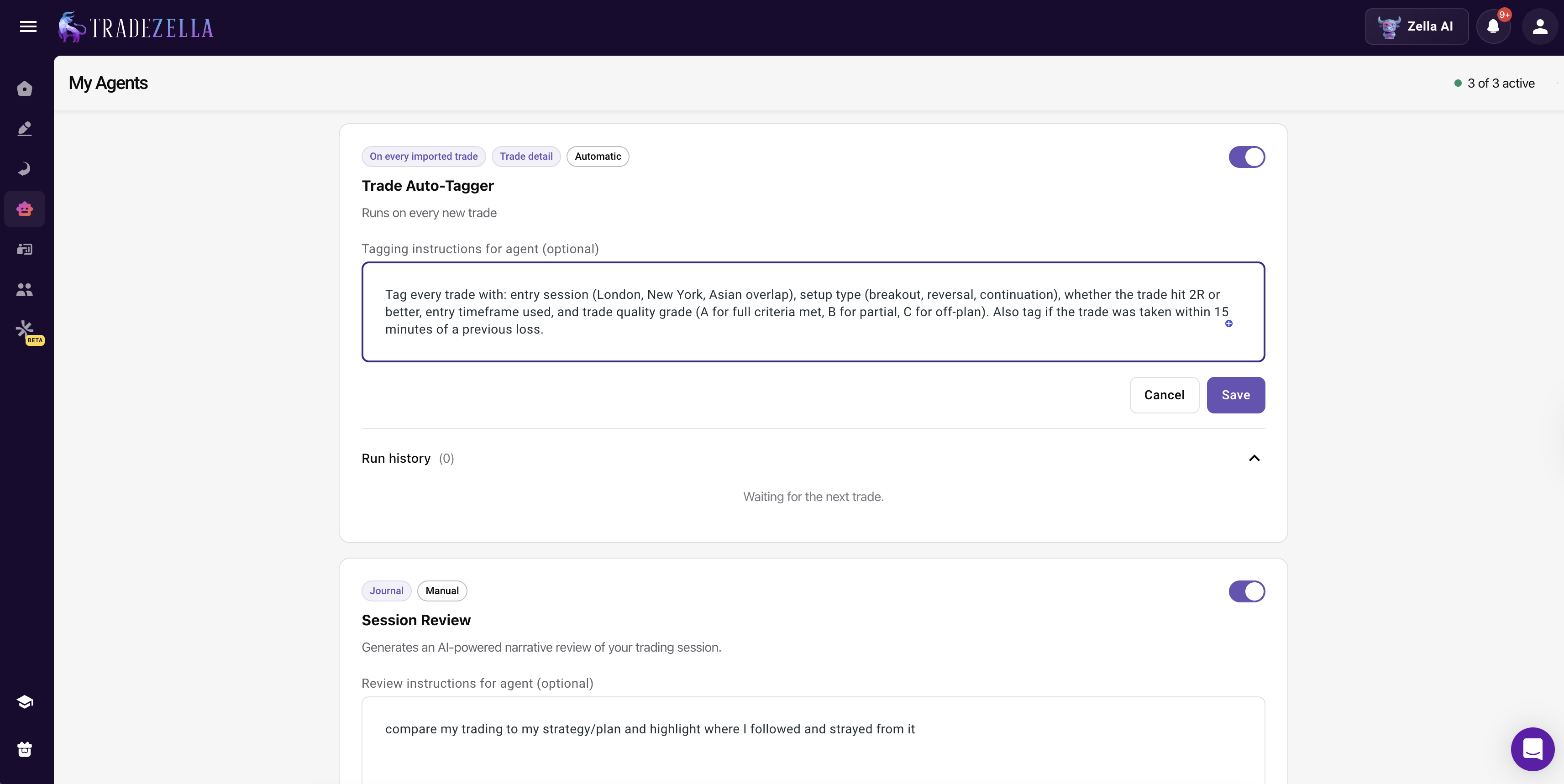
Risk management in Phase 1 is conservative. Take your best setups. Follow your strategy strictly. In TradeZella, Zella AI's Auto Trade Tagger tags each trade automatically based on rules you define, so you can see exactly which Strategies are building your buffer without doing any manual work after the session.
Zella AI Agent Auto Tagger
Why does this matter? Because Phase 2 will test you.
Most traders want to hit their profit target immediately. They size up early. They take lower-probability trades hoping to accelerate. This is how they blow up. Build the buffer first. You have 30-60 days. You don't need to hit 8% in the first week.
Phase 2: The Survival (Days 6-20)
Phase 2 is psychological warfare. You've built a small gain, and now the market will test whether you can keep it.
Some traders will see a losing streak here. You might drop from up $300 to up $150 to breakeven to down $100. This is normal volatility. This is where discipline matters.
In Phase 2, your goal isn't to grow the buffer. It's to preserve it. Reduce your position size. Tighten your stops. Trade only your highest-conviction setups. Many traders make their Phase 2 profit target achievement, but they take bigger risks to do it. Don't.
If you're down 2-3% in Phase 2, don't panic. You still have 30-40 days left. The math is still in your favor if you have an edge.
If you're down 6-7% (close to max drawdown), it's time to step back. TradeZella's Prop Firm Sync dashboard shows your drawdown in real time with the Challenge widget, so there is no guessing. Zella AI's Session Review will also flag if your recent sessions show a pattern of increasing risk, which is the most common drawdown accelerator during Phase 2.
Phase 3: The Execution (Days 21+)
By Phase 3, you've proven you can survive. Now you can trade with confidence.
You're either close to your profit target or you need a final push. Your buffer is (hopefully) still intact. Position size can increase slightly, but not dramatically. You're 80% of the way there. Don't blow it by taking unnecessary risks in the final stretch.
Many firms see a jump in trader failures in the final week. Traders get impatient. They take a big position thinking "this is my last chance." The market moves against them. They lose 3% in two days and fail.
Don't do this. In Phase 3, trade the same way you traded in Phases 1 and 2. The target will come if your edge is real. TradeZella's Prop Firm Sync shows your exact progress toward the profit target, so you can see how close you are without doing the math yourself. Zella AI's Market Sentiment Briefing agent builds your pre-market plan based on how you trade, your assets, and the setups you look for, so each session in Phase 3 starts with a clear plan instead of emotional pressure to close the gap.
Why Do Most Traders Fail Prop Firm Challenges?
Understanding the rules and phases isn't enough. You also need to know what specific behaviors blow up accounts.
Killer #1: Revenge Trading After a Drawdown
You take a loss. It stings. The next trade comes up, and instead of following your normal position size, you take 1.5x or 2x the size "to make it back."
This is the #1 killer in prop firm challenges.
Here's what happens: your normal edge is 52% win rate, 1.5:1 reward-to-risk. You're supposed to make money over 100 trades. But if you take a bigger position after losses, you're violating the math. You're introducing variance.
Over 100 normal-sized trades at 52% win rate with 1.5:1 RR, you make money. But on trade 15, after a loss, you double size. You lose again. Now you're down 2% instead of 1%, and your psychology is damaged.
The rule: position size never changes based on recent P&L. Zella AI's Session Review catches this automatically. It compares your position sizes across the session and flags when you deviated from your normal range, so revenge trading behavior shows up in your review before it costs you the challenge. If you want to understand why this pattern happens and how to break it, read our guide on emotional trading.
Killer #2: Oversizing to Hit Target Faster
You're at day 20 of 40. You're up 3% and need 5% more to hit target. You have 20 days left. You should be fine.
But impatience creeps in. You think: "If I just take bigger positions, I can hit 8% by day 25." So you trade 1.5x your normal size.
Now your daily loss limit of $1,000 means you can only take 2-3 losses before you're locked out. Your edge still assumes 5+ trades per day with room for losers.
You hit your daily loss limit by noon on day 22. Then again on day 24. By day 28, you've been locked out 4 times, and you're back to up 1%. Now you have 12 days to make up 7% and you're rattled.
Don't oversize to accelerate. If you have an edge, time is your friend. Your profit factor will compound naturally over enough trades. Zella AI tracks your profit factor by Strategy, so you can see exactly which setups are doing the compounding and which are dragging you down.
Killer #3: Trading Outside Your Strategy
You have a strategy. It works. It's designed around the 15-minute timeframe, support/resistance levels, and specific economic news.
Day 10, you see a stock making a big move. You haven't tested this stock in your strategy. You don't know how it reacts to volume. But FOMO hits. You take a trade.
You lose. Then you take another trade on the same stock thinking you can catch the bounce. You lose again.
You just burned $600 of your $1,000 daily loss limit on trades that weren't in your strategy.
The challenge isn't the place to experiment. It's the place to execute what you already know works. If you want to test new setups, use backtesting first. Stay in your lane. In TradeZella, every trade is tagged to a Strategy by the Auto Trade Tagger. If you take a trade that does not match any of your setups, it stands out immediately in your analytics, and Zella AI's Session Review will flag it as off-plan in your daily review.
Killer #4: Ignoring Daily Loss Limits
The daily loss limit exists. Your firm will enforce it. You will get locked out.
Some traders think the limit is negotiable. It's not. Some traders think they can "make an exception" on a big opportunity. They can't.
Once you hit your limit, you're done. No exceptions. No negotiation. Respect the rule from day one.
TradeZella's Calendar view and Prop Firm Sync dashboard show your running P&L against your daily limit, so you always know exactly how close you are. If you find yourself hitting the limit repeatedly, that is a sign of trading tilt, not bad luck.
How Do You Track Your Prop Firm Challenge Progress?
The single biggest advantage traders have during challenges is accurate data on their progress.
If you're trading without tracking, you are flying blind. You do not know if you are on track to pass. You do not know which parts of your strategy are working and which are not. You are making decisions based on gut feeling and recent results, which creates the revenge trading problem.
1. Daily P&L vs. Daily Limit: Every single day, log your net profit or loss and compare it to your daily limit. If you can trade, trade up to your limit. If you're locked out, mark it. Over 30 days, this tells you how often you're hitting your limit (if it's more than once a week, you're oversizing).
2. Peak Equity and Current Drawdown: Track this weekly. Peak equity is your highest point so far. Drawdown is how much you're down from that peak. If you're at 6% drawdown with 12% max allowed, you have room to trade harder. If you're at 10%, it's time to reduce size.
3. Profit Target Progress: This is obvious, but track it. If you need 8% profit and you're at day 20 of 40, you should be at least 2-3% by now. If you're at 0%, you're behind.
4. Trade-by-Trade Data: For each trade, log the setup, entry, exit, P&L, and which part of your strategy it came from. Over 30-50 trades, patterns emerge. Which setups win more often? Which timeframes work best? Which days of the week are you sharper? Tracking R-multiples per trade makes this even clearer.
TradeZella is built exactly for this. Import your trades through direct broker connections or CSV upload, then use Prop Firm Sync to map each trading account to its evaluation. You can see daily P&L, drawdown, and progress to target in one dashboard across multiple accounts. Zella AI's Auto Trade Tagger organizes every trade by Strategy automatically, and the Session Review agent compares your plan against your actual results at the end of each session. After a few weeks, you have a complete picture of which setups are profitable, which sessions cost you money, and whether your trading discipline is holding up under challenge pressure.
Not sure if prop firm trading is worth the cost? Use the free Prop Firm ROI Calculator to run a Monte Carlo simulation on your expected returns before committing to a challenge.
This data becomes your competitive advantage. While other traders are guessing, you're making decisions based on what actually happened.
Weekly Review:
Every Sunday (or end of trading week), spend 30 minutes reviewing:
Am I on track for the profit target?
Which strategies are winning?
How many times did I hit my daily loss limit? Why?
What's my current drawdown and how much room do I have?
What's my plan for next week?
Zella AI makes this review faster. The Session Review agent already answers most of these questions after every session. Your weekly review becomes a 15-minute check on the patterns Zella AI flagged during the week, not a 60-minute data dig. For a full walkthrough of the review process, read our trade review process guide.
If you're behind on the profit target, don't panic. Adjust your approach. Maybe you need to focus on your highest-win-rate setup only. Maybe you're trading too frequently and noise is killing you. The data will tell you.
What Happens After You Pass a Prop Firm Challenge?
You passed. You hit the profit target. You got approved for a funded account.
Now the real work begins.
A funded account is not a bigger challenge. It's a different challenge. The rules change. The psychology changes. Your account size changes.
Rule Changes:
Most prop firms keep similar daily loss limits and maximum drawdown caps, but they add new elements:
Holding requirements: You may need to hold overnight positions and face wider swings.
Scaling: Some firms automatically scale up your account size if you hit targets on a smaller account (pass with $25K, get scaled to $50K, then $100K).
Minimum monthly profit requirements: Instead of hitting a target once, you need to make a minimum amount each month to keep your account.
Profit splits: You earned the account. Now the firm takes a cut of your profits (typically 30-50%, you keep 50-70%).
Psychology Changes:
Challenges are temporary. Funded accounts are ongoing. You can't just grind for 40 days and coast.
Many traders pass challenges and then lose it all in the first month of a funded account because they stop being disciplined. No daily loss limit mentality anymore. They start revenge trading. They start oversizing.
Wrong move.
A funded account requires the same discipline you showed in the challenge, except now you do it every month, indefinitely. Your daily loss limit should still exist (internally, if not firm-imposed). Your position sizing should still be calibrated to your edge.The only difference is that you now have a profit-generating asset. This is the whole point. You proved it works. Keep doing it.
TradeZella's Prop Firm Sync works for funded accounts too, tracking your ongoing daily limits, drawdown, and monthly performance across multiple funded accounts in one dashboard. Zella AI becomes even more valuable on funded accounts because the Session Review agent catches behavioral drift over time, not just day to day. The patterns that slowly erode funded accounts (size creep, schedule expansion, skipping reviews) show up in Zella AI's analysis before they show up in your P&L. For the full toolkit, read our guide on tools every funded trader needs.
Scaling Path:
Most traders don't stay on their first funded account size forever. If you pass a $25K challenge and get a funded $25K account, you'll eventually want to scale to $50K or $100K.
This requires hitting monthly targets consistently. Three months of 5%+ returns, and many firms will offer to scale you.
When you scale, don't change your approach. Use the same position sizing formula. If you made 5% on $25K by risking $200 per trade, make 5% on $50K by risking $400 per trade. The scale is proportional. Your edge doesn't change because the account is bigger.
Key Takeaways
Prop firm challenges are risk management tests, not trading tests. Passing isn't about finding winning trades; it's about surviving the rules long enough to prove your edge.
Position sizing is everything. Calculate your daily loss budget, then size positions so that you can take 5-10 trades and survive even if 2-3 lose. This is non-negotiable.
Hit your daily loss limit and stop trading. No recovery attempts, no "one more trade." The daily limit is a hard rule.
Trade in three phases: Setup (days 1-5), Survival (days 6-20), Execution (days 21+). Each phase has a different goal and risk profile.
Avoid the four challenge killers: revenge trading, oversizing for speed, trading outside your strategy, and ignoring daily limits.
Track everything. Daily P&L, drawdown, profit progress, trade-by-trade data. TradeZella's Prop Firm Sync tracks challenge metrics across all your accounts, and Zella AI's agents handle tagging, session reviews, and pre-market planning automatically.
Don't change your approach after passing. A funded account requires the same discipline as the challenge, just longer-term and with higher stakes.
Frequently Asked Questions
How long does it usually take to pass a prop firm challenge?
Most traders pass between 15-35 days. The 30-60 day window exists because you don't need to hit the target immediately. You need to prove consistency. If you have a real edge, 15-20 days is typical. If you're in month 2 still grinding, it might be time to reassess whether the edge is there, or whether your psychology is the limiting factor. TradeZella's Prop Firm Sync tracks your daily progress so you can see if you're on pace.
What's the best trading strategy for prop firm challenges?
The best strategy is the one you've already tested and know works. Most prop firms don't care if you day trade, swing trade, or trade multiple timeframes. They care that you're consistent and don't violate the rules. If your edge is 52% win rate with 1.5:1 reward-to-risk, that works. If it's 40% win rate with 3:1 reward-to-risk, that also works. The strategy doesn't matter. Execution and discipline do. Whatever strategy you use, track it in TradeZella so you can see your actual win rate, average R, and profit factor across your challenge trades.
Can I use a trading journal for prop firm challenges?
Absolutely. In fact, you should. A journal that tracks daily P&L, drawdown, trade-by-trade results, and strategy performance turns your challenge into a learning tool, not just a grind. TradeZella is purpose-built for this. Its Prop Firm Sync feature connects directly to your challenge account, tracks your progress against the firm's rules in real time, and shows you exactly which setups are profitable and which are costing you. You can see daily P&L vs. your daily loss limit, current drawdown vs. maximum allowed, and progress toward your profit target all in one dashboard. Use the free Prop Firm ROI Calculator to model your expected returns before you start.
What happens if I fail a challenge? Can I try again?
Most firms allow you to retry. You typically lose the fee for the first attempt, but you can buy another challenge. Some traders fail their first attempt because of psychological pressure or because they discover their edge isn't as strong as they thought. Failing isn't the end. Review the data, adjust your approach, and try again. TradeZella keeps your full trade history from the failed attempt, so you can analyze exactly where things went wrong: which setups lost money, when you hit your daily limits, and what your drawdown curve looked like. Many traders pass on their second or third attempt because they use this data to fix specific weaknesses.
How is a funded account different from a challenge?
Funded accounts don't have a fixed profit target to hit. Instead, you have minimum monthly profit requirements and ongoing drawdown limits. You're trading indefinitely, not for 30-60 days. The psychological pressure is different because it's long-term. The reward is also different: you're not trying to earn an account anymore. You're earning an income. TradeZella supports funded account tracking with the same Prop Firm Sync features, so your daily limits and drawdown monitoring carry over seamlessly.
Still choosing which firm to apply to? Read our full prop firm trading guide for a breakdown of the top firms, their fee structures, and what to look for.
Need to check your risk-to-reward ratio before entering a trade during your challenge? Use the free calculator to make sure the math works before you click buy or sell.
Can AI help you pass a prop firm challenge?
AI cannot trade for you, but it can catch the behavioral mistakes that fail most challenges. Zella AI tags every trade automatically based on rules you define, reviews each session against your morning plan, and flags when your position sizing or rule adherence deviates from your normal patterns. The traders who fail challenges usually know their strategy works. They fail because of revenge trading after a loss, oversizing to hit targets faster, or drifting from their plan under pressure. Zella AI catches these patterns in your first session review, not after you have already blown the account. Read our full guide on how AI helps prop firm traders for a deeper breakdown.



.png)

