Trading 201: The Skills That Actually Separate Profitable Traders
Trading 201: The Skills That Actually Separate Profitable Traders
You know the basics. Now learn what actually makes traders profitable: finding your edge with data, eliminating behavioral leaks, building measurable strategies, and creating the feedback loops that turn experience into consistent results.
class SampleComponent extends React.Component {
  // using the experimental public class field syntax below. We can also attach
  // the contextType to the current class
  static contextType = ColorContext;
  render() {
    return <Button color={this.color} />
  }
}
Trading 201: The Skills That Actually Separate Profitable Traders
You've learned the basics. You know what a candlestick is, how to place orders, and that risk management matters. And you're still not consistently profitable. That's normal, and it's not a knowledge problem.
Last updated: March 2026
The gap between "understanding trading" and "making money trading" isn't filled by more YouTube videos or strategy PDFs. It's filled by the skills no course teaches: identifying your real edge, eliminating behavioral leaks, and building the feedback loops that turn experience into actual improvement.
In this guide, you'll learn what separates traders who plateau from traders who break through, and the specific tools and habits that make the difference.
In This Guide
TL;DR: Most traders plateau because they keep adding knowledge instead of building feedback loops. The traders who break through are the ones who measure their edge with data, tag their behavioral patterns, and review their performance systematically. TradeZella's 50+ analytics reports, strategy playbooks, and trade replay make these habits practical, not theoretical.
Why Most Traders Plateau After Learning the Basics
There's a specific pattern that traps intermediate traders. You've moved past the beginner mistakes, random entries, no stop-losses, position sizes based on gut feel. You have strategies. You have rules. And you still give back profits in frustrating cycles.
The problem isn't what you know. It's the gap between what you know and what you consistently do. Here's why traders get stuck:
The traders who break through this plateau all share one thing: they stopped guessing about their performance and started measuring it.
Finding Your Actual Edge (Not the One You Think You Have)
Your edge isn't a strategy you read about online. It's a statistical pattern in your execution, the specific conditions under which you make money consistently, after accounting for enough trades to matter.
Most traders believe they know what works for them. The data usually disagrees. Here's how to find your real edge:
Calculate Your Expectancy
Expectancy tells you how much you can expect to make per trade on average. The formula:
Expectancy = (Win Rate × Average Win) − (Loss Rate × Average Loss)
Example: If you win 45% of trades with an average gain of $300, and lose 55% with an average loss of $150:
A positive expectancy means your strategy makes money over time. A negative one means you're slowly bleeding, regardless of how good individual trades feel.
Why Win Rate Alone Is Meaningless
A 70% win rate sounds impressive until you realize the average winner is $100 and the average loser is $400. That's a losing strategy. Conversely, some of the best traders win only 35-40% of the time but their winners are 3-5x larger than their losers.
What matters is the relationship between win rate and reward-to-risk. That's why R-multiples, measuring each trade's outcome as a multiple of your planned risk, are more useful than dollar P&L.
Segment Your Performance
Your overall stats hide the real story. You need to break your performance down by:
TradeZella's 50+ analytics reports handle this segmentation automatically. Connect your broker, tag your trades, and the platform breaks down your performance across every dimension, revealing which setups actually have positive expectancy and which ones just feel good in the moment.
The Three Patterns That Cost Traders the Most
Mistake
What Happens
Why It's Destructive
Revenge Trading
After a loss, your brain wants to make it back immediately, leading to larger position sizes and lower-quality setups.
Losses compound rapidly as emotional decision-making replaces disciplined execution.
FOMO Entries
You see a move happening without you and jump in late, driven by urgency rather than a valid setup.
These trades statistically fail because you're chasing extended moves with poor risk-to-reward.
Early Exits on Winners
Fear of giving back profits causes you to close winners too early while holding losers in hope of recovery.
This inverts your R-multiples and systematically destroys your edge over time.
Building a Strategy You Can Actually Measure
"Buy the dip" isn't a strategy. "Go long when RSI is below 30" isn't either, it's a signal without a plan. A testable strategy has five components:
Document each strategy as a playbook, a written set of rules you can review before trading and audit afterward. Keeping strategies in your head guarantees inconsistent execution.
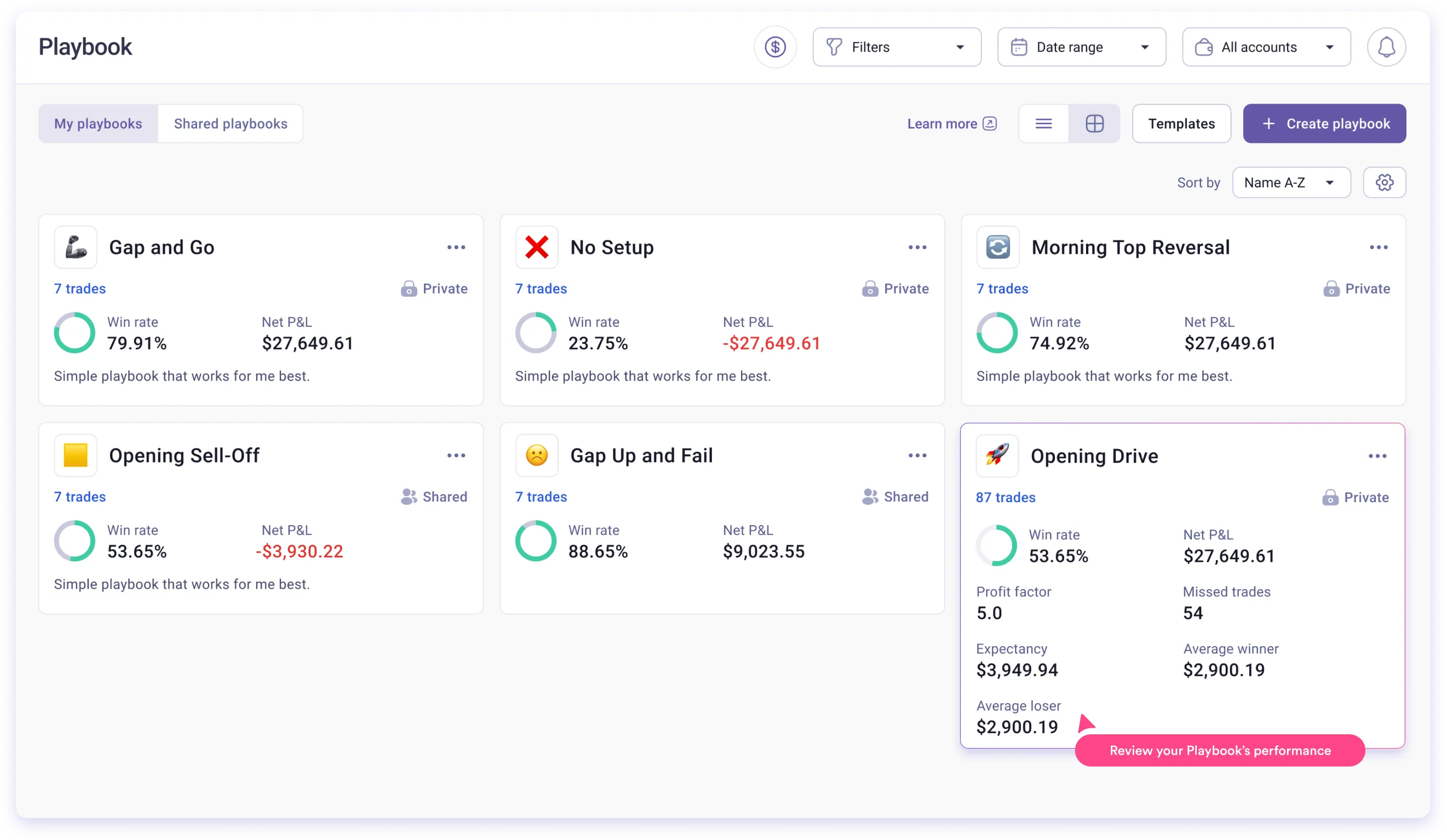
TradeZella's Playbooks feature lets you standardize your entry and exit rules, attach notes and images, and then track performance per playbook over time. When you tag trades with their strategy, the platform shows exactly which playbooks make money and which ones you should retire.
The Weekly Review That Actually Changes Your Trading:
Most traders who journal still don't improve, because they log and forget. The weekly review is where improvement actually happens. Here's the process:
This takes 30 minutes. It's the highest-ROI 30 minutes in your trading week.
Backtesting: Proving Your Edge Before Risking Capital
Backtesting lets you validate a strategy on historical data before trading it live. But most traders do it wrong, and end up with false confidence in strategies that fail in real conditions.
The Missing Step: Forward Testing
After backtesting, most traders jump straight to full-size live trading. The smarter approach:
TradeZella's integrated backtesting draws on 11+ years of historical data, and Trade Replay lets you review historical setups tick-by-tick, seeing exactly how price moved, with time and sales data and Level 2 market depth.
Frequently Asked Questions
How many trades do I need before I can trust my data?
At minimum, 30-50 trades per setup for any directional signal. Fewer than that and random variance dominates. Key thresholds:
This is per setup type, not overall. Knowing your total win rate across all strategies tells you almost nothing useful.
Should I trade multiple strategies or master one first?
Master one first. Adding strategies before proving edge in your primary approach divides your attention and muddies your data. Once one strategy has a proven positive expectancy 50+ trades, you can begin developing a second. Think of it like a business, profitable businesses don't diversify before their core product works.
How do I know if my edge is gone or I'm just in a drawdown?
Compare your current drawdown to historical ones. If your worst losing streak is 8 trades and you're currently at 7, you're within normal variance. If you're at 15, something may have changed. Key signals that edge has degraded:
TradeZella's analytics let you compare current performance windows against your historical baseline, making this judgment data-driven rather than emotional.
What's the fastest way to improve as a trader?
Weekly reviews with specific action items. Not more screen time, not more courses, not more indicators. The traders who improve fastest are the ones who:
This feedback loop, trade, tag, review, adjust, is what separates traders who accumulate years of experience from traders who accumulate one year of experience repeated over and over.
How much should I risk per trade as an intermediate trader?
1-2% of your trading account per trade remains the standard, regardless of experience level. What changes as you advance is how precisely you calculate it:
The goal is surviving long enough for your edge to play out. One oversized loss can erase weeks of disciplined gains.
Key Takeaways
Trading 201 isn't about learning more strategies. It's about building the systems that turn your existing knowledge into consistent execution:
The traders who break through the intermediate plateau aren't smarter or more disciplined. They just built better feedback loops. TradeZella's automated journaling, 50+ analytics reports, strategy playbooks, and trade replay give you the infrastructure to build those loops, so your experience actually compounds into improvement.