AI Trading Agents: How AI Does the Work Traders Skip (So You Can Focus on Trading)
AI Trading Agents: How AI Does the Work Traders Skip (So You Can Focus on Trading)
AI trading agents handle the work most traders skip: tagging trades, reviewing sessions, and building pre-market plans. This guide explains what AI agents actually do, how they differ from chatbots, and how TradeZella's Zella AI agents automate the entire post-trade workflow.
class SampleComponent extends React.Component {
  // using the experimental public class field syntax below. We can also attach
  // the contextType to the current class
  static contextType = ColorContext;
  render() {
    return <Button color={this.color} />
  }
}
Last Updated: May 28th, 2026
An AI trading agent is a piece of software that performs specific trading tasks on its own, without waiting for you to ask. Unlike a chatbot that answers questions when prompted, an agent runs in the background. It tags your trades the moment they close. It reviews your session against your rules. It builds a pre-market plan based on how you actually trade. You configure it once, and it works every day after that.
The concept is simple: most traders know what they should do after a trading session. Review the trades. Tag the setups. Check if they followed their rules. Write down what happened. But most traders skip it. Not because the work is hard, but because it is boring, repetitive, and easy to put off after a losing day. AI trading agents exist to handle exactly that work, consistently, every single session, whether you feel like it or not.
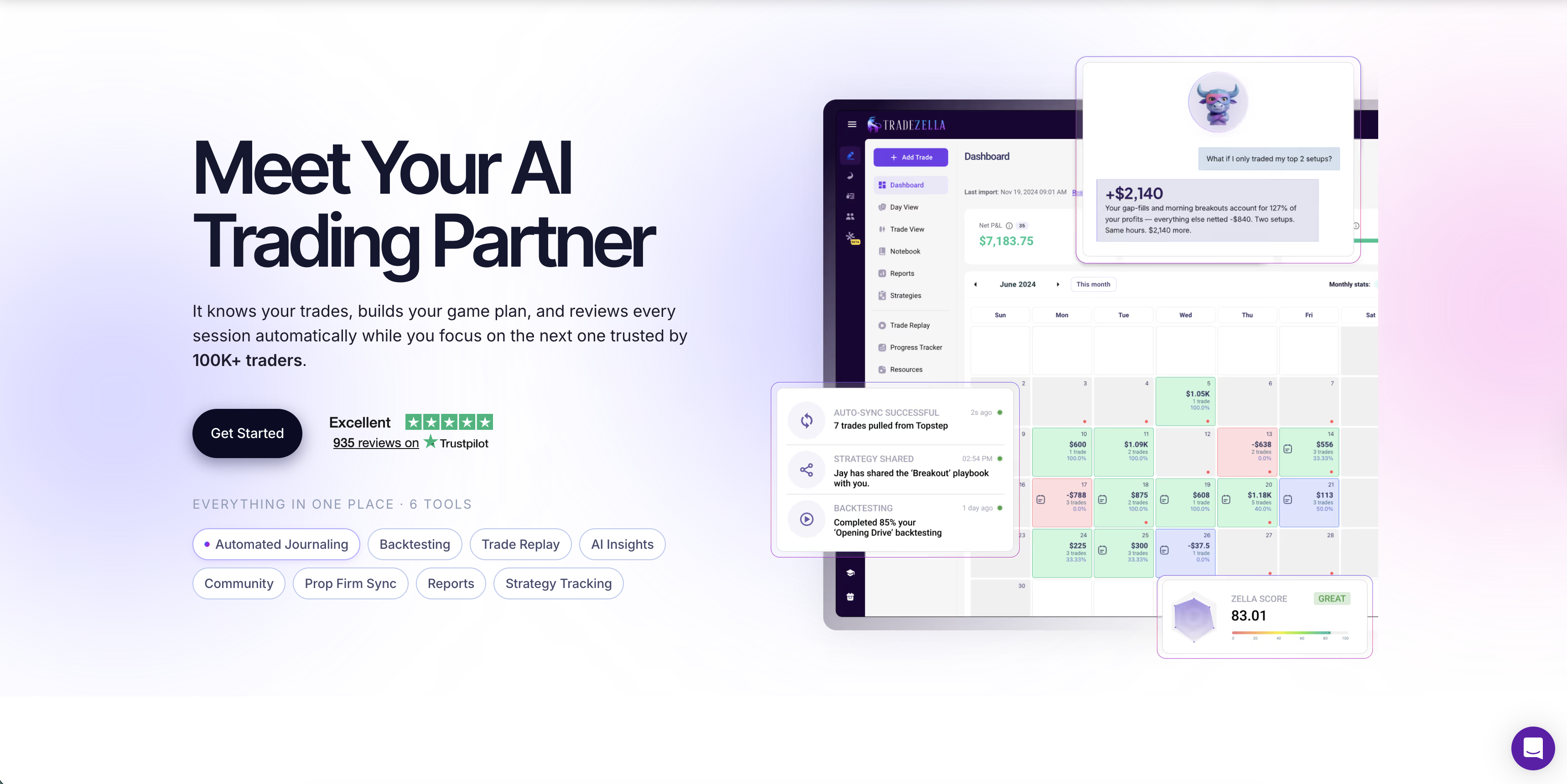
TradeZella's Zella AI is the first AI trading partner built around this agent model. Instead of offering a chat window that answers generic questions, Zella AI deploys agents that take action on your data. They tag, review, plan, and journal for you. This guide explains what AI trading agents actually do, how they differ from chatbots, and how to put them to work in your daily trading routine.
Zella AI Your AI Trading Partner
Why Do Traders Need AI Agents?
The gap between knowing and doing is where most traders lose money. Every trader understands that reviewing trades matters. Every trader knows that consistent tagging reveals patterns. But the data tells a different story.
Studies on trader behavior show that manual journaling compliance drops below 40% after the first month. When a trader loses $1,500 on a Wednesday, the last thing they want to do that evening is write a detailed review of exactly what went wrong. So they skip it. Then Thursday arrives, and they trade the same pattern with the same mistake, because the data that would have flagged it was never recorded.
On a $50,000 account risking $500 per trade, skipping reviews for even two weeks means 20 to 40 trades go unexamined. If just three of those trades repeated a fixable mistake, like entering during your worst time window or oversizing after a loss, that is $1,500 in avoidable damage. Over a quarter, unreviewed trades can quietly cost 5% to 10% of account value.
AI agents fix this by removing you from the equation. The agent does not care if you had a bad day. It does not get tired, forget, or decide to "do it tomorrow." It runs the same process on every trade, every session, every week. That consistency is the entire point.
This is not about replacing your judgment. It is about making sure the data that informs your judgment actually gets collected, organized, and surfaced. You still make every trading decision. The agent handles the operational work around those decisions, the tagging, the reviewing, the plan-building, so your decisions are based on complete information instead of memory and gut feelings.
What Do AI Trading Agents Actually Do?
AI trading agents fall into three categories based on when they work in your trading day: before you trade, after you trade, and continuously in the background. Each category handles a different piece of the workflow that traders typically skip.
Pre-Session: Building Your Trading Plan
A pre-session agent creates a trading plan for the day based on how you actually trade. You configure it once with your style (ICT, order flow, supply and demand, price action), your assets (ES, NQ, specific stocks, forex pairs), and the factors you care about (economic calendar, higher timeframes, fair value gaps, order blocks, trendlines). When you start your day, the agent generates pre-market scenarios and a game plan tailored to your configuration.
This is not a generic market briefing pulled from a news feed. The agent builds the plan around your specific setup criteria. If you are an ICT trader who focuses on ES and NQ during the New York session, your pre-session plan covers the levels, scenarios, and conditions that matter to your approach. A swing trader watching AAPL and TSLA gets a completely different output.
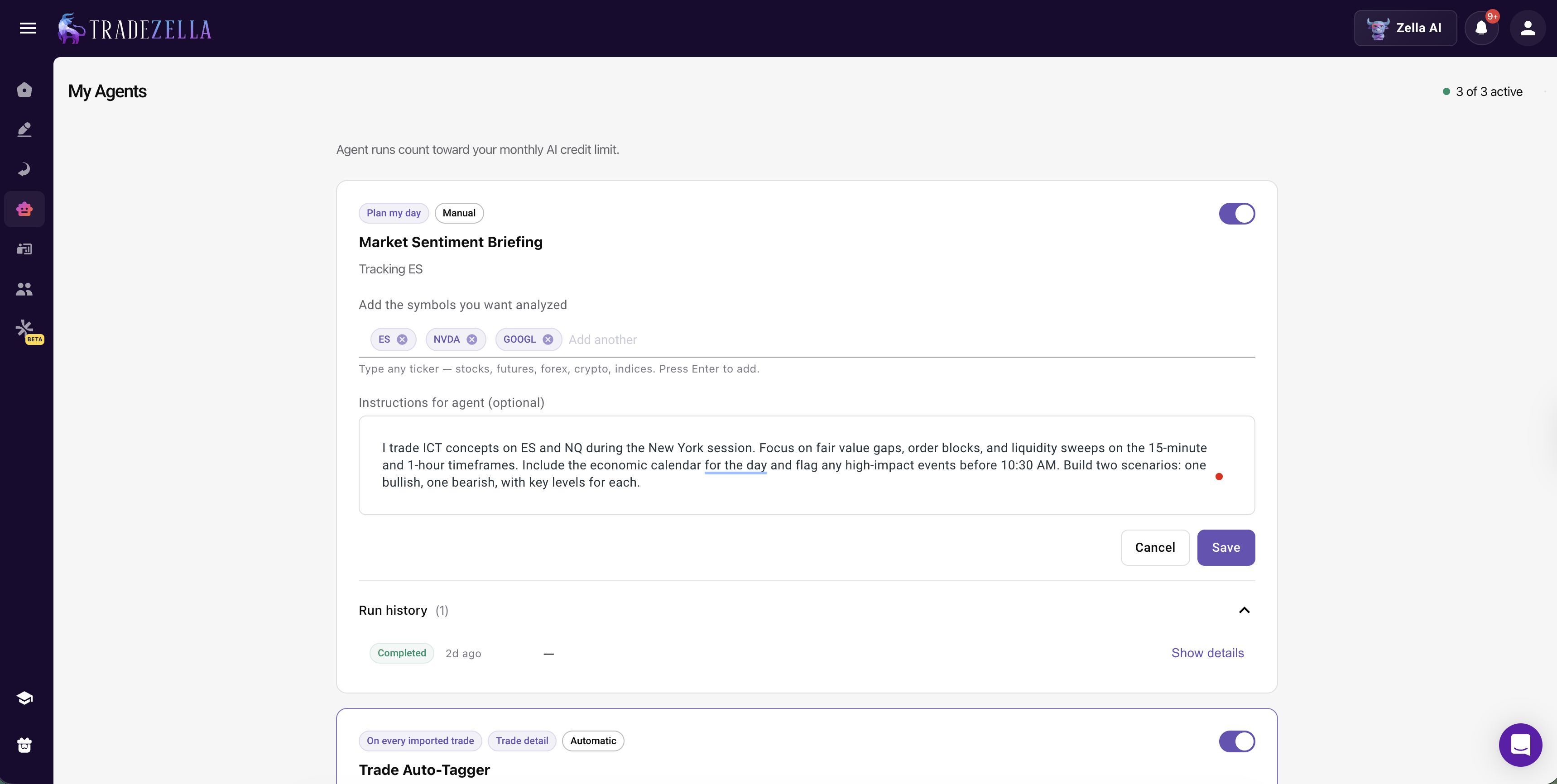
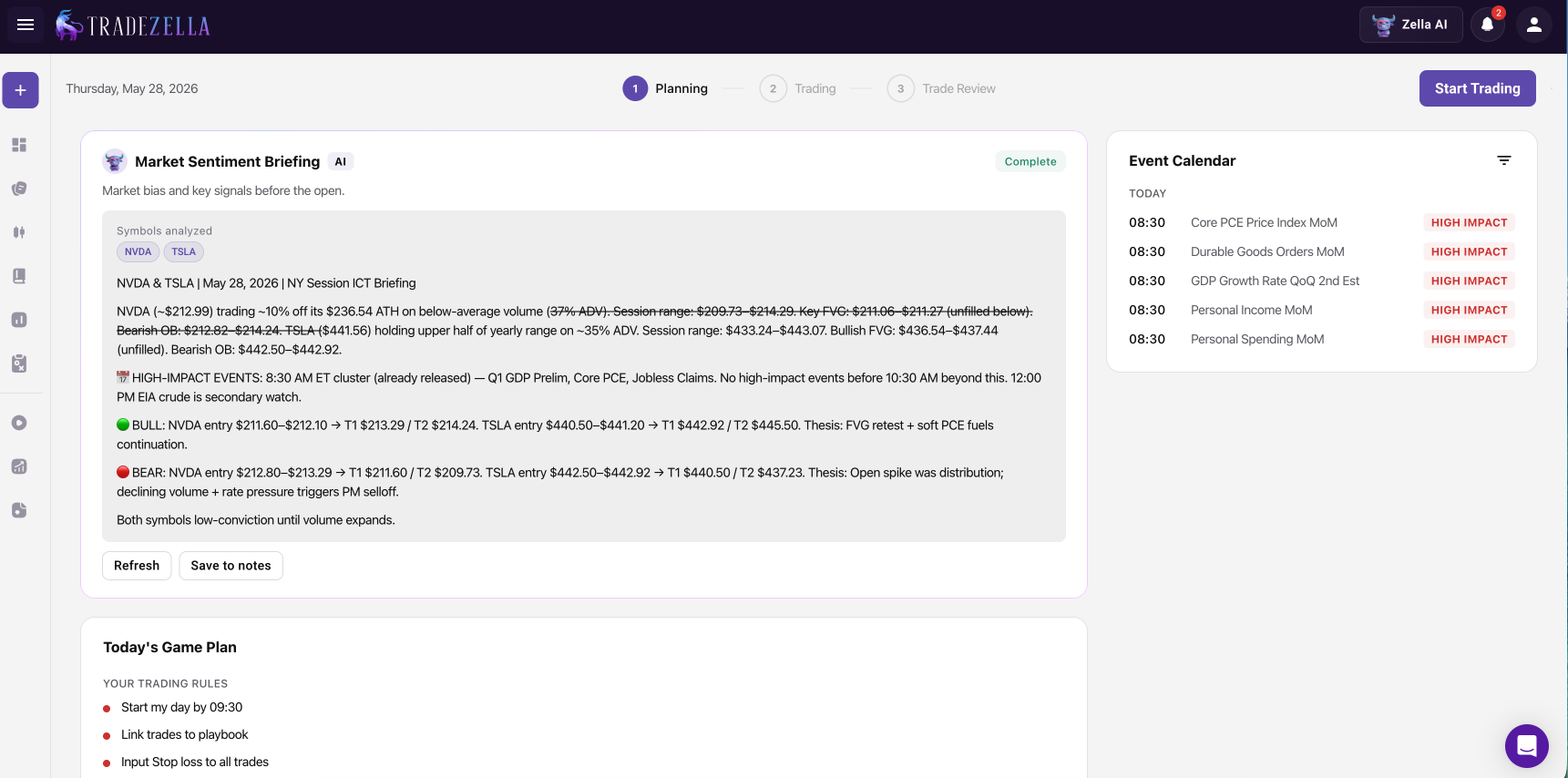
In Zella AI, this is the Market Sentiment Briefing agent. You configure it with how you trade, select your assets, and tell it what you look at. When you click "Start My Day," it creates pre-market scenarios and a trading plan based on your style and configuration. The plan becomes your anchor for the session, giving your Session Review agent something to compare your actual results against later.
Market Sentiment Briefing Agent
Post-Session: Reviewing and Journaling Your Trades
Post-session is where the biggest gap exists. Most traders close their platform and walk away. A post-session agent does the opposite: it reviews every trade from the session, compares your results against the morning plan, checks whether you followed your rules, identifies what worked and what did not, and journals the entire day for you.
On a $50,000 account, consider what a post-session review catches. You planned to risk $500 per trade but averaged $680 on your last five trades. Your win rate on morning entries was 62%, but your afternoon trades dropped to 38%. You took a revenge trading entry 12 minutes after your largest loss. A human reviewing this might notice one of these patterns. The agent catches all of them, every session, automatically.
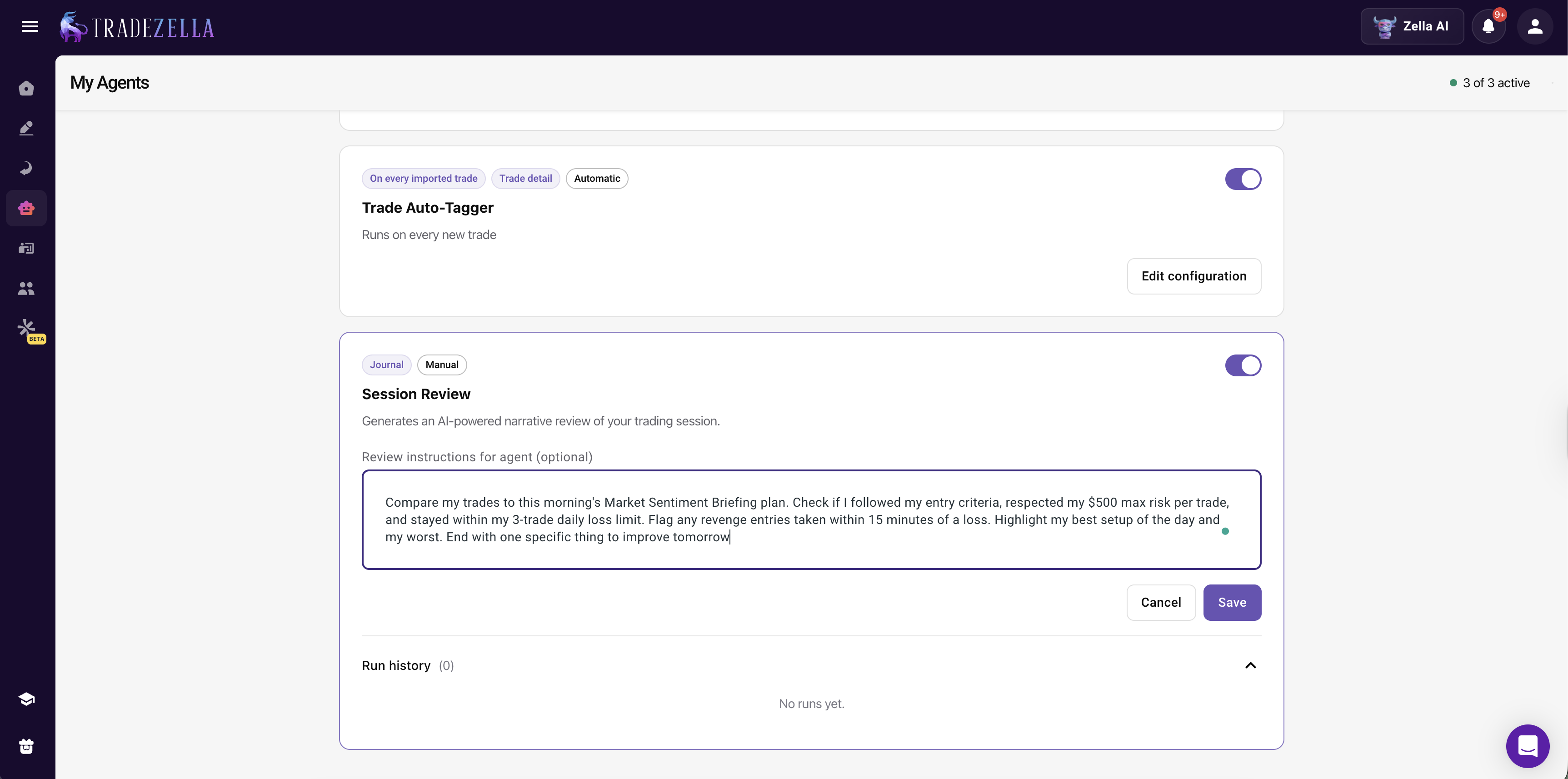
Zella AI's Session Review agent handles this. It automatically reviews your trading day after you finish. It compares your morning plan from Start My Day against your actual results. It checks rule adherence, what went well, what did not, and how to improve. You customize what it emphasizes: rule adherence, deviations from plan, sizing consistency, emotional patterns. The output is a complete session journal you did not have to write.
This connects directly to your trade review process. The difference is that manual reviews depend on you showing up. The agent review happens whether you show up or not.
Session Review Agent
Ongoing: Tagging Every Trade Automatically
Tagging is the most underrated part of trading improvement, and the first thing traders stop doing. Without consistent tags, your analytics are incomplete. You cannot filter by setup type, emotional state, market condition, or session timing if the data was never tagged in the first place.
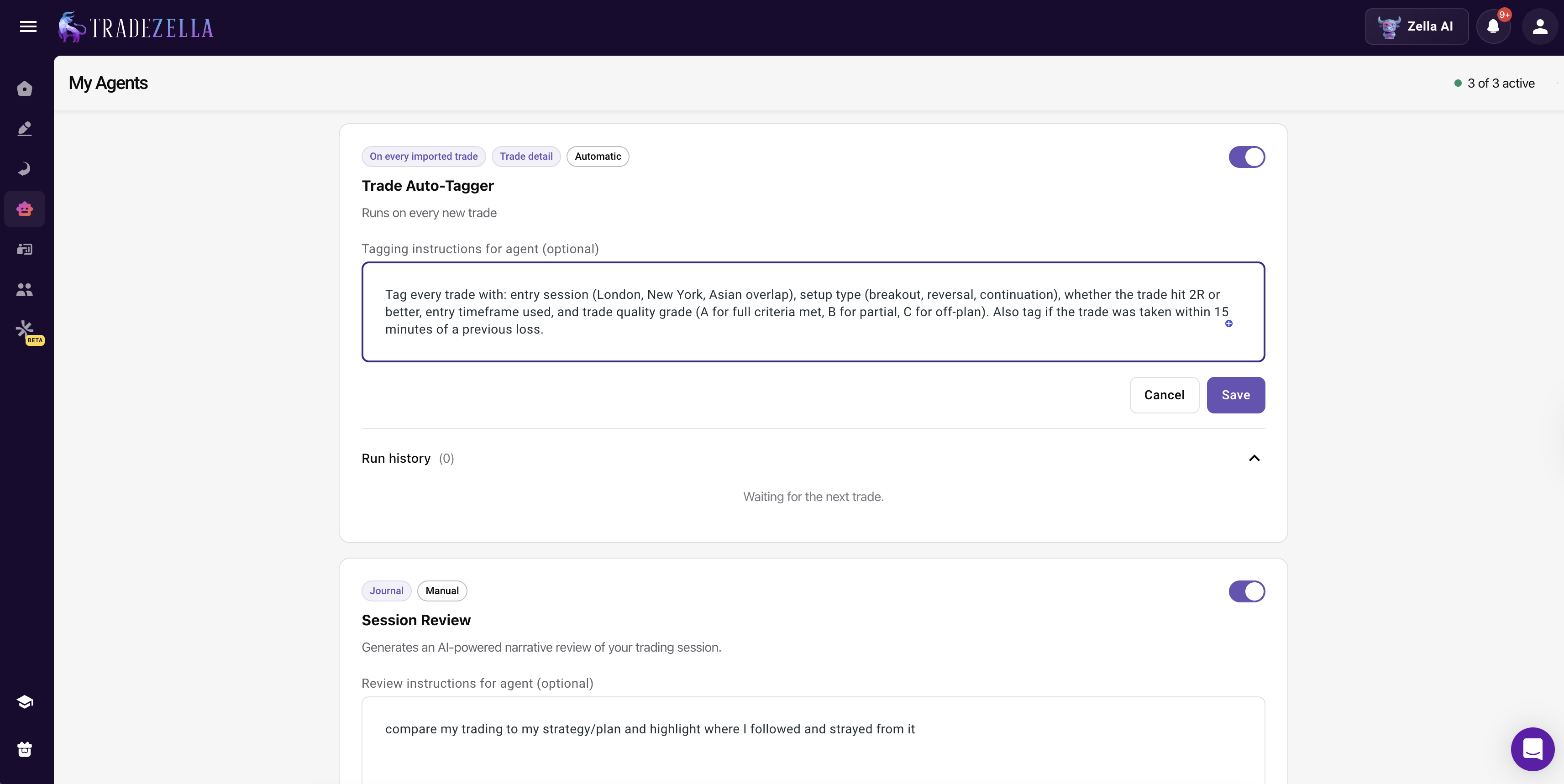
An auto-tagging agent applies tags to every trade based on rules you define. Examples: "If a trade went 2R, tag it as a winner." "Tag all trades by entry timeframe." "Tag whether SMT divergence was present." "Tag supply and demand concepts." "Tag the session (London, New York, Asian)." You set the criteria once, and the agent applies them to every trade that comes in.
Zella AI's Auto Trade Tagger does exactly this. You set up your tagging criteria and rules. The agent applies tags automatically to every trade based on those rules. This is how you collect clean, consistent data without spending 10 minutes per trade doing it manually. Over 100 trades, that is 16 hours of manual tagging replaced by zero effort.
Clean tags feed everything downstream. Your win rate by setup becomes reliable. Your profit factor per session is accurate. Your R-multiple tracking reflects reality instead of whatever you remembered to log. When you sit down for a weekly review using your trading dashboard, the data is already there, filtered and ready.
Trade Auto Tagger Agent
How Are AI Agents Different from Chatbots?
This distinction matters because most "AI trading tools" are chatbots with a trading skin. You type a question, you get an answer. That is useful for research, but it does nothing for your daily workflow. The moment you close the chat window, nothing changes in your data.
A chatbot waits for you to ask. An agent acts on its own. A chatbot gives you information. An agent changes your data. A chatbot forgets your last conversation (unless it has memory). An agent remembers your rules, preferences, and history across every session.
Here is the practical difference on a $50,000 account:
With a chatbot: You finish trading. You open the chat. You type "Review my trades today." The chatbot asks for details because it cannot see your trades. You paste in some data. It gives a generic analysis. You close the tab. Tomorrow you do not bother asking, because the friction was too high.
With an agent: You finish trading. The Session Review agent has already pulled your trades, compared them to your morning plan, checked your trading discipline score, tagged every trade, and written a session journal. You open TradeZella and the review is waiting for you. No prompting, no copy-pasting, no effort.
The difference is not intelligence. Modern chatbots like ChatGPT and Claude are extraordinarily capable at reasoning. The difference is that they lack three things agents have: access to your actual trade data, the ability to take action on that data, and the consistency to do it every single day without being asked.
Zella AI includes both. You can have a conversation with Zella (it has memory across sessions, remembers your name, risk limits, Strategies, and trading style). But the agents are where the real value compounds. The conversational layer answers your questions. The agents do the work.
What Does an AI Trading Agent Workflow Look Like in Practice?
Here is what a complete agent-powered trading day looks like, step by step. This is based on how Zella AI agents work inside TradeZella.
7:00 AM: Start My Day. You open TradeZella and click "Start My Day." The Market Sentiment Briefing agent generates your pre-market scenarios and trading plan. It builds this around your configured style, your assets, and the factors you told it matter. Five minutes, and your plan is ready.
TradeZella Agent
9:30 AM to 4:00 PM: You trade. Focus on execution. No journaling during the session. No tagging between trades. Just trading.
4:01 PM: Agents take over. The moment your session ends:
The Auto Trade Tagger applies your configured tags to every trade from the session. Setup type, entry timeframe, whether your criteria were met, emotional markers if you defined them.
The Session Review agent compares your morning plan against your actual results. It checks whether you followed your rules, flags any deviations, and writes a complete session journal.
4:15 PM: You review the output. You open TradeZella and your day is fully documented. Tagged trades, session review, plan-vs-result comparison. You spend 5 minutes reading instead of 30 minutes writing. If something stands out, you can ask Zella AI follow-up questions because it has memory of your entire history.
Sunday: Weekly review. You sit down for 30 minutes and analyze trading performance using a full week of agent-generated data. Every trade tagged. Every session reviewed. Your trading edge data is complete. You can filter by setup, by time, by session, by tag, because the agents collected everything consistently.
Compare that to a manual workflow. Without agents, you are spending 15 to 30 minutes per session on journaling. That is 75 to 150 minutes per week just on data entry. Most traders stop doing it by month two. With agents, data entry drops to zero and compliance stays at 100%.
What Can AI Agents See That You Cannot?
Agents do not just collect data. Because they process every trade consistently, they surface patterns that are invisible to manual review.
Time-of-day patterns. Your win rate might be 58% overall, but the agent shows it is 71% before 11:00 AM and 39% after 2:00 PM. On a $50,000 account risking $500 per trade, trading only your best hours could save $3,000 to $5,000 per quarter in avoidable losses.
Strategy drift. You defined a breakout Strategy with specific entry rules. The agent tags every trade against those rules and shows that 30% of your recent trades deviated from the criteria. Your breakout Strategy has a 2.1 profit factor when you follow it and 0.7 when you do not. Without consistent tagging, you would never see this split.
Behavioral cascades. The agent detects that after a loss exceeding $750, you take a second trade within 15 minutes 68% of the time. Those revenge entries have a 29% win rate and average -1.3R. It flags the emotional trading pattern every time it appears, not just when you happen to notice it.
Edge concentration. Across 200 tagged trades, the agent shows that 80% of your profits come from just two setups traded in a specific three-hour window. Everything else is noise or slightly negative. This kind of trading edge discovery requires clean, complete data, exactly what agents produce and manual journaling rarely does.
Drawdown signals. Before a drawdown becomes serious, the data shows warning signs: increasing average risk per trade, more trades during your worst hours, lower tag quality scores. The agent tracks these metrics passively. By the time you notice a drawdown on your equity curve, the agent has already been flagging the behaviors that caused it, giving you a clear path for risk management.
What Should You Look for in an AI Trading Agent Platform?
Not every platform that says "AI" actually has agents. Most have a chatbot with trading vocabulary. Here are five features that separate real agent platforms from marketing copy.
1. It works on your actual trade data. The platform must import trades from your broker automatically. If you have to copy-paste or screenshot trades into a chat window, you do not have an agent. You have a chatbot. TradeZella imports from 500+ brokers through API and CSV, so agents always have your complete, real data to work with.
2. It takes action without being asked. The defining feature of an agent is autonomy. After you configure it, the agent runs on its own. Tags are applied automatically. Reviews are generated automatically. Plans are built when you click one button. If you have to prompt it every time, it is a chatbot.
3. It remembers across sessions. An agent that forgets your preferences every day is useless. "Call me Josh." "My max risk is $500." "I trade ICT setups on ES and NQ." "I am working on not revenge trading." The agent should remember all of this and compound its usefulness over time. Zella AI has memory across sessions, so every interaction makes the next one more personalized and more accurate.
4. It has trading-specific skills. General-purpose AI does not know what ICT is. It cannot evaluate order flow. It does not understand breaker blocks, prop firm consistency targets, or VWAP exhaustion. An agent built for traders speaks trader language natively. Zella AI has trading-specific skills, including ICT, order flow, book map, prop firm rules, and more, built into its intelligence layer.
5. It tells the truth. This matters more than any feature. A good agent pushes back when your data says you are wrong. "Wednesday is not your best Tesla day. Do not trade it." "Your afternoon trades have a negative expectancy. Stop taking them." It does not validate poor decisions. It shows you the data. Zella AI is built to tell the truth, not to make you feel good.
How Do AI Trading Agents Help with Prop Firm Accounts?
Prop Firm Traders: Why Agents Are Not Optional
On a funded account, the margin for error is razor thin. A $100,000 evaluation with a $5,000 max drawdown means every mistake costs twice: once in P&L, and once in distance to your limit. AI agents give prop firm trading accounts three specific advantages:Rule compliance tracking. The Session Review agent checks every trade against your plan. On a funded account, "I forgot my daily loss limit" is not an excuse. The agent flags deviations the same session they happen, before they compound into a blown account.Multi-account consistency. If you run three funded accounts on ES, correlated risk across accounts can end multiple evaluations in a single bad session. The Auto Trade Tagger tracks sizing and exposure across accounts, surfacing aggregate risk you would miss reviewing each account separately.Evaluation-to-funded transition. The behaviors that pass an evaluation are not always the behaviors that keep a funded account profitable. Agents track this transition automatically, comparing your evaluation metrics to your funded performance and flagging when your approach starts drifting.TradeZella's Prop Firm Sync connects your funded accounts and pulls trades automatically. Combined with Zella AI agents, every funded trade is tagged, reviewed, and compared against your plan without manual effort.
How Do AI Agents Compound Over Time?
The most underappreciated advantage of AI agents is compounding. Not financial compounding, but data compounding. Every trade the agent tags, every session it reviews, every plan it generates adds to a growing dataset that makes the next output smarter.
Month 1: The agent learns your basics. Your Strategies, your risk limits, your preferred assets. Reviews are general but consistent. You are building the data foundation.
Month 3: Patterns emerge. The agent has 150 to 250 tagged trades. It can now tell you that your breakout Strategy outperforms your reversal Strategy by 1.4R on average. It knows your best trading hours. It flags trading tilt sequences because it has seen enough of them in your data.
Month 6: Deep context develops. The agent has 400+ trades and months of session reviews. It connects your pre-market plans to actual results across different market conditions. It identifies that your Strategy works best in trending markets and breaks down in choppy conditions. Your reviews reference patterns from three months ago.
Month 12: Full history. The agent has a year of your trading data, tagged and reviewed. Seasonal patterns, strategy evolution, behavioral progress, everything is documented. Asking Zella AI "How has my revenge trading improved since January?" produces an answer backed by 12 months of tagged data, not guesswork.
This compounding only works with consistent data. Miss a week of manual journaling and you have a gap. Agent-generated data has no gaps, because the agent does not skip days. That consistency is what makes the month-12 analysis possible in the first place.
How Do You Set Up AI Trading Agents?
Getting started with AI trading agents requires three steps. This is based on how Zella AI agents work inside TradeZella, though the principles apply to any agent platform.
Step 1: Connect your broker. TradeZella supports 500+ brokers. Connect through API (recommended for automatic syncing) or CSV import. Once connected, every trade flows into your account automatically. The agents cannot work without trade data, so this is the foundation.
Step 2: Configure your agents.
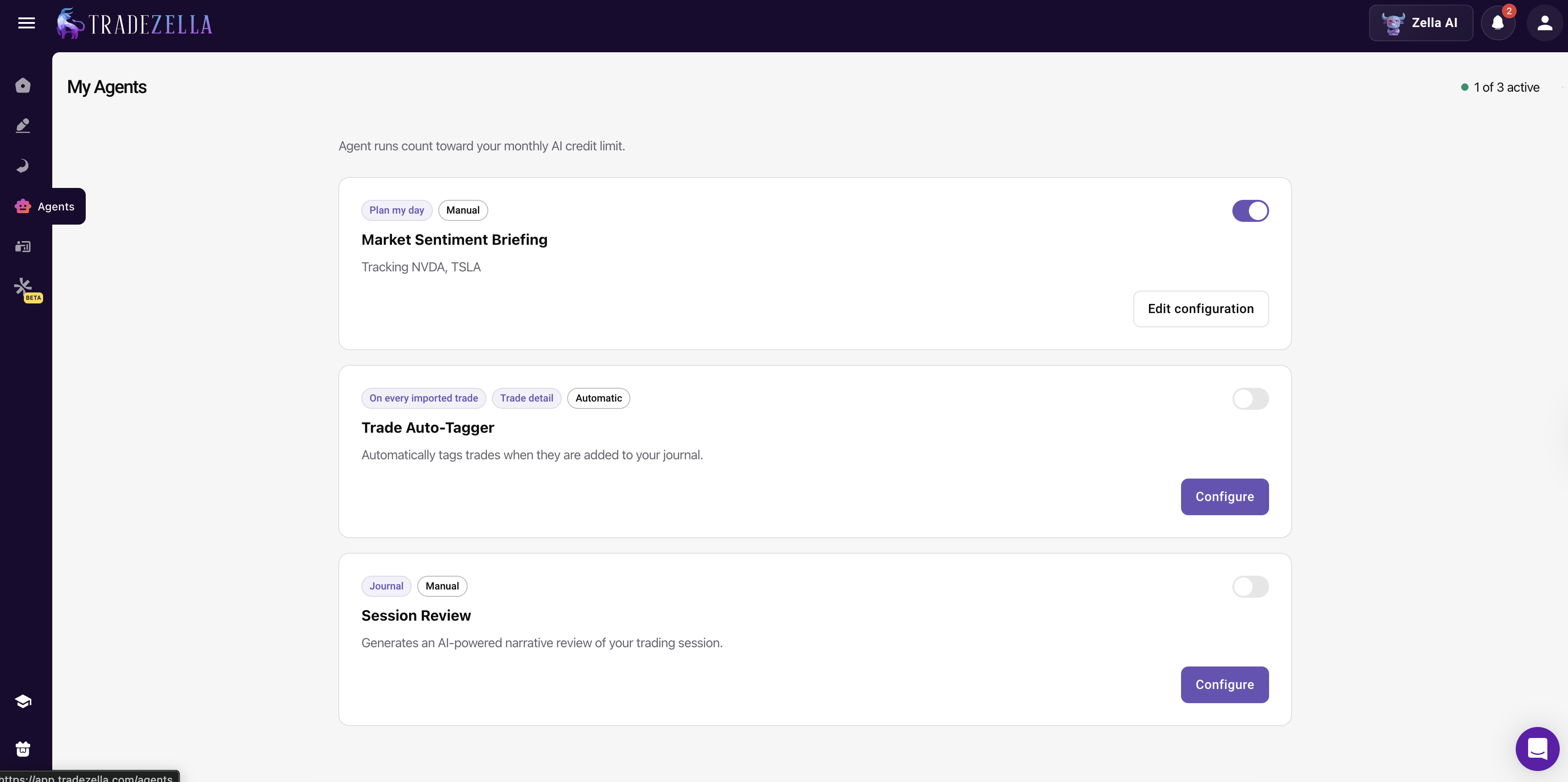
Auto Trade Tagger: Define your tagging criteria. What setups do you trade? What tags matter to you? Examples: entry timeframe, SMT presence, session (London, NY), quality grade (A, B, C), emotion state. Start with 5 to 7 tags and add more as you learn what matters.
Market Sentiment Briefing: Tell it how you trade, your assets, and what you look at. Are you an ICT trader? Order flow? Supply and demand? Select the concepts that matter to your approach. The more specific your configuration, the more relevant your daily plan.
Session Review: Customize what the review emphasizes. Rule adherence? Sizing consistency? Plan deviations? Emotional trading patterns? Set your priorities and the agent structures its review around them.
Step 3: Trade normally. Once configured, the agents run on their own. Import happens automatically. Tags are applied automatically. Session reviews are generated automatically. Your only job is to trade and then read the output. Over time, refine your agent configurations as you learn what data matters most. Add tags. Adjust review priorities. The system gets better as you use it.
Key Takeaways
AI trading agents act on their own, tagging trades, reviewing sessions, and building plans without being prompted. They are not chatbots.
Most traders skip post-session work because it is tedious. Agents do it consistently, every session, creating the data foundation that drives improvement.
Zella AI deploys three categories of agents: the Market Sentiment Briefing (pre-session), the Auto Trade Tagger (ongoing), and the Session Review (post-session). More agents are coming.
Agents compound over time. Month 1 is basic. Month 12 is a complete trading history no manual journal could match.
Look for five features: works on your data, takes action autonomously, remembers across sessions, has trading-specific skills, and tells the truth.
Agents do not trade for you, monitor your screen, or replace market analysis. They handle the operational work so your decisions are based on complete information.
Frequently Asked Questions
What is an AI trading agent?
An AI trading agent is software that performs specific trading tasks autonomously. Unlike a chatbot that waits for you to ask questions, an agent runs on its own after you configure it. It tags trades, reviews sessions, and builds trading plans without manual input. In TradeZella, Zella AI includes agents like the Auto Trade Tagger, Session Review, and Market Sentiment Briefing that handle the daily trading workflow automatically.
How are AI trading agents different from trading bots?
Trading bots execute trades automatically based on algorithms. AI trading agents do not place trades. Instead, they handle the analysis, tagging, review, and planning work that surrounds your trading decisions. You still make every entry and exit. The agent handles the operational work that most traders skip, like post-session reviews and consistent trade tagging.
Do AI trading agents work for day traders and swing traders?
Yes. Day traders benefit most from the Auto Trade Tagger and Session Review because their higher trade volume makes manual tagging impractical. A day trader placing 5 to 10 trades per session would spend 30 to 60 minutes on manual tagging alone. Swing traders benefit from the Market Sentiment Briefing and memory features, which track thesis evolution and multi-day setups across sessions.
How many trades does an AI agent need to be useful?
Agents start working from your first trade, tagging it, reviewing it, and comparing it to your plan. For pattern detection and meaningful analytics, 50 trades gives the agent enough data to surface initial insights. At 100 to 200 trades, the agent can identify time-of-day patterns, strategy comparisons, and behavioral sequences. The more data you provide, the more actionable the output becomes.
Can AI trading agents help with prop firm evaluations?
Absolutely. Prop firm accounts have strict drawdown rules and consistency targets. The Session Review agent checks every trade against your plan, flagging rule violations the same day they happen. The Auto Trade Tagger tracks sizing and exposure across multiple accounts, surfacing correlated risk. TradeZella's Prop Firm Sync connects your funded accounts and feeds agent analysis with complete, real-time data.
What is the difference between Zella AI and ChatGPT for trading?
ChatGPT is a general-purpose chatbot. It cannot see your trades, does not remember your trading history between sessions (without manual effort), and cannot take action on your data. Zella AI is an AI trading partner built specifically for traders. It connects to your actual trade data through TradeZella, deploys autonomous agents that tag and review without prompting, remembers your preferences across every session, and has trading-specific skills like ICT, order flow, and prop firm rules built in.
Do I need to be technical to use AI trading agents?
No. Setting up AI trading agents in TradeZella takes about 10 minutes. You connect your broker, define your tagging criteria in plain language, configure your Market Sentiment Briefing with your trading style, and customize your Session Review priorities. No coding, no APIs, no technical setup. The agents handle the rest.