How AI Tools Like ChatGPT and Claude Handle Backtesting, What They Get Wrong, and What Actually Works
How AI Tools Like ChatGPT and Claude Handle Backtesting, What They Get Wrong, and What Actually Works
Can AI tools like ChatGPT and Claude backtest a trading strategy? They can write code and run calculations on data you upload, but without real market data they invent results and show you no trades. This guide explains exactly what they can and cannot do, and how TradeZella backtests on 11+ years of real data and draws every trade so you can trust the results.
class SampleComponent extends React.Component {
  // using the experimental public class field syntax below. We can also attach
  // the contextType to the current class
  static contextType = ColorContext;
  render() {
    return <Button color={this.color} />
  }
}
Last Updated: July 03, 2026
Can AI tools like ChatGPT and Claude backtest a trading strategy? Partly. They can write backtesting code, and if you upload your own price data they can run real calculations on it, but they are not reliable standalone backtesters. Without real market data they estimate or invent results, they cannot handle intraday or seconds-level data, and they give you no inspectable log of the trades they claim to have taken. That gap is the whole point of this article. General AI is great at explaining and coding. It is not built to run a trustworthy backtest on its own. Here is exactly what these tools can and cannot do, and what to use when you need results you can actually rely on.
This matters because more traders than ever open a chat window, paste in a strategy idea, and ask the AI to "backtest it." Sometimes they get something useful. Often they get a confident answer built on data the model never actually had. Knowing the difference protects you from trading on numbers that were never real.
TL;DR
AI tools like ChatGPT and Claude can help you backtest, they write the code and can run real calculations on data you upload, but they are not reliable standalone backtesters. Without real market data they estimate or invent results, they cannot test intraday or seconds-level setups, and they give you no trade log to verify what they claim. A purpose-built tool keeps the plain-English ease but runs on real data: TradeZella tests your strategy across 11+ years of real historical data and draws the exact setup on every trade, so you get results you can actually trust. Use general AI to learn and to code. Use a dedicated engine when the results have to be real.
So Can They Actually Backtest?
The honest answer is that it depends entirely on how you use them. There are two very different scenarios.
When they genuinely help. AI tools like ChatGPT and Claude are strong at writing backtesting code. Ask for a Python script using a library like backtrader or vectorbt and you will usually get working code. On top of that, using a code or data-analysis feature, you can upload a CSV of historical prices and the AI will run real calculations on that file, producing an actual win rate, profit factor, and drawdown from the data you provided. That is real math on real data, not a guess. For a coder who already has clean data, this is a legitimate way to prototype a simple, rules-based strategy.
When they fall apart. The problem is what most traders actually do: they type something like "backtest this strategy on Tesla over the last two years" without giving the model any data. The AI does not have reliable built-in historical prices, so it estimates or simply invents the results. The output looks confident and specific, a win rate, an average return, a drawdown, but the numbers can be fabricated. Trading real money on a backtest the model made up is worse than not backtesting at all.
Where General AI Runs Into Walls
Even when you do everything right and feed the AI clean data, a few hard limits remain.
No built-in market data. ChatGPT and Claude do not ship with a historical price database. You have to supply it. If you do not, you are trusting invented numbers.
No intraday or seconds-level testing. Getting clean minute or seconds data into a chat window is impractical, so day-trading, scalping, and ICT setups are effectively off the table.
No realistic execution. Slippage, fills, spreads, and fees are not modeled unless you code them yourself, which most traders will not do.
No inspectable trade log. This is the big one. You cannot see each trade drawn on a chart, so you cannot confirm the AI actually traded your setup. You get an answer you have no way to verify.
Backtesting capability
AI tools like ChatGPT & Claude
TradeZella
Describe strategy in plain English
Yes
Yes
Write backtest code for you
Yes (Python)
Not needed (no code)
Run on data you upload
Yes (upload a CSV)
Yes (data built in)
Built-in historical market data
No, you supply it
Yes, 11+ years
Results without real data
Often estimated or invented
Always on real data
Intraday / seconds-level testing
No
Down to seconds
Realistic execution (slippage, fills)
Only if you code it
Yes
Every trade drawn on the chart
No
Yes (FVG, sweep, breaker)
Inspectable trade log
No
Yes, every trade
Compare backtest to live trades
No
Yes, imports 500+ brokers
None of this means the tools are bad. It means they are general-purpose assistants, not purpose-built backtesting engines. Asking them to be a backtester is asking the wrong tool to do the job.
What Actually Works
The fix is a tool that keeps the ease of plain English but runs on real data you can trust. That is what TradeZella's automated backtesting does. It gives you the same "just describe it" experience as a chatbot, but instead of guessing, it executes your rules across real historical market data and shows you every trade it took. You are not trading on estimates. You are looking at what your strategy would have actually done.
How Does TradeZella's Automated Backtesting Actually Work?
Here is the full flow, start to finish, with no code at any point.
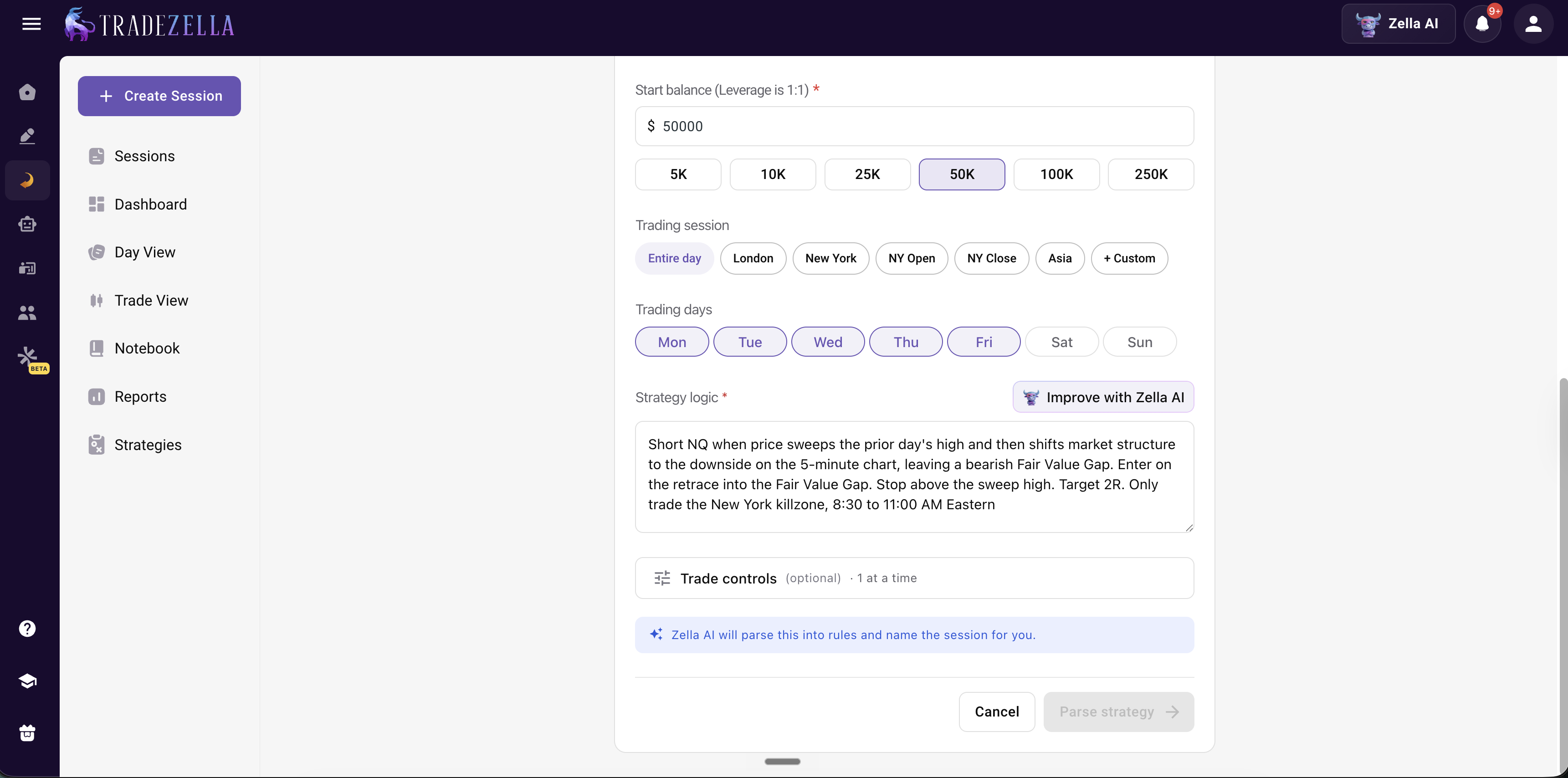
1. You describe the strategy in plain English. You type what you want the engine to test, the same way you would explain it to another trader. For example: "Go back two years on Tesla. Buy if the stock opens green in the first five minutes, with a one dollar stop loss and a two dollar take profit, and never hold a trade longer than thirty minutes." No indicators to configure, no rule builder, no script.
2. It confirms the details before running. If anything is missing, the engine asks. How much capital do you want to start with, say $50,000? Which session? Which timeframe? It fills in the gaps with you so the test is set up correctly, rather than silently assuming, which is where chatbot answers go wrong.
3. It runs across real historical data. The engine tests your rules across 11+ years of real market data on stocks, futures, forex, and crypto, down to seconds-level timeframes. That seconds-level depth is exactly what a chatbot cannot do, and it is what makes day-trading, scalping, and ICT setups testable. Nothing gets uploaded and nothing gets invented, because the data is already there.
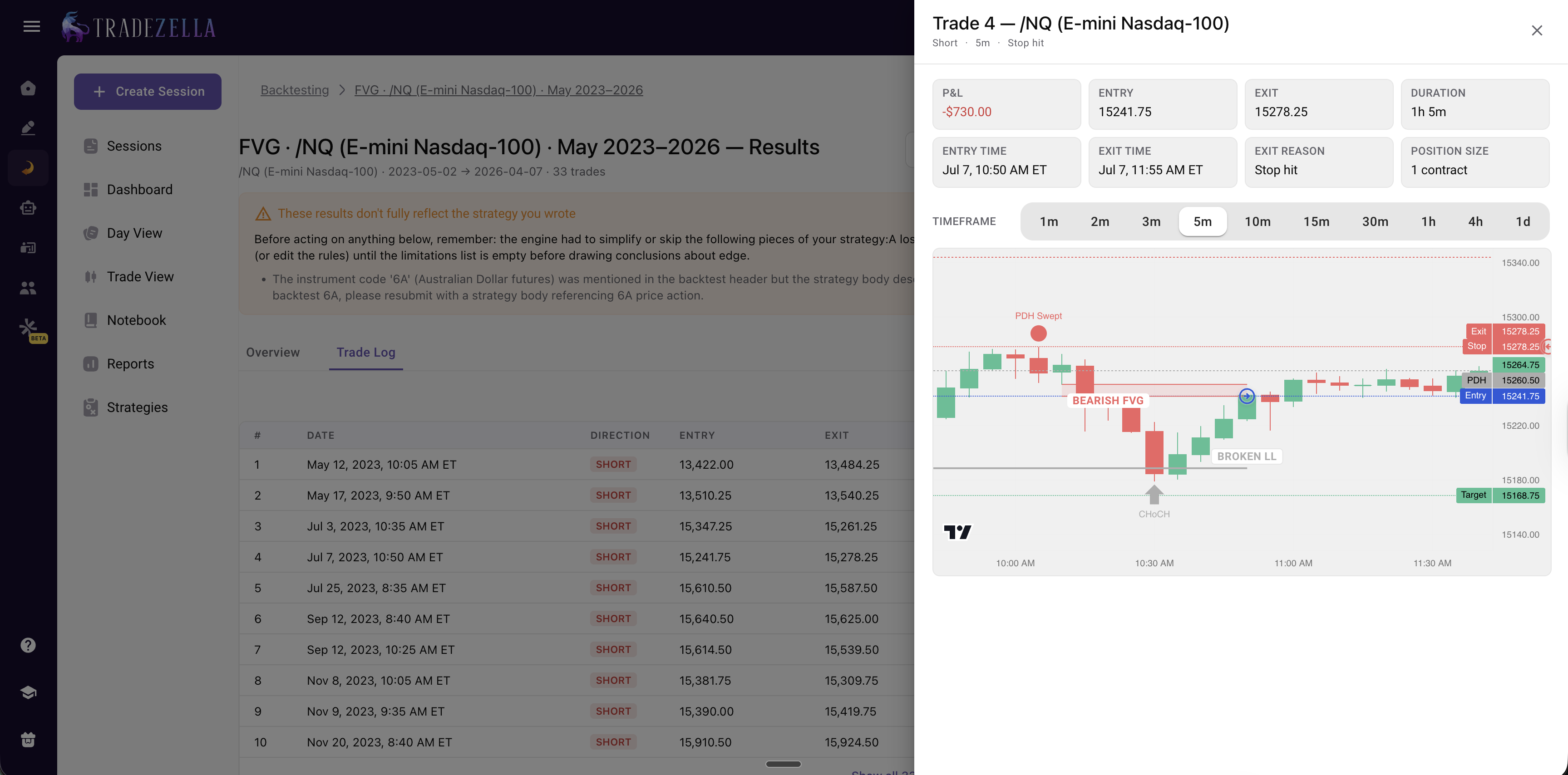
4. You get every trade, with the setup drawn on the chart. This is the part general AI cannot touch. Instead of just handing you a win rate, TradeZella opens a trade log where you can click into every single trade the strategy took. Each one shows the exact setup drawn on the chart: the bullish or bearish Fair Value Gap, the liquidity sweep, the breaker block and its retest, the market-structure shift, even the SMT confirmation if your strategy uses it. You can literally see why each trade was entered and how it played out. Most automated backtesters, including some of the most popular ones, only give you the summary numbers, so you are blind to what actually happened. Here you are not.
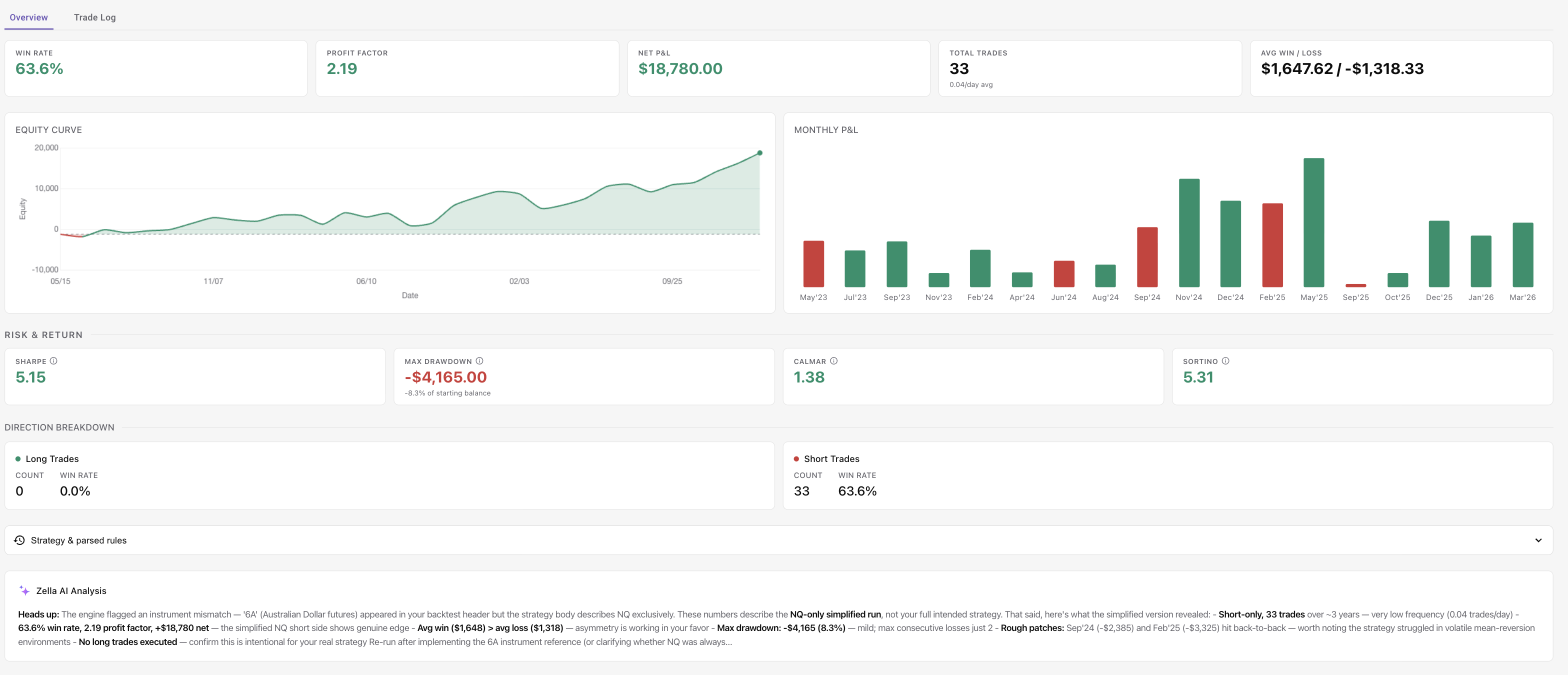
5. You get the overview stats and AI analysis. Open the overview and you get the full picture: total trades, win rate, profit factor, average win versus average loss, drawdown, and the equity curve. Zella AI then analyzes the results and tells you what to fix, a weak session, a losing day of the week, or setups that only work under certain conditions. It reads the results the way a mentor would, and it works across your wider trading, not just this one test.
6. You refine and rerun. Change a rule, tighten a stop, shift the session, and run it again in seconds. Because every trade is inspectable, you are improving a strategy based on what really happened, which is how you build a real trading edge instead of a guessed one. For the deeper walkthroughs, see AI backtesting and automated backtesting that draws every setup.
And if you would rather test by hand, TradeZella also has manual backtesting: you replay the market bar by bar and place trades as if you were trading live, and every trade is logged automatically. So whether you want the automated engine to run your rules for you or you want to practice execution yourself, both are covered, and both run on real data with a full record of every trade.
A Simple Way to Think About It
Use general AI for what it is good at: explaining backtesting concepts, writing code, and sketching strategy ideas. When you need to know whether a strategy actually made money, on a $50K account, across real market conditions, with every trade you can inspect, use a dedicated engine. On a $50K account risking $500 a trade, the difference between a fabricated 60% win rate and the real number is the difference between scaling a losing strategy and catching it early. That is not a risk worth taking on invented data. This is also how you find a real trading edge instead of a hallucinated one.
Key Takeaways
AI tools like ChatGPT and Claude can help with backtesting: they write backtest code and can run real calculations on data you upload.
They are not reliable standalone backtesters. Without supplied data they estimate or invent results that look real but are not.
They cannot handle intraday or seconds-level data, do not model execution realistically, and give you no inspectable trade log.
A dedicated tool keeps the plain-English ease but runs on real historical data. TradeZella runs 11+ years of data and draws the exact setup on every trade.
Use general AI to learn and to code. Use a purpose-built engine when you need results you can trust and verify.
Frequently Asked Questions
Can ChatGPT backtest a trading strategy?
Partly. ChatGPT can write backtesting code and, using its data-analysis feature, can run real calculations on a price data file you upload. But if you ask it to backtest a strategy without giving it data, it does not have reliable historical prices and will estimate or invent the results. It is helpful for coding and prototyping, but it is not a dependable standalone backtester.
Can Claude backtest a trading strategy?
The same applies to Claude. It is strong at writing backtest code and can analyze data you provide, but it has no built-in historical market data, so results generated without real data can be fabricated. For a trustworthy backtest you need a tool with real market data built in.
Why are AI chatbot backtest results often wrong?
Because the model does not have a reliable historical price database. When you ask it to backtest without supplying data, it fills the gap by estimating, and the output can be entirely made up even though it looks precise. It also does not model slippage, fills, or fees, and it cannot show you the individual trades, so you have no way to verify what it reported.
What is the best way to backtest with AI?
Use an AI-powered tool that is purpose-built for backtesting and runs on real market data, rather than a general chatbot. TradeZella automated backtesting lets you describe your strategy in plain English, runs it across 11 plus years of real data down to seconds, and draws the exact setup on every trade so you can verify the results. You get the ease of plain English with data you can trust.
Can AI tools backtest day-trading or scalping strategies?
General chatbots cannot do this well because getting clean intraday or seconds-level data into a chat window is impractical. A dedicated backtesting engine like TradeZella tests down to seconds-level timeframes, which is what intraday, scalping, and ICT strategies require.
Should I trust a backtest ChatGPT or Claude gives me?
Only if you supplied the data and can see the calculation. If the numbers came from a prompt with no data attached, treat them as unverified and do not trade on them. For results you can act on, use a tool that runs on real historical data and shows you every trade.