How to Backtest an ICT Strategy in Plain English (and Get Results in Seconds)
How to Backtest an ICT Strategy in Plain English (and Get Results in Seconds)
You can backtest an ICT strategy by describing it in plain English, the sweep, the Fair Value Gap, the entry, and TradeZella runs it across years of data in seconds. Then the AI draws the exact setup it traded on every trade, so you see whether your ICT model actually has an edge, not just whether it feels right.
class SampleComponent extends React.Component {
  // using the experimental public class field syntax below. We can also attach
  // the contextType to the current class
  static contextType = ColorContext;
  render() {
    return <Button color={this.color} />
  }
}
Last Updated: July 02, 2026
To backtest an ICT strategy in plain English, you describe the setup the way you would explain it to another trader, the liquidity sweep, the Fair Value Gap, the entry, the stop, and the session, and the engine runs it across years of historical data in seconds. In TradeZella, you do not code a single line and you do not build menu conditions. You write the model in words, run it, and then the AI draws the exact setup it traded on every trade, so you can see whether your ICT model actually has an edge instead of guessing from a screenshot. This guide shows how to write an ICT strategy in plain English, what ICT concepts you can test, and how to read the results.
ICT strategies are hard to backtest by hand. A single model can involve a sweep, a market structure shift, a Fair Value Gap, and a session filter, and testing 100 of those setups manually takes weeks. Describing the model in plain English and letting the engine run it changes the math, and because the AI draws each setup on the chart, you keep the visual context ICT traders rely on. If you want the broader picture of how this works, see AI backtesting and automated backtesting.
TL;DR
You can backtest an ICT strategy without code by describing it in plain English: the liquidity sweep, the Fair Value Gap or order block, the entry, the stop, the target, and the killzone. TradeZella runs it across years of data in seconds, draws the exact setup it traded on every individual trade, and lets Zella AI analyze the results. You can also start from the pre-built ICT template and adjust it. Then filter by session and day of week, check win rate, profit factor, and expectancy, and forward test before going live.
What Is an ICT Strategy?
An ICT strategy is a trading model built on Inner Circle Trader concepts, which focus on how price seeks liquidity and rebalances inefficiencies. The common building blocks are the liquidity sweep (price runs a prior high or low to trigger stops), the market structure shift (a break of structure that signals a change in direction), the Fair Value Gap (an imbalance or inefficiency left in price that often gets revisited), order blocks and breaker blocks (the last down or up candle before an impulsive move, and a failed level that flips), and killzones (the specific London and New York session windows when these setups tend to work). A typical ICT entry waits for a sweep, then a market structure shift, then enters on a retrace into a Fair Value Gap or order block, with the stop beyond the sweep. Because every piece is objective, an ICT model is a strong candidate for backtesting.
How Do You Backtest an ICT Strategy in Plain English?
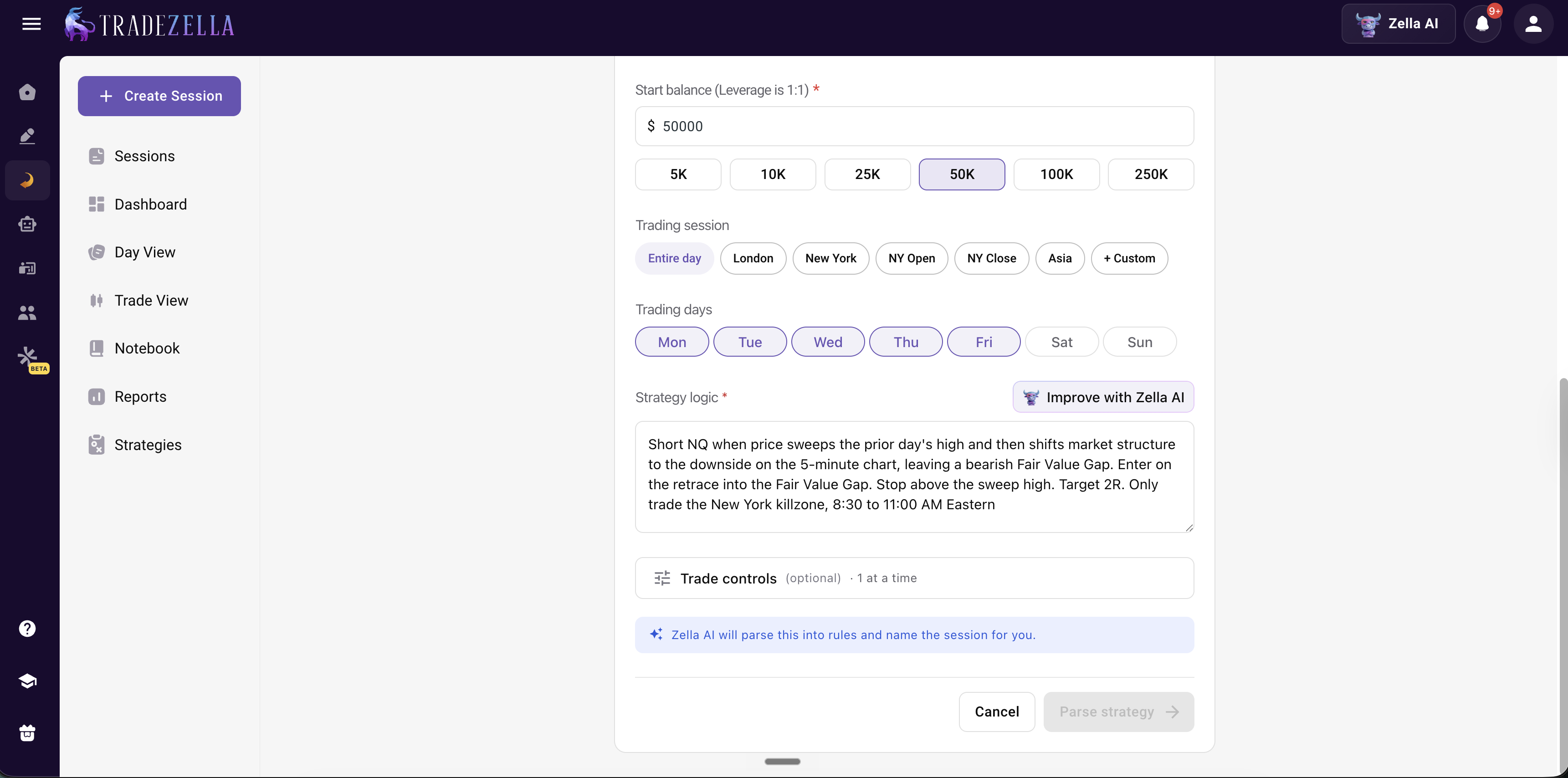
You write the model as a set of plain sentences and the engine turns it into a test. Here is a full ICT model written the way you would say it out loud:
"Short NQ when price sweeps the prior day's high and then shifts market structure to the downside on the 5-minute chart, leaving a bearish Fair Value Gap. Enter on the retrace into the Fair Value Gap. Stop above the sweep high. Target 2R. Only trade the New York killzone, 8:30 to 11:00 AM Eastern."
TradeZella Automated Backtesting
That is the input. No NinjaScript, no Pine Script, no dropdown conditions. The engine parses the sweep, the market structure shift, the Fair Value Gap entry, the stop, the target, and the session filter, confirms the details with you, and runs the test across years of data. You can also start from TradeZella's pre-built ICT template and adjust the parts that do not match your model.
Why Does It Matter That the AI Draws the Setup?
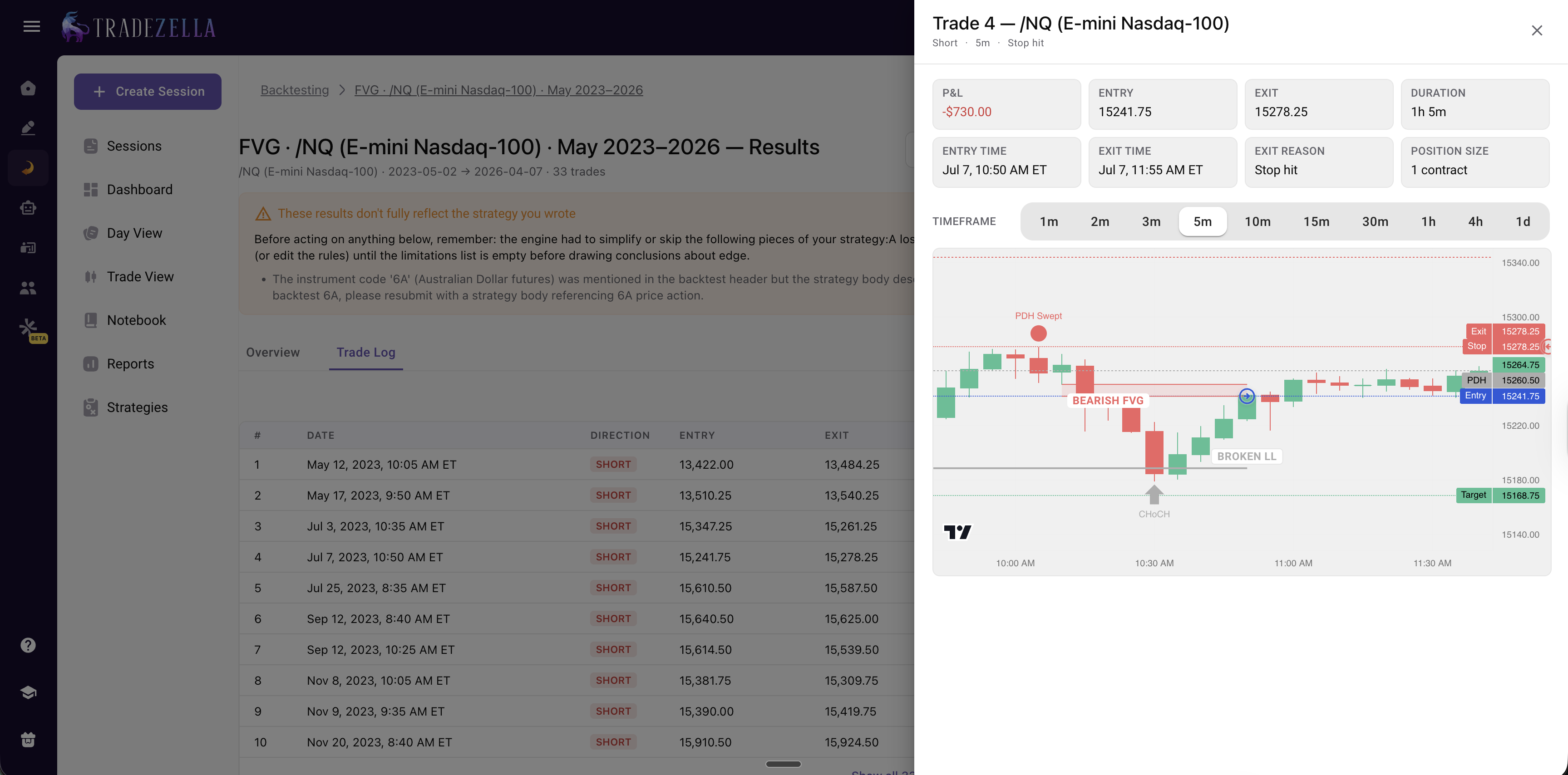
This is the part that matters most for ICT traders. When the backtest runs, the AI does not just log an entry price. On every individual trade, it draws the exact setup it traded directly on the chart. If the entry was based on a Fair Value Gap, you see that FVG drawn. If it was a breaker block, you see the breaker and its retest drawn. So for each of the 100 trades the engine took, you can open the chart and confirm the sweep ran the level, the structure actually shifted, and the entry filled where your model says it should. No other automated backtesting tool lets you do this. It is the difference between trusting a number and seeing the model work, which is exactly how ICT traders think.
Here is an example. In the NQ short below, the engine drew exactly what it traded: the swept prior-day high (PDH Swept), the bearish Fair Value Gap it entered on, and the change of character (CHoCH) where structure shifted, with the entry, stop, and target marked. You can tell at a glance whether the setup was valid, not just whether the trade won or lost.
TradeZella Automated Backtesting Per Trade Analysis
What ICT Concepts Can You Backtest?
Any ICT concept you can state objectively. Because the input is plain English and TradeZella has built-in ICT tools, the range is wide. Here is how the common building blocks translate into plain-English rules.
ICT concept
Plain-English rule you type
What the AI draws on each trade
Liquidity sweep
"Enter after price sweeps the prior day's high and reverses."
The swept level and the wick that ran it
Market structure shift
"Only enter after a break of structure to the downside on the 5-minute."
The structure break that confirmed the shift
Fair Value Gap (FVG)
"Enter on the retrace into a bearish Fair Value Gap, stop above the gap."
The Fair Value Gap the entry filled into
Order block
"Enter at the last up candle before the impulse move down."
The order block and the entry within it
Breaker block
"Enter when a failed high flips and price retests it as resistance."
The breaker block and its retest
Killzone / session
"Only trade the New York killzone, 8:30 to 11:00 AM Eastern."
Trades outside the killzone are excluded from the test
Optimal trade entry (OTE)
"Enter on the 62 to 79 percent retrace of the impulse leg."
The retracement zone the entry landed in
You can also combine them, which is where ICT backtesting gets powerful. Test the base model, then test it with only the New York killzone, then with a higher-timeframe bias filter, then with an order block entry instead of a Fair Value Gap entry. Each variation takes seconds, so in one session you can find the exact configuration where your model has the highest expectancy. That is how you turn an ICT idea into a measured trading edge. For related price-action models, see trading patterns and the gap and go strategy.
How Do You Read the Results?
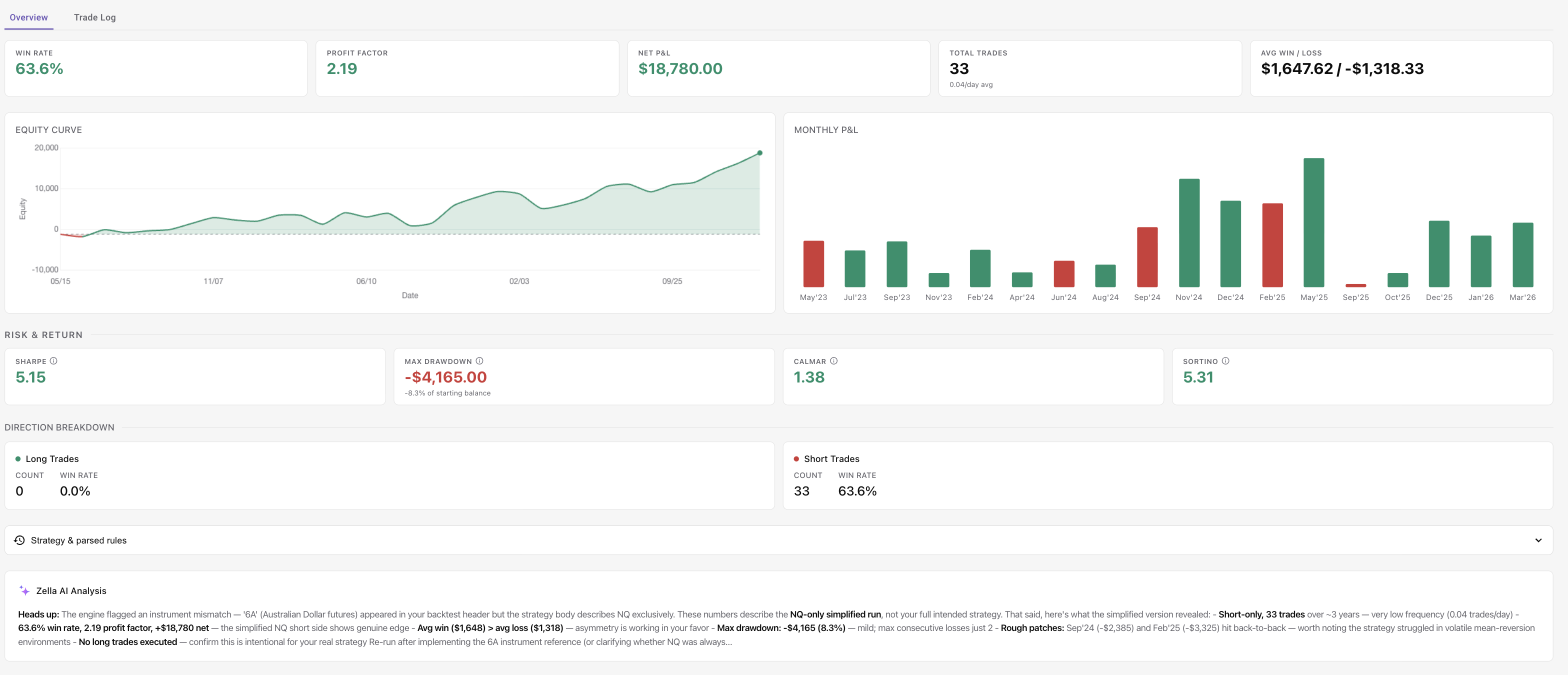
Once the backtest is done, open the results dashboard to see the overall stats, win rate, profit factor, net P&L, average win versus loss, and an equity curve.
TradeZella Automatic Backtesting Stats with Zella AI Analysis
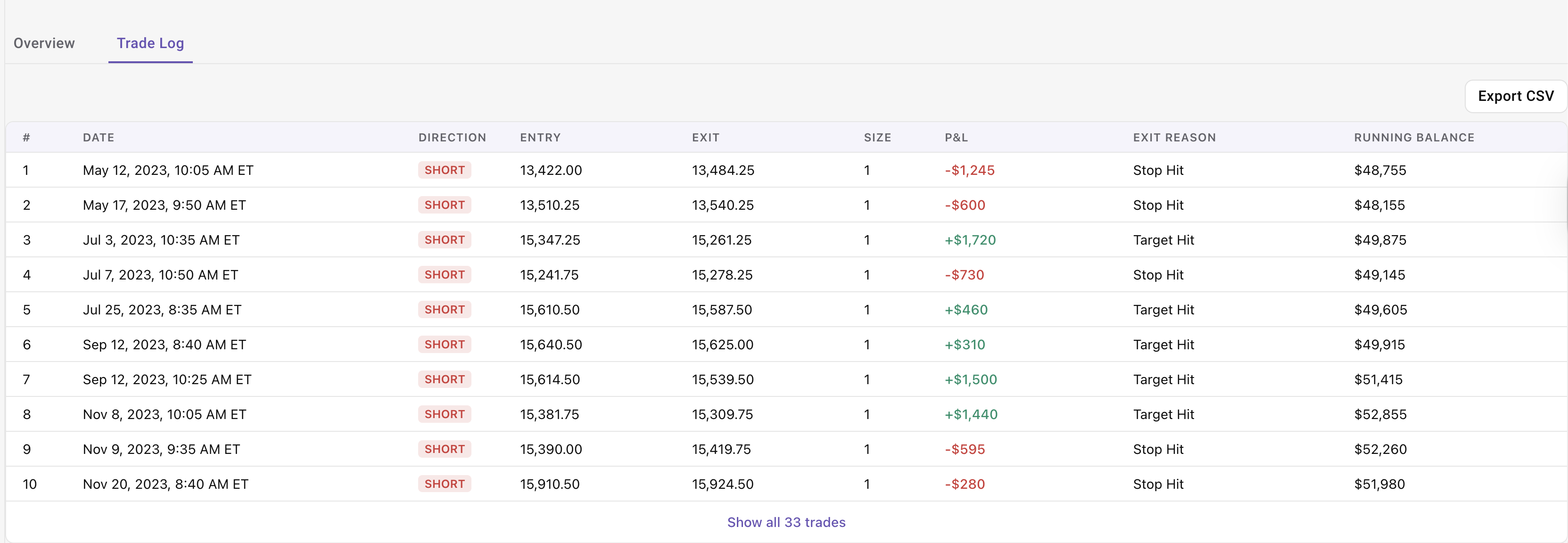
Then open the Trade Log and click through the trades one by one. Each trade shows how it performed and opens its chart with the setup drawn, the swept high, the Fair Value Gap, and the market structure shift, so you can see exactly how the model traded. Zella AI also summarizes the run and flags what to fix.
TradeZella Automatic Backtesting Trade Log
From Backtest to Live
A strong ICT backtest is the start, not the finish. Forward test the model at reduced size, 25 to 50 percent, for 20 to 30 trades, and compare live results to the backtest. If your live win rate and average R stay within 15 to 20 percent of the backtest, the edge is translating. Because TradeZella imports trades from 500+ brokers, your backtested ICT trades and your live ICT trades sit in the same dashboard for a direct comparison.
You can backtest an ICT strategy in plain English: describe the sweep, the market structure shift, the Fair Value Gap or order block entry, the stop, the target, and the killzone, and the engine runs it in seconds.
No code and no menu conditions. Start from the pre-built ICT template or write the model in words.
The AI draws the exact setup it traded on every trade, the FVG, or the breaker block and its retest, so you can confirm each ICT entry visually. No other automated backtesting tool does this.
Filter by killzone and day of week. ICT setups are session-dependent, and the right session filter often turns a marginal model into a strong one.
Check win rate, profit factor, average R-multiple, and expectancy, then forward test at reduced size before going live.
Frequently Asked Questions
Can you backtest an ICT strategy without coding?
Yes. In TradeZella you describe the ICT model in plain English, the liquidity sweep, the market structure shift, the Fair Value Gap or order block entry, the stop, the target, and the killzone, and the engine runs it across years of historical data. There is no NinjaScript, no Pine Script, and no dropdown conditions. You can also start from a pre-built ICT template and adjust it.
How do you backtest a Fair Value Gap strategy?
Describe the entry in plain English, for example: "Enter long when price shifts market structure up and retraces into a bullish Fair Value Gap on the 5-minute chart, stop below the gap, target 2R." The engine runs the model and, on every trade, the AI draws the Fair Value Gap it used on the chart so you can confirm the entry was valid. You then filter by session and check win rate, profit factor, and expectancy.
Does TradeZella have ICT indicators for backtesting?
Yes. TradeZella has built-in ICT tools including Fair Value Gap, liquidity sweeps, market structure, Asian Session Range, higher-timeframe bias, Key Levels, and Power of 3, so you do not need third-party scripts. During an AI backtest, the setup the engine traded is drawn on each trade's chart automatically.
What is the best timeframe and session to backtest ICT setups?
Most ICT day-trading models are tested on lower timeframes such as the 1-minute to 15-minute charts, with entries confirmed against a higher-timeframe bias. Sessions matter more than almost anything else in ICT, so test within the London and New York killzones and compare them. TradeZella lets you filter backtest results by session and day of week, which usually reveals that a model performs far better in one killzone than across the full day.
How many trades do you need to backtest an ICT strategy?
Aim for at least 50 trades, with 100 or more giving stronger confidence. ICT setups can be selective, so if your model triggers infrequently, extend the date range or test the same rules across additional instruments such as ES, NQ, and a couple of forex pairs. The larger the sample, the more reliable the win rate, profit factor, and expectancy.
Is ICT backtesting reliable?
It is reliable when the model is defined objectively and tested on a large enough sample. The risk with ICT specifically is subjective interpretation, deciding after the fact that a sweep or a Fair Value Gap counts. Automated backtesting removes that bias because the engine applies the same rules every time, and because the AI draws the setup it traded, you can verify the trades were valid rather than trusting a summary number.
Can you backtest ICT strategies for a prop firm evaluation?
Yes. Set the backtest balance to your evaluation account size and confirm the model stays within the firm's daily loss limit and maximum drawdown across several months of data. If an ICT model cannot pass those thresholds in a backtest, it will not pass them live. TradeZella's Prop Firm Sync then lets you track the model on the funded account once you go live.