Scalping Strategies: 4 High-Frequency Setups With Exact Rules for Active Day Traders
Scalping Strategies: 4 High-Frequency Setups With Exact Rules for Active Day Traders
Four scalping strategies with exact entry, exit, and stop-loss rules for active day traders. Plus the review framework that lets you analyze 20-40 trades per day in under 15 minutes.
class SampleComponent extends React.Component {
  // using the experimental public class field syntax below. We can also attach
  // the contextType to the current class
  static contextType = ColorContext;
  render() {
    return <Button color={this.color} />
  }
}
Last Updated: March 26, 2026
What Is Scalping?
Scalping is a trading style that targets small price movements, typically $0.10 to $0.50 per share, with holding periods ranging from a few seconds to a few minutes. Instead of waiting for one large move, scalpers take many trades per session (usually 15 to 40) and aim to compound small, consistent gains.
Scalping differs from day trading in speed and frequency. A typical day trader might take 2 to 5 positions and hold them for 30 minutes to several hours. A scalper is in and out in seconds to minutes, often trading the same stock multiple times in one session.
The edge in scalping comes from three things: reading short-term order flow better than other participants, having a statistical edge on a specific setup repeated many times, and keeping losses smaller than wins on a per-trade basis. Without all three, the commission costs and execution slippage that come with high-frequency trading will eat your account.
This is also why scalping demands more from your data and review process than any other trading style. A swing trader taking 3 trades a week can manually journal every trade. A scalper taking 25 trades a day cannot. The review framework covered later in this article solves that problem.
Scalping works when you have a defined setup with defined rules and enough data to know your specific execution of that setup is profitable. The challenge most scalping guides skip: how do you actually review and improve your performance when you are taking 20 to 40 trades per day?
Manual trade logging is impossible at scalping volume. And without systematic review, you are trading on gut feel, not edge. This guide covers four specific scalping strategies with exact rules, and the framework for analyzing high-volume trade data efficiently.
What Scalping Actually Requires
Speed. Direct-access execution is required. Retail web platforms introduce too much slippage.
Focus. Taking 20 to 30 trades requires undivided attention.
Discipline on size. Many traders compensate for small moves by using larger share sizes. This amplifies losses as much as gains. Use a position size calculator to set your max risk per trade before the session starts, not during it. If your stop is $0.15 and your max risk is $100, your position size is 666 shares. Calculate this before the open. Sound risk management means your worst scalp cannot damage your account.
Automated data. At 25 trades per day, manual trade logging is not feasible. You need a system that imports trades directly from your broker so every entry, exit, and P&L is captured without manual input.
Strategy 1: Level 2 Momentum Scalp
Uses real-time order flow (bid-ask data) combined with time and sales to identify when a move is about to accelerate. Save this as a strategy in your journal so every trade taken with this setup gets tagged and tracked separately from your other setups.
Best in: First 90 minutes of the session (9:30 to 11:00am). Highest volume, most liquid order flow.
Setup Criteria
Stock gapped up or down at least 2% on news.
Volume in first 5 minutes exceeds 50% of average daily volume.
Level 2 shows "stacking" on one side (more buyers at ask than sellers at bid).
Price has consolidated 2 to 3 minutes after initial spike.
Entry: When price breaks the consolidation high (for longs) with large bids lifting on Level 2.
Stop: Below the low of the consolidation candle.
Target: 1:1 to 2:1 risk-reward. Take partial profits at 1:1 (this is a 1 R-multiple gain), trail the rest.
Exit if wrong: Any time Level 2 flips (large offers appear, large bids disappear). Exit immediately. Do not wait for your stop.
Your win rate on this setup should sit between 55% and 65% if you are selective about the stocks you trade. If it is below 50% after 30 trades, review whether you are entering on weak stacking or chasing late breakouts.
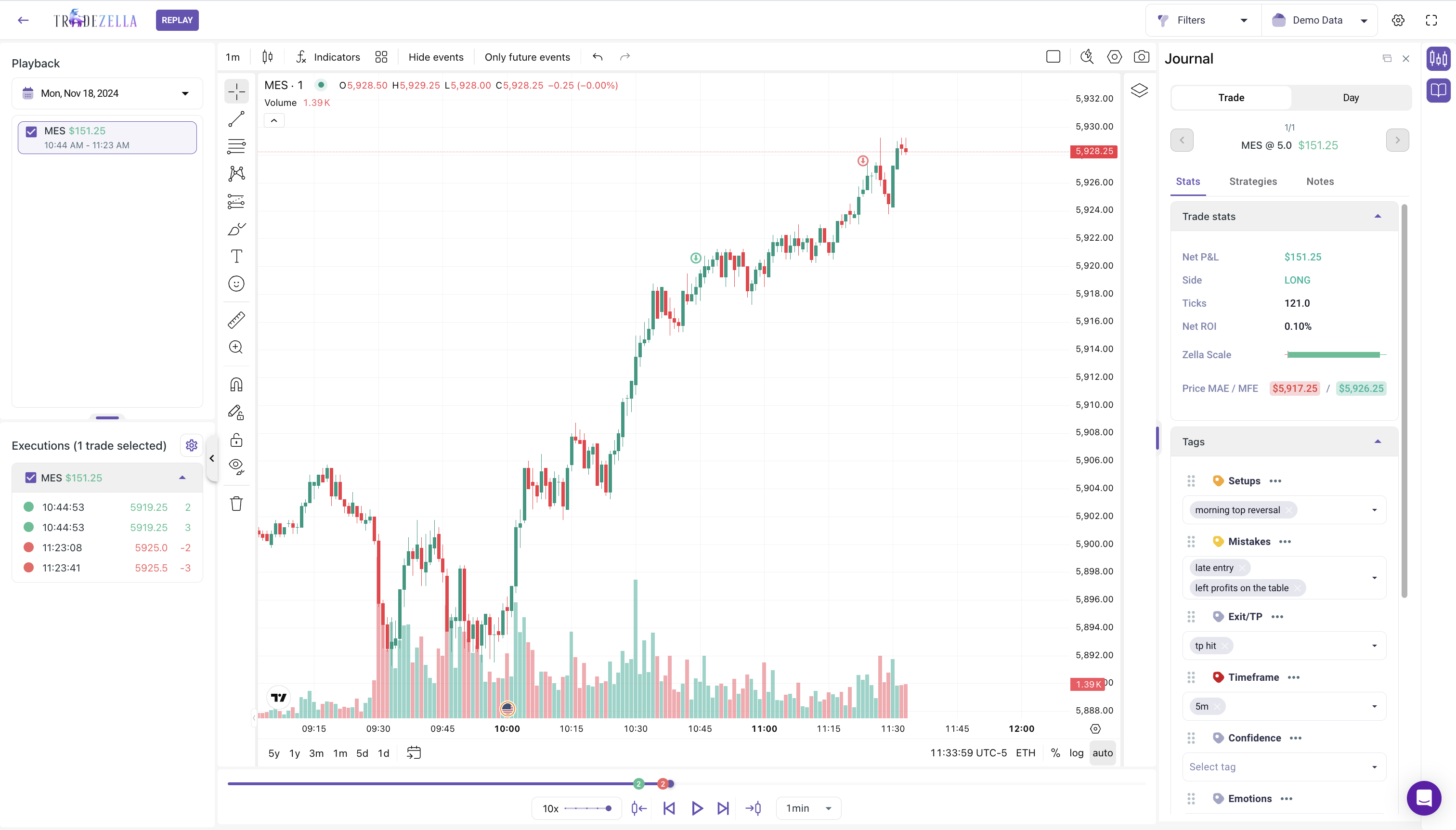
In TradeZella, the Trade Replay feature lets you replay any scalp tick-by-tick . After your session, replay each losing trade to identify what the order flow looked like when you made the decision.
TradeZella Replay Feature
Strategy 2: VWAP Deviation Scalp
When price moves significantly above or below VWAP, it often snaps back. That reversion is the scalp. This is the same VWAP bounce concept covered in the expectancy article, but applied as a scalp with tighter targets and faster exits.
Best in: Trending market days with clear directional bias.
Setup Criteria (Long Example)
Price is above VWAP overall (bullish bias).
Price pulls back to within $0.05 to $0.15 of VWAP.
Volume on the pullback is declining.
Reversal candle forms at or near VWAP.
Most reliable in first 2 hours and last 90 minutes of session.
Entry: Close of the reversal candle at VWAP, or break of that candle's high.
Stop: $0.10 to $0.20 below VWAP.
Target: Prior intraday swing high. Or a fixed $0.20 to $0.30 target.
Note: The VWAP scalp fails frequently in the first 15 minutes when VWAP is still establishing. Do not use before 9:45am.
Track this separately as a strategy in your journal. After 30 trades, compare its expectancy to your other setups. If VWAP deviation consistently produces smaller winners than Level 2 Momentum but has a higher win rate, it is still worth trading as long as the expectancy is positive.
The opening range is the high and low set in the first 5, 15, or 30 minutes of the session. When price breaks out of that range with significant volume, it often continues for 2 to 5x the range.
Best in: News catalyst days where a stock has a clear directional move in the first hour.
Setup Criteria
Identify the high and low of the first 15 minutes.
Wait for a candle that closes above the range high (for longs) or below the range low (for shorts).
Volume on the breakout candle is at least 1.5x average 15-minute volume.
Broader market aligned with trade direction.
Entry: On the break of the opening range high.
Stop: Below the middle of the opening range candle.
Target: 1x the opening range projected above the breakout.
Scaling: Take half position off at 1:1. Trail the rest. ORBs can produce 3 to 5:1 moves on strong catalyst days.
Log this as a separate strategy so you can compare ORB performance against your other setups at the end of each month. Many scalpers find ORBs produce their biggest winners but lowest win rate, which means expectancy can still be strong even at 40% wins.
Strategy 4: Micro Pullback on Strong Momentum
On days when a stock is running hard (up 5 to 10% in the first hour), the best scalp is not chasing the spike but entering on the first micro-pullback within the trend.
Best in: Strong directional days driven by news or earnings. Does not work in choppy markets.
Setup Criteria
Stock is up 5%+ on the day with 3x+ relative volume.
Price has made a strong initial move of at least $1 from the open.
Price pulls back to the 5-minute VWAP or 20-period MA on the 1-minute chart.
Pullback shows declining volume.
Bullish candle forms at support.
Entry: Break of the high of the reversal candle on the 1-minute chart.
Stop: Below the low of the pullback. $0.10 to $0.20 maximum.
Target: The prior high of the run.
Exit if wrong: Stock gives back more than 50% of the initial move.
Tag this as its own strategy. The micro pullback is the most discretionary of the four setups here, so data matters even more. After 20 trades, check whether your entries are actually at the pullback low or whether you are entering too early while the pullback is still developing.
Strategy Comparison: Which Scalp Setup Fits Your Style
Not every scalp setup works in every market condition. Here is how the four strategies compare across the dimensions that matter most.
Metric
Level 2 Momentum
VWAP Deviation
Opening Range Breakout
Micro Pullback
Best Market
Gapped stocks with news catalyst
Trending days with directional bias
News catalyst days, first hour
Strong momentum days (5%+ gap)
Session Window
9:30 - 11:00am
9:45 - 11:30am and 2:30 - 4:00pm
9:45 - 10:30am
9:30 - 11:30am
Risk Per Trade
$0.10 - $0.20/share
$0.10 - $0.20/share
Half the opening range
$0.10 - $0.20/share
Typical R:R
1:1 to 2:1
1:1 to 1.5:1
1:1 to 5:1
1.5:1 to 3:1
Win Rate Range
55 - 65%
60 - 70%
40 - 55%
50 - 60%
Difficulty
Advanced
Intermediate
Intermediate
Advanced
Key Skill
Reading Level 2 order flow
Identifying VWAP support
Volume confirmation on breakout
Patience to wait for pullback
If you are just starting, pick one setup and trade it exclusively for 30 days. Trying all four simultaneously splits your attention and makes it impossible to know which one is actually working. Start with the VWAP Deviation Scalp if you want the most structured rules, or the Level 2 Momentum Scalp if you already read order flow.
Import These Strategies Into Your Journal
You can import pre-built strategy templates for each of these four setups directly into TradeZella. Each template comes with the entry rules, exit rules, and risk parameters already configured. Just import, start trading, and your performance data will be automatically organized by setup.
The Scalping Data Problem (And How to Solve It)
25 trades per day is 500 trades per month. You cannot manually review 500 trades. The solution is import plus filtered analytics.
In TradeZella, automated and file import supports 500+ brokers including all major direct-access platforms (DAS Trader, Sterling Trader, Lightspeed). The time-of-day analytics show your win rate, average P&L, and total performance broken down by 30-minute intervals.
What to do: Set up auto-import from your broker in TradeZella. After 30 days, pull the time-of-day report. If your win rate drops sharply after 11:00am, make that your hard stop time. Most scalpers find that 60% to 80% of their profits come from a 90-minute window. Identifying that window and only trading inside it is the single highest-impact change you can make.
Reviewing 25 Trades a Day Without Spending 3 Hours
Daily (15 minutes)
Review only the outliers. Your 3 biggest wins and 3 biggest losses. For each: was this trade in my strategy, or a deviation? In TradeZella, tag each trade with the strategy name (Level 2 Momentum, VWAP Deviation, ORB, Micro Pullback) so your filtered reports show performance by setup automatically.
Weekly (30 minutes)
Pull your analytics dashboard. Look at: win rate by strategy, win rate by time of day, and whether average loss was larger or smaller than average win. Also check your profit factor for each strategy. A profit factor below 1.0 means that strategy lost money that week. A profit factor above 2.0 means it performed well.
Monthly (60 minutes)
Full review. Time-of-day heat map, P&L by trade number (to check overtrading), and expectancy by setup. This is when you make rule changes. Before changing any rules, run a backtesting check on your proposed change against the last 30 days of data. Do not change rules based on a single bad week.
Scalping requires direct-access execution, full focus during the session, disciplined position sizing, and automated trade logging.
The four most reliable scalping setups: Level 2 momentum scalp, VWAP deviation reversion, opening range breakout, and micro pullback on strong momentum.
Every scalping setup has a specific "exit if wrong" rule. Knowing when to cut is as important as knowing when to enter.
The most important data report for scalpers is time-of-day performance. Most scalpers have a clear profitable window.
Review only outliers daily (15 min), run weekly metrics review (30 min), and do full strategy analysis monthly (60 min).
If you trade prop firm accounts, the same risk management framework applies, but drawdown rules make position sizing even more critical. Scalpers in prop firm challenges should reduce max risk per trade to stay within daily loss limits.
Frequently Asked Questions
What is scalping in trading?
Scalping targets small price movements ($0.10 to $0.50 per share) with short holding periods from seconds to a few minutes. Scalpers make many trades per day (15 to 40), relying on consistent small gains rather than large individual moves.
Is scalping profitable?
Scalping can be profitable but requires direct-access execution, strong risk management, and systematic performance review. The biggest obstacle is that many platforms charge commissions that eat into scalping margins. Check your net P&L after commissions, not gross. A setup that makes $0.15 per share but costs $0.01 per share round trip in commissions is still viable. A setup that makes $0.05 and costs $0.01 may not be.
What is the best indicator for scalping?
VWAP and Level 2 order flow are the most used by professional scalpers. VWAP shows where institutional buying and selling is concentrated. Level 2 shows real-time order book depth. Moving averages (9 EMA, 20 EMA on the 1-minute chart) are secondary confirmation tools, not primary entry signals.
How many trades should a scalper take per day?
Your data determines your maximum. Pull your P&L by trade number report and find where your performance degrades. For most scalpers, the number is between 5 and 20 trades. If your 15th trade of the day is consistently a loss, you are overtrading. Set a hard daily trade limit based on your data, not your opinion.
Can beginners scalp trade?
Scalping is one of the harder styles to start with because speed and execution discipline take time to develop. Most coaches recommend beginners start with swing trading to develop pattern recognition before moving to scalping's faster pace. If you do start with scalping, begin with one setup only and keep position sizes at 25% of what you plan to eventually trade. Build size as your data proves the setup works in your hands.



.png)

