The Only AI Trading Tool You Will Ever Need in 2026
The Only AI Trading Tool You Will Ever Need in 2026
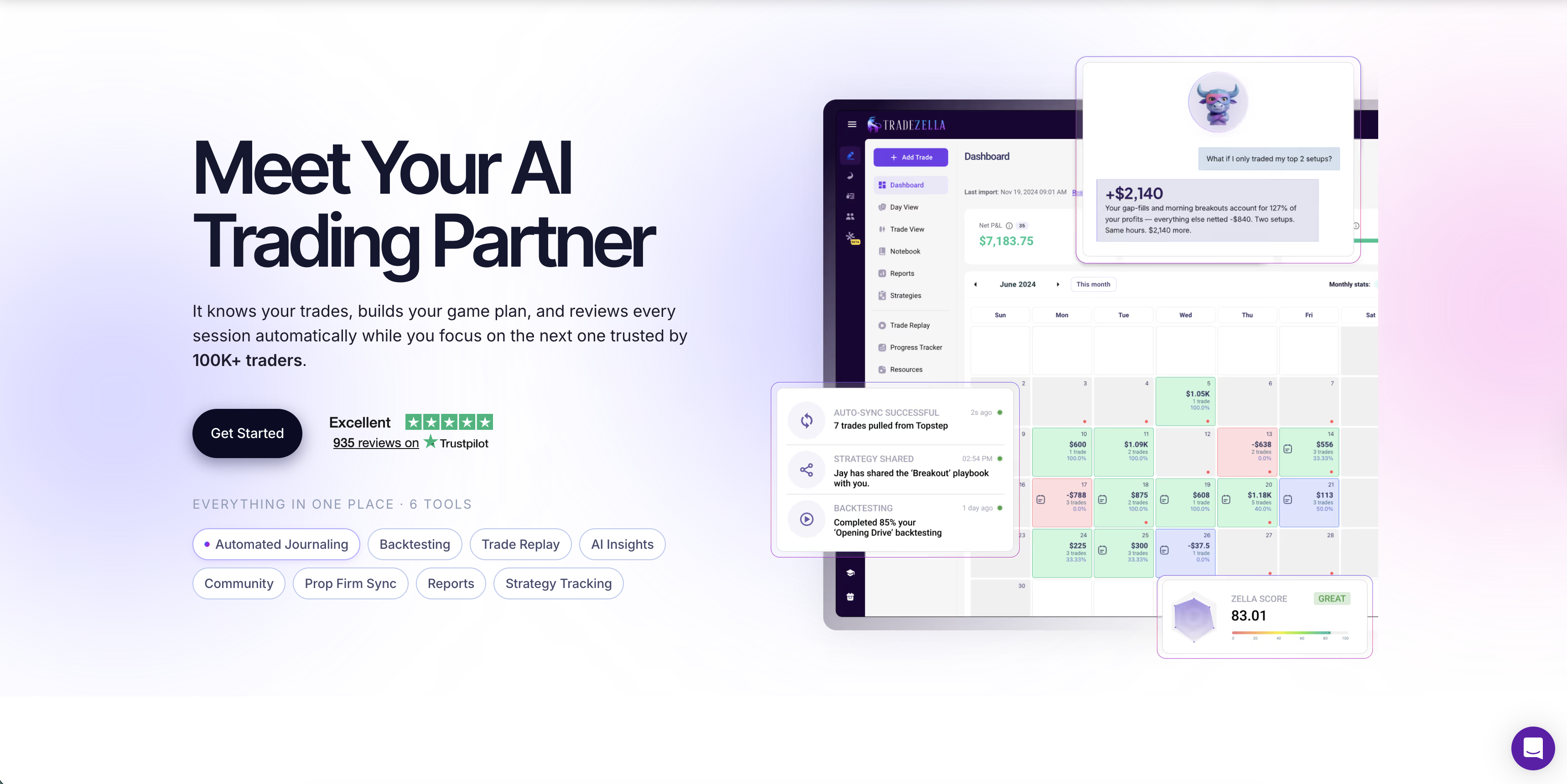
Most AI trading tools answer questions and stop there. TradeZella is the only platform where AI handles your entire trading workflow: pre-market planning, trade tagging, session reviews, and performance analytics, all running automatically on your actual data.
class SampleComponent extends React.Component {
  // using the experimental public class field syntax below. We can also attach
  // the contextType to the current class
  static contextType = ColorContext;
  render() {
    return <Button color={this.color} />
  }
}
Last Updated: July 13th, 2026
An AI trading tool is software that uses artificial intelligence to automate parts of the trading workflow, from pre-market preparation and trade tagging to session reviews and performance analytics. The problem is that most tools calling themselves "AI" are doing one small thing. ChatGPT answers questions about trading but forgets everything the next day and has no access to your actual data. Other journal platforms bolt on a basic chatbot and call it AI. None of them handle the full workflow. You still end up manually logging trades, writing journal entries, and spending hours on reviews that never happen consistently.
TradeZella with Zella AI is different. It is the only platform where AI handles your entire trading workflow in one place. Your trades import automatically from 500+ brokers. AI tags every trade based on rules you define. AI reviews every session against your plan. AI generates your pre-market preparation based on how you trade. And it remembers everything, your risk limits, your Strategies, your preferences, compounding its understanding of your trading over months.
This is not a chatbot. This is your AI trading partner.
Why Do Most AI Trading Tools Fall Short?
Most tools calling themselves "AI" are doing one small thing, and it is almost always the same thing: answering questions.
General AI chatbots (ChatGPT, Claude, Gemini) can answer questions about trading concepts, analyze screenshots, and help you think through ideas. But they have no connection to your broker, no memory of your trading history, and no ability to take action on your data. If you ask ChatGPT why your win rate dropped last month, it does not know. It cannot check. It will give you a generic answer about psychology and suggest you review your journal. The one you are probably not keeping.
Journal platforms with "AI" features bolt a basic chatbot onto a logging tool and call it artificial intelligence. You can ask it questions about your trades, but it does not tag anything automatically, it does not review your session against your plan, and it does not generate your pre-market preparation. You still do the manual work. The AI is a side feature, not the engine.
Spreadsheets with AI add-ons let you write formulas or plug in GPT to analyze cells, but your trade data still lives in a spreadsheet with no broker connection, no replay, no Strategy tracking, and no memory. You are building the infrastructure from scratch every time.
None of these give you what you actually need: a single tool that connects to your broker, imports your trades, tags them, reviews your sessions, generates your preparation, and learns from your history over time. That is what TradeZella does.
What Makes Zella AI Different from Every Other AI Trading Tool?
The difference comes down to five things no other tool combines.
1. It Takes Action on Your Data
Most AI trading tools answer questions. Zella AI takes action. The Auto-Tagger tags every trade based on criteria you define, the moment it imports. Session Review journals your entire day by comparing your plan against your actual results. Market Sentiment Briefing generates a personalized pre-market plan based on your trading style. These are not features you click into. They are agents that run autonomously on your data.
This is the fundamental difference between an AI that talks and an AI that works. When you import 15 trades from your afternoon session, the Auto-Tagger does not wait for you to manually categorize them. You set up rules once: "tag trades that went 2R," "tag by entry timeframe," "tag whether the trade was with or against the trend," "tag ICT concepts like fair value gaps and order blocks." The agent applies your rules to every trade, every time. No skipped days. No inconsistent tagging.
2. It Has Trading-Specific Skills
ChatGPT knows about ICT concepts because it read about them. Zella AI knows about ICT concepts because it was built to work with them. The difference matters when you are configuring your Market Sentiment Briefing and you say "I trade ICT, I look at fair value gaps, order blocks, and breaker blocks on the 15-minute chart." A general AI would need you to explain what those are. Zella AI already knows. It speaks order flow, book map, prop firm rules, VWAP exhaustion, and every other concept traders actually use.
This vertical depth is something generalist AI cannot replicate. They have breadth across every topic. Zella AI has depth in the one topic that matters to you.
3. It Remembers Everything
Memory is what turns a tool into a partner. Zella AI remembers your name, your risk limits, your Strategies, your trading style, and your preferences across sessions. Tell it your max loss is $500 and it flags sessions where you exceeded that. Tell it you trade the first two hours of the New York session and it focuses your analysis on that window. Every interaction makes the next one better because the context compounds.
Compare that to ChatGPT, where every conversation starts from zero. No memory of your last session. No knowledge of your account size. No context about whether your breakout strategy has been underperforming for three weeks. You have to re-explain everything, every time.
4. It Connects to Your Actual Data
TradeZella imports trades from 500+ brokers via API and CSV. NinjaTrader, Tradovate, Interactive Brokers, Coinbase, Bybit, and hundreds more. Your trades flow into the platform automatically. Zella AI works on that data, not on screenshots you paste into a chat window, not on descriptions you type from memory, but on your actual entries, exits, position sizes, and timestamps.
This is why AI trade analysis in TradeZella catches patterns that manual review and general AI cannot. When Zella AI tells you that your afternoon reversal trades have a negative expectancy over the last 40 trades, it is not guessing. It is reading your data.
5. It Tells the Truth
General AI tools are designed to be agreeable. You tell ChatGPT your trading strategy is great and it will validate you. Zella AI pushes back when your data says otherwise. "Wednesday is not your best Tesla day. Your win rate drops to 28% after 2pm. Your revenge trades after a loss cost you $3,200 last month." That is not what traders want to hear, but it is what they need to hear.
The difference between an AI trading coach that validates and one that tells the truth is the difference between staying stuck and actually improving.
What Does Zella AI Actually Do Every Day?
Here is what the workflow looks like when AI handles the heavy lifting.
Before the market opens: You open TradeZella and click "Start My Day." Market Sentiment Briefing generates your pre-market plan. You configured it once with how you trade (your style, your assets, what you look at), and the agent creates scenarios and a trading plan tailored to your configuration. Not a generic market summary. A plan built around how you told it you trade. Five minutes, and your day has structure.
After the session: Your trades sync automatically from your broker. The Auto-Tagger tags every trade based on the criteria you defined. Session Review compares your morning plan against your actual results. It checks rule adherence, flags deviations, identifies what went well and what did not, and journals the entire day. You do not write a single word. The review is waiting for you when you are ready to read it.
Weekly review (30 minutes, Sunday): Open your trading dashboard. The 50+ reports and 7 dashboard views show you everything: win rate by Strategy, profit factor by time of day, trading expectancy per setup, R-multiple distribution, drawdown patterns. Use the Strategy comparison to find which setups are making money and which ones are not. This is where you analyze your trading performance and find your trading edge.
The total manual work: 5 minutes pre-market, 0 minutes post-session, 30 minutes on Sunday. Everything else is automated.
How Does One Tool Replace an Entire Stack?
Most traders cobble together a stack: TradingView for charts, a spreadsheet for logging, ChatGPT for questions, maybe a scanner for ideas. Each tool does one thing. None of them talk to each other. Your trade data lives in three places, and connecting the dots between your chart analysis, your journal, and your performance metrics is entirely manual.
TradeZella replaces the journaling, analytics, review, and AI portions of that stack. Here is what it covers:
Automated journaling. Every trade tagged the moment it closes. Every session reviewed against your rules. No manual writeups. No spreadsheets. This is what makes it the most complete AI trading journal on the market.
Performance analytics. 50+ reports, 7 dashboard views, Strategy comparison, Day & Time analysis, Tags report, Calendar view, Zella Score. Filter by any dimension: setup, time, asset, tag, date range. For a deep dive into what these reports reveal, see the best trading analytics software comparison.
Backtesting. 11+ years of historical data. Write your rules in plain English, run them across years of price action, and see every individual trade with automated no-code backtesting.
Replay. Walk through historical charts bar by bar with Trade Replay (individual trades), Day Replay (full sessions), and Scenario Replay (coming soon). Journal directly from replay.
Prop Firm Sync. Connect to major prop firms and track evaluation progress, daily drawdown proximity, trailing drawdown headroom, and payout schedules. See all accounts, personal and funded, in one dashboard with independent analytics for each. Full guide on prop firm trading.
Risk management. Position Size Calculator, Risk/Reward Calculator, Drawdown Recovery Calculator, Monte Carlo Simulator, and more on the free trading calculators page. R-Multiple View tracks whether your actual risk matches your planned risk.
From journal to analytics to AI, everything lives in one place.
What Can Zella AI See That You Cannot?
The real value of AI on your data is not saving time. It is seeing patterns that are invisible to manual review.
Time-of-day patterns. Your breakout trades before 10:30 AM might average +1.8R while the same setup after 1:00 PM averages -0.3R. You would never see this scrolling through a spreadsheet. The Day & Time report surfaces it in seconds.
Strategy drift. Your best Strategy might have a 2.1 profit factor over the last 90 days but only 0.8 over the last 14 days. That is a signal that something changed, either in the market or in your execution. Manual review catches this weeks too late. Filtered analytics catch it immediately.
Behavioral cascades. A loss leads to a FOMO trading entry. The FOMO trade loses. That triggers revenge trading. The revenge trade is oversized. Now a $500 planned loss has turned into a $2,000 actual loss. Session Review flags this cascade automatically because it compares your plan against what actually happened, trade by trade.
Edge concentration. Out of five Strategies you trade, two might generate 90% of your profits. The other three are noise, or worse, they are draining the edge. Strategy comparison shows this clearly. Most traders keep trading all five because they never filter the data to find out.
Drawdown management signals. Your Calendar view might show that losses cluster on Wednesdays and Fridays. Or that your worst weeks follow your best weeks (overconfidence leading to oversizing). Or that your max drawdown always starts with the same mistake: moving a stop loss further away. Tags and filtered analytics turn these patterns from invisible to obvious.
Who Is This Tool Built For?
Zella AI works for any trader who uses a repeatable process, but the value scales with volume and complexity.
Day traders taking 5 to 20 trades per day see the biggest time savings. At 10 trades per day, manual tagging alone takes 20 to 30 minutes. Add session review and that is 45 to 60 minutes of post-session work. Zella AI drops that to zero. Multiply by 20 trading days and you are saving 15 to 20 hours per month.
Swing traders taking 5 to 15 trades per week benefit most from the analytics depth. With fewer trades, every data point matters more. Strategy comparison, holding period analytics, and market condition tagging help swing traders find their edge faster with smaller sample sizes.
Prop firm traders managing multiple accounts need the consolidated view. If you are running three evaluations simultaneously, correlated risk is invisible without a tool that shows all accounts in one place. Prop Firm Sync tracks drawdown proximity, trailing drawdown headroom, and payout schedules per account. Trading discipline on funded accounts is non-negotiable, and Session Review holds you accountable automatically.
Beginners get the process right from day one. Instead of developing bad habits for six months and then trying to fix them, you start with automated tagging, structured reviews, and data-driven analytics. The trade review process that takes experienced traders years to build is built into the platform from the first trade.
How Does the AI Compound Over Time?
Most tools give you the same experience on Day 300 as Day 1. Zella AI gets better because memory compounds.
Month 1: Zella AI learns your basics. Your name, your risk limits, your Strategies, your preferred assets. The agents tag and review based on the rules you set up. The data starts building.
Month 3: With 60 to 200 trades in the system, patterns start emerging. Your best setup, best time, and best conditions become clear. Zella AI's reviews reference your history. "Your breakout Strategy has a 1.8 profit factor over 85 trades. Your reversal Strategy has 0.7 over 40 trades." The recommendations are specific because the data is specific.
Month 6: The AI has deep context on your trading. It knows which days you overtrade, which setups you chase, which market conditions cause you to break rules. Session Reviews are not generic. They reference your patterns, your tendencies, your strengths. "You broke your daily loss limit twice this month, both on Wednesdays after a morning loss. Consider reducing size on Wednesday afternoons."
Month 12: A year of data, tagged and reviewed automatically. You can compare Q1 to Q4. You can see exactly how your edge evolved. You can measure whether the strategy changes you made in July actually improved your results. No other AI trading tool gives you this because no other tool has been learning from your data for 12 months straight.
Key Takeaways
Most AI trading tools solve one problem. Chatbots answer questions. Journal add-ons let you query your data. Spreadsheet plugins run formulas. None of them handle the full workflow. You end up doing the same manual work and wondering why "AI" did not change anything.
Zella AI handles the entire workflow. Market Sentiment Briefing builds your plan. Auto-Tagger tags every trade. Session Review journals your day. 50+ reports surface your patterns. Memory compounds over months. One tool. One login. Zero manual journaling.
The five differentiators matter. It takes action (not just answers). It has trading-specific skills (ICT, order flow, prop firm rules). It remembers everything. It connects to your data (500+ brokers). It tells the truth even when you do not want to hear it.
Your data is the moat. The longer you use it, the more patterns it finds. Month 6 is better than Month 1. Month 12 is better than Month 6. No other AI trading tool compounds understanding of YOUR trading over time.
Frequently Asked Questions
What is the best AI trading tool in 2026?
TradeZella with Zella AI is the most complete AI trading tool available. It is the only platform that combines automated trade tagging, AI session reviews, pre-market plan generation, memory across sessions, and 50+ analytics reports in one tool. Other platforms handle one piece of the workflow. TradeZella handles the full cycle from planning to performance analysis.
How is Zella AI different from using ChatGPT for trading?
ChatGPT has no connection to your broker, no access to your trade history, and no memory across sessions. Every conversation starts from zero. Zella AI works on your actual trade data, remembers your risk limits and Strategies across sessions, and takes action autonomously through agents that tag trades, review sessions, and generate plans. ChatGPT answers questions. Zella AI does the work.
Does Zella AI place trades for me?
No. Zella AI handles everything before and after the trade: pre-market preparation, trade tagging, session reviews, and performance analytics. You make all trading decisions and execute trades yourself. The AI enhances your process and handles the manual work, not your market judgment.
What brokers does TradeZella support?
TradeZella imports trades from 500+ brokers via API and CSV. This includes NinjaTrader, Tradovate, Interactive Brokers, Coinbase, Bybit, and hundreds more across stocks, futures, forex, crypto, and options. Some brokers connect via direct API for automatic syncing. Others use CSV export and import.
Can Zella AI help with prop firm trading?
Yes. TradeZella's Prop Firm Sync connects to major prop firms and tracks evaluation progress, daily drawdown proximity, trailing drawdown headroom, and payout schedules. You can see all prop firm accounts alongside personal accounts with independent analytics for each. Session Review flags rule violations that could end an evaluation, and the Auto-Tagger tracks compliance automatically.
How much does TradeZella cost?
TradeZella offers three plans: Essential at $35 per month, Pro at $59 per month, and Ultra at $99 per month. Save 25% with annual billing. Zella AI is included on all plans. All plans include 500+ broker imports, the full analytics dashboard, Strategies, and AI features. The Pro plan adds advanced features for traders managing multiple accounts and prop firm evaluations, and the Ultra plan includes expanded automated backtesting and unlimited Mentor Mode.
How long before I see results from using Zella AI?
Most traders see measurable improvement within 30 to 60 days. The first 30 trades build your data baseline. By trade 50, you can filter for patterns and start identifying your best setups and times. By trade 100, you should have a clear Edge Statement. The AI's value compounds over time as memory builds context about your specific trading patterns and tendencies.