FOMO Trading — How to Recognize It and What to Do Instead
FOMO Trading — How to Recognize It and What to Do Instead
FOMO trading goes beyond buying after a big move. It shows up as chasing entries, widening stops, and oversizing on momentum names. This guide gives you a 5-question pre-entry audit to catch it and a 30-day tagging system that turns vague awareness into hard numbers.
class SampleComponent extends React.Component {
  // using the experimental public class field syntax below. We can also attach
  // the contextType to the current class
  static contextType = ColorContext;
  render() {
    return <Button color={this.color} />
  }
}
Last Updated: April 1, 2026
FOMO trading is responsible for more blown accounts than almost any other mistake. Not overleveraging. Not ignoring stop losses. Not picking bad stocks. Fear of missing out. The specific, measurable behavior of chasing entries, widening stops, and jumping into positions your rules never said to take.
Here is what makes FOMO dangerous: most traders know they do it, but they don't know how much it's costing them. The fix isn't willpower or discipline mantras. It's data. Once you can see in dollar terms what your FOMO entries are costing you versus your planned setups, the behavior changes on its own.
This blog breaks down exactly what FOMO trading looks like in practice, gives you a 5-question pre-entry audit to catch it before it happens, and shows you how to use tagging and trade analytics to eliminate it systematically over 30 days.
What Does FOMO Trading Actually Look Like?
Most traders think of FOMO as buying a stock after it's already moved 10%. That's the obvious version. The more expensive version is subtler.
FOMO trading shows up in three specific behaviors:
Chasing entries. Your setup requires a pullback to a support level before entry. The stock doesn't pull back. You buy anyway because it's "still going." You've just paid a worse price for a setup your own rules said to wait on.
Widening stops. You enter a trade and it goes slightly against you. Your stop says to exit at -1%. Instead, you move the stop wider because you "know" it's going to reverse. What you're actually doing is refusing to accept that the trade might be wrong. This single behavior destroys your risk-reward ratio and makes even winning trades unprofitable on a risk-adjusted basis.
Adding size on hot tickers. A ticker is up 8% on the day. It's all over Reddit. You put twice your normal size in because it "feels" like a sure thing. Your position sizing rules are out the window.
All three have the same root cause: you're trading what the market feels like it might do instead of what your tested rules say to do.
What Is the 5-Question FOMO Audit?
Before entering any trade, run through these five questions. If you can't answer yes to all of them, you're likely making a FOMO entry.
1. Is this setup in my strategy list?
Not "is it similar to a setup in my strategy list." Is it exactly in your strategy list, with the specific criteria you've documented?
2. Did I plan this trade before the session?
Trades you planned in your pre-market prep have a systematically better win rate than trades you found during the session. If this isn't on your watchlist, ask why you're considering it now.
3. Am I entering at the price I intended, or chasing?
If the stock has moved more than 0.5% past your intended entry, you're chasing. The setup's risk-reward calculation is now wrong.
4. Has my risk per trade changed from my standard size?
If you're putting more money in because the move "looks stronger," that's FOMO talking, not your trading system.
5. Would I take this trade if no one else was talking about it?
This is the most important question. If your answer to this trade changed the moment you saw it trending on social media, the trade idea is not yours.
5-Question FOMO Audit (Run Before Every Entry)
Is this setup in my strategy list?
Did I plan this trade before the session?
Is my entry price within 0.5% of plan?
Does my position size match my standard rules?
Would I take this trade if nobody was talking about it?
If any box is unchecked, skip the trade.
How Does the FOMO Tag System Work?
Knowing you have FOMO is useless. Measuring it is powerful.
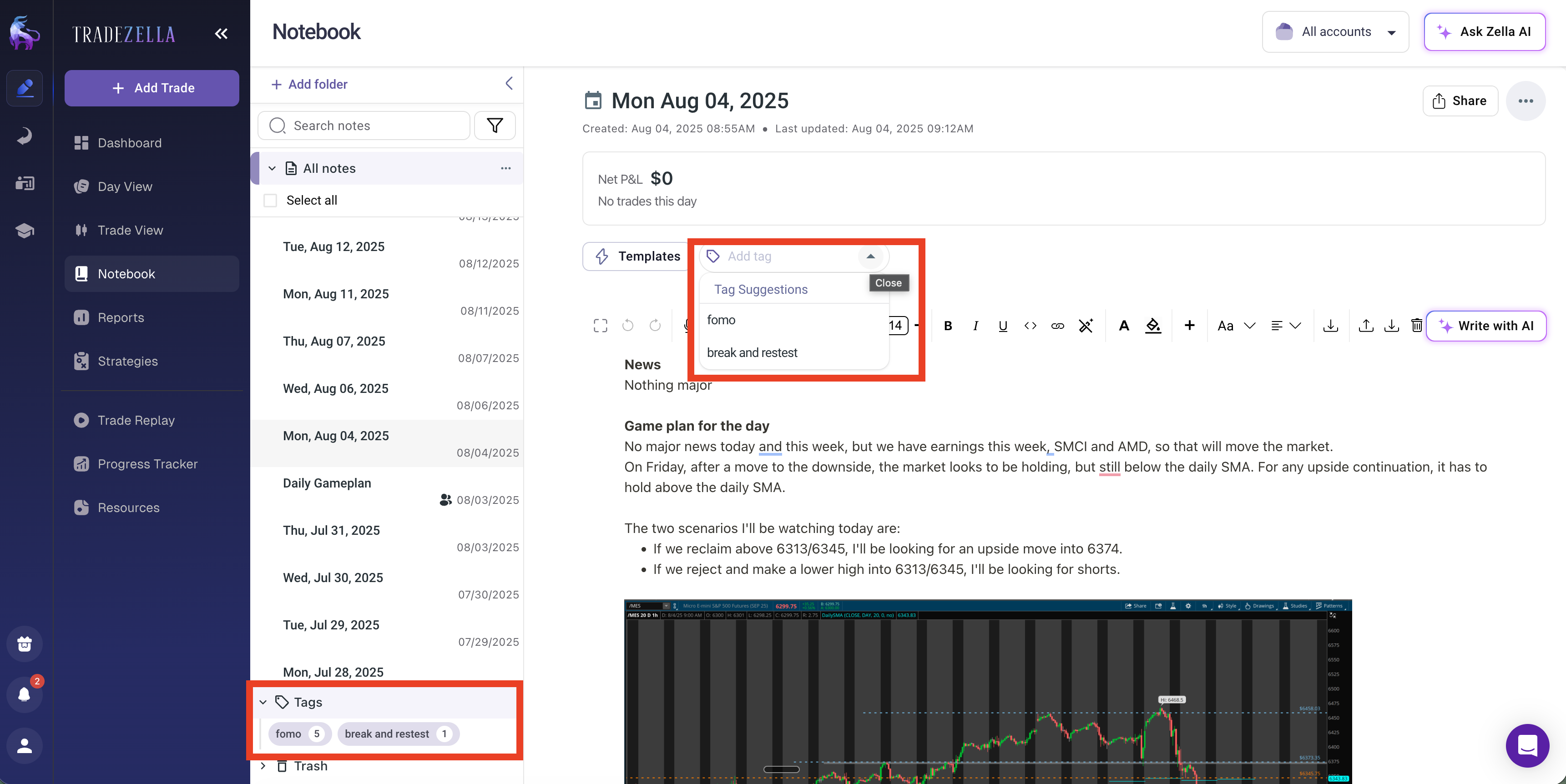
The system: any time you take a trade and you suspect it was FOMO-driven (even partially), tag it "FOMO entry" in your journal immediately after the trade closes. This is the same tag-and-review approach that works for tracking any trading habit, but applied specifically to your most expensive behavioral pattern.
After 30 trades tagged as FOMO, pull up your tag performance report and look at two numbers: win rate on FOMO-tagged trades versus your overall win rate, and total P&L on FOMO-tagged trades versus your planned setup trades.
In TradeZella, your tag analytics show every tagged entry side by side: win rate, average P&L per trade, total profit or loss, and average R-multiple. The comparison is usually jarring.
Tradezella reports tag performance
What to do: Create a "FOMO entry" tag in your journal today. Tag every suspected FOMO trade for the next 30 days. After 30 tagged trades, sort your analytics by tag and look at the win rate breakdown and the expectancy gap between your FOMO trades and your planned setups.
What Do FOMO Trades Actually Cost? A Side-by-Side Comparison
The numbers below represent composite data from typical retail trader journals. Your specific numbers will vary, but the pattern is consistent: FOMO trades underperform planned setups across every metric.
Metric
FOMO Trades
Planned Setups
What It Means
Win Rate
28 – 35%
55 – 65%
FOMO entries lose roughly twice as often
Average R-Multiple
-0.6R to -0.3R
+0.4R to +0.8R
FOMO trades are negative expectancy as a group
Profit Factor
0.5 – 0.8
1.5 – 2.2
Below 1.0 means net loser; above 1.5 means real edge
Avg Loss Size
1.5 – 2x normal
1x (per rules)
Wider stops and bigger size inflate FOMO losses
Avg Hold Time
Shorter than plan
Matches strategy
FOMO exits early on fear or exits late hoping for recovery
Typical Trigger
Social media, big green candle, chat rooms
Pre-market prep, watchlist, strategy rules
Source of the trade idea predicts the outcome
The profit factor gap is the clearest signal. A profit factor below 1.0 means FOMO trades are net losers as a category. Planned setups running above 1.5 tells you exactly where your edge lives.
Why Does Willpower Fail Against FOMO (But Data Works)?
Every trading book tells you to "just be more disciplined." This advice has never helped a single trader. FOMO triggers are emotional and immediate. Willpower is abstract and future-oriented.
Data is different. When you can look at your own journal and see that your FOMO-tagged entries have a 31% win rate versus your planned setups at 64%, you're not dealing with a principle anymore. You're dealing with a number that represents actual money you lost.
The behavior change happens automatically because you're no longer fighting instinct with discipline. You're comparing two options: take the FOMO trade and join a statistical class with a 31% win rate, or wait for the planned setup with the 64% win rate. That's not a discipline question. That's a math question.
This is the same reason tracking any trading habit works better than trying to force behavior change. When you can see the dollar cost of a behavior in your own data, the decision makes itself.
How Should You Journal FOMO Trades for Faster Improvement?
Tagging a trade is the minimum. For faster improvement, add a brief note to any trade you tagged as FOMO. Keep it to two or three sentences: what triggered the FOMO, what your rules actually said to do, and what you did instead.
In TradeZella's notebook, you can link notes directly to individual trades, so your FOMO journal entry sits right next to the trade data for that entry.
After 30 days of tagging and journaling, review your FOMO notes as a batch. You'll almost certainly find a pattern: a specific time of day, a specific type of ticker, or a specific trigger (social media, chat rooms, a big green candle). That pattern is your actual problem to solve, not "FOMO" in general.
FOMO and Prop Firm Challenges
If you're trading a prop firm challenge, FOMO is even more dangerous. Most challenge failures come from a single blown day, and FOMO entries are the most common trigger. One oversized FOMO trade can violate your daily drawdown limit and end the challenge immediately. The 5-question audit is non-negotiable during funded evaluations.
FOMO Looks Different for Scalpers vs Swing Traders
For scalpers, FOMO typically shows up as chasing a move that's already 3-5 ticks past the intended entry. The risk-reward collapses instantly because scalp setups have tight parameters. For swing traders, FOMO is more about entering a position because the daily chart "looks like it's about to break out" without waiting for the actual confirmation your strategy requires. Both are the same behavior, just on different timeframes.
Key Takeaways
FOMO trading includes chasing entries, widening stops, and oversizing on momentum names. Not just "buying after a big move."
The 5-question pre-entry audit catches FOMO before it happens: Is this in your strategy list? Did you plan it pre-market? Are you chasing? Did your size change? Would you take it if no one was talking about it?
Willpower fails against FOMO because it's abstract. Data works because it's specific.
Tag every suspected FOMO trade. After 30 tags, review the performance breakdown.
FOMO, revenge trading, and overtrading are usually a sequence. Fix the FOMO and you interrupt the cascade at the start.
FOMO is especially dangerous during prop firm challenges where a single oversized trade can end the evaluation.
Frequently Asked Questions
What is FOMO trading?
FOMO trading is taking a position based on fear of missing a move rather than based on your trading rules. It typically looks like chasing an entry after price has already moved, putting more size in than your rules allow because a trade "feels" strong, or entering a setup that doesn't meet your criteria because everyone else is talking about it.
How do I know if I'm FOMO trading?
Run the 5-question audit before every entry: Is this setup in your strategy list? Did you plan it pre-market? Are you entering at the price you intended? Did your position size change? Would you take this trade if no one was talking about it? If you answer "no" to any of these, it's likely FOMO.
Does FOMO trading actually cost money?
Yes, and it's measurable. Traders who tag FOMO entries in their journal and review the performance data typically find their FOMO-tagged trades have win rates 20-35% lower than their planned setups. You can see this in your own data by filtering your win rate by tag in your journal analytics.
Can you completely eliminate FOMO from trading?
Not entirely, because the emotional trigger is human. But you can eliminate the behavior by building a system: pre-trade audit, post-trade tagging, and monthly review of FOMO trade performance. After 60-90 days, most traders find their FOMO entries drop by more than half.
What's the fastest way to stop FOMO trading?
Tag every FOMO entry for 30 days, then review the performance data. Seeing your own numbers (31% win rate versus 64% on planned trades, a specific dollar cost) is more powerful than any mindset advice.
How does FOMO affect prop firm challenge accounts?
FOMO is one of the top reasons traders fail prop firm evaluations. A single oversized FOMO trade can breach your daily drawdown limit and disqualify you immediately. During funded evaluations, the 5-question pre-entry audit becomes critical because you have zero margin for behavioral mistakes.