How to Handle a Trading Losing Streak (The Recovery Framework)
How to Handle a Trading Losing Streak (The Recovery Framework)
Losing streaks are statistically inevitable for every trader with a positive expectancy. This guide walks through a 3-phase recovery framework (Diagnosis, Stabilization, Rebuild) with TradeZella analytics at each step, plus the math that shows what's normal and what's not.
class SampleComponent extends React.Component {
  // using the experimental public class field syntax below. We can also attach
  // the contextType to the current class
  static contextType = ColorContext;
  render() {
    return <Button color={this.color} />
  }
}
Last Updated: April 17th, 2026
A losing streak in trading is a sequence of consecutive losing trades that drains your account balance and, more dangerously, your confidence and discipline. Every trader with a positive trading expectancy will experience losing streaks. They are a statistical certainty, not a sign that your strategy is broken. Even a strategy with a 60% win rate will produce strings of 5 or more consecutive losses roughly once in every 100 trades. The problem isn't the losing streak itself. It's what most traders do during one: they panic, change their strategy, double their position size, or quit altogether.
The difference between traders who recover and traders who blow up comes down to one thing: a system for handling the drawdown. Not willpower. Not "taking a break." A structured recovery framework that turns a losing streak from an emotional crisis into a diagnostic opportunity.
This guide walks through the 3-phase recovery framework: Diagnosis (find the root cause), Stabilization (stop the bleeding), and Rebuild (scale back up with confidence). We'll use a real scenario throughout: a trader who lost $2,800 over 8 trades and used this framework to discover that 6 of those trades were taken outside their best time window.
What Actually Causes a Trading Losing Streak?
Before you can fix a losing streak, you need to figure out what's driving it. Most traders skip this step entirely. They assume the strategy is broken and start making changes, which usually makes things worse.
Losing streaks generally fall into three categories:
Strategy problem. Your setup has stopped working. This happens when market conditions shift. A breakout strategy that crushed it during a trending market will bleed during choppy, range-bound conditions. The data signature: your win rate drops across all your setups, not just one.
Execution problem. Your strategy is fine, but you're not following it. You're entering early, moving stops, skipping setups, or revenge trading after losses. The data signature: your "rules followed" trades are still profitable, but your overall numbers are dragged down by impulsive trades.
Market condition problem. The market itself has changed (low volatility, news-driven chop, holiday volume). No strategy thrives in every environment. The data signature: your win rate and average P&L are down, but so are most other traders in your timeframe and market.
Each cause requires a different fix. A strategy problem needs adaptation. An execution problem needs accountability. A market condition problem needs patience. The diagnosis phase below tells you which one you're dealing with.
The Math: Losing Streaks Are Inevitable
If your win rate is 55%, the probability of any single sequence of 5 trades all being losers is 0.45 to the fifth power, or about 1.8%. That sounds rare. But over 250 trades in a year, you have roughly 246 possible starting points for a 5-trade sequence. The probability of experiencing at least one 5-trade losing streak over those 250 trades is over 98%.
Here is what that looks like at different win rates:
40% win rate: A 5-trade losing streak has a 7.8% chance per sequence. Over 250 trades, it's essentially guaranteed multiple times per year.
50% win rate: A 5-trade losing streak has a 3.1% chance per sequence. You should expect 2 to 3 per year.
55% win rate: A 5-trade losing streak has a 1.8% chance per sequence. You should still expect 1 to 2 per year.
60% win rate: A 5-trade losing streak has a 1.0% chance per sequence. Even at this win rate, it happens.
The takeaway: if you're a profitable trader and you experience a 5-trade losing streak, the most likely explanation is math, not a broken strategy. Your trading expectancy hasn't changed. The variance within that expectancy just showed up in a cluster.
The Behavior: When Variance Triggers a Cascade
The real danger of a losing streak is not the losses themselves. It's what the losses make you do next. Behavioral research consistently shows that losses feel roughly twice as painful as equivalent gains feel good. Three consecutive $200 losses feel much worse than three consecutive $200 wins feel good.
That emotional asymmetry triggers a predictable cascade:
Loss 1-2: Mild frustration. You review the trades and move on.
Loss 3-4: Self-doubt starts. You begin questioning whether your setup still works. FOMO trading creeps in as you chase entries trying to "get it back."
Loss 5-6: Discipline breaks down. You take trades outside your plan, increase size, or switch strategies mid-session. This is full revenge trading behavior.
Loss 7+: Tilt. You're trading to make back money, not to follow your system. Overtrading takes over. What started as $200 risk per trade becomes $400 or $500 because "I need to recover."
The cascade is the real problem. The first 2-3 losses may have been pure variance, trades that followed your rules and just didn't work out. But losses 4 through 7 were behavioral. They were trading mistakes caused by your emotional reaction to the streak, not by the market. This is why a protocol matters. You need to know, in advance, exactly what you will do at each stage.
How Do You Diagnose a Losing Streak? (Phase 1)
The first thing to do when you hit a losing streak is stop guessing and start looking at data. Pull up your last 20 trades and run through this diagnostic checklist.
Step 1: Isolate the Losing Period
Open your trade journal and filter to the exact date range where the losses started. Don't look at your "all time" numbers. You need a clean view of just the losing period.
In TradeZella, your analytics dashboard lets you filter by custom date range. Select the start date of when the streak began and today's date. You'll see your total P&L, win rate, average winner, average loser, and profit factor for just that period.
TradeZella Dashoard
What to do: Set your date range to cover the exact losing period. Write down your win rate, profit factor, and average R-multiple for this window. Compare these numbers to your 90-day average.
Step 2: Check Performance by Setup Type
Filter your analytics by each Strategy you trade. Are all your setups losing? Or is the damage concentrated in one or two?
If one Strategy accounts for most of the losses, the problem is likely strategy-specific. Pause that setup and continue trading the ones that are working. If all Strategies are underperforming equally, look at execution or market conditions next.
Step 3: Check Performance by Time of Day
This is where the real insight often hides. Here's the scenario we mentioned: a trader lost $2,800 over 8 trades. When they filtered by time, they discovered 6 of those 8 trades happened after 1:00 PM. Their morning trades (before 11:00 AM) were actually still profitable during this "losing streak."
In TradeZella, the time-of-day performance report breaks your results into hourly or session-based windows. You'll see a clear breakdown showing which hours are profitable and which are costing you money.
What to do: Pull up your time-of-day report for the losing period. Compare it to your overall time-of-day performance. If specific hours are dragging you down, you've found your first actionable fix.
Step 4: Check for Execution Breakdowns
Look at each losing trade individually and ask: did I follow my rules? Tag each trade honestly as "rules followed" or "rules broken."
If more than 40% of your losing-period trades are "rules broken," the losing streak is an execution problem, not a strategy problem. Use the trade review process framework to assess entry quality, exit execution, and whether each trade matched your written trading plan.
The Diagnosis Decision Tree
If your rule-following trades are still profitable but your overall P&L is negative: Execution problem. Go to Phase 2 with a focus on trade selection and rule adherence.
If all setups are losing but your execution is clean: Market condition problem. Go to Phase 2 with a focus on reducing exposure until conditions improve.
If one specific setup is driving the losses: Strategy problem. Go to Phase 2 with a focus on pausing that setup and verifying it through backtesting on recent market data.
What Should You Do During a Losing Streak? (Phase 2: Stabilization)
Once you know the cause, the next phase is stabilization. The goal here isn't to make money. It's to stop the bleeding and rebuild confidence through controlled, disciplined trading. The protocol below gives you specific actions at each severity level. The dollar examples assume a $50,000 account with $200 risk per trade (0.4% of capital, well within standard risk management guidelines). Adjust the numbers to your account size using a position size calculator.
Level
Consecutive Losses
Account Impact ($50K, $200/trade)
Response
Normal Variance
2-3
-$400 to -$600 (0.8%-1.2%)
Review trades for rule violations. If rules followed, continue at full size.
Caution
4-5
-$800 to -$1,000 (1.6%-2%)
Cut position size by 50%. Review last 10 trades in journal. Check strategy metrics.
Warning
6-7
-$1,200 to -$1,400 (2.4%-2.8%)
Stop trading for the session. Full journal review. Compare metrics to 100-trade baseline.
Critical
8-10
-$1,600 to -$2,000 (3.2%-4%)
Take 1-3 days off. Backtest strategy on recent data. Paper trade 5-10 trades before going live.
Emergency
10+
-$2,000+ (4%+)
Full strategy audit. Paper trade 1-2 weeks. Re-enter at 25% size with graduated recovery.
Level 1: Normal Variance (2-3 consecutive losses, down $400-$600)
Review the last 2-3 trades. Were they all rule-following setups? If yes, this is normal. Keep trading at full size. Every strategy has stretches where valid setups lose. The worst thing you can do at this stage is start second-guessing a system that has proven itself over hundreds of trades.
If one or more of the trades broke your rules (entered early, moved your stop, sized too large), note the violation in your journal and refocus on execution. The fix here is awareness, not a change in strategy.
Level 2: Caution (4-5 consecutive losses, down $800-$1,000)
Cut your position size by 50%. This is non-negotiable. If you normally risk $200 per trade, drop to $100. This does two things: it limits further damage, and it reduces emotional pressure. When less money is on the line, you make cleaner decisions. A $100 loss feels very different from a $200 loss when you're already down $800.
Trade only your top 2 setups. Look at your all-time analytics. Which two Strategies have the highest profit factor and the most trades? Those are the only setups you're allowed to take during stabilization. Pull up your Strategies performance in TradeZella and sort by profit factor to find them instantly.
Level 3: Warning (6-7 consecutive losses, down $1,200-$1,400)
Stop trading for the rest of the session. Do not take another trade today. Six to seven consecutive losses is rare enough (less than 1% probability per sequence even at a 50% win rate) that it warrants a full pause.
Do a complete journal review of all trades in the streak. Tag each one: "followed rules" or "broke rules." If the majority followed rules, your strategy may be experiencing a market regime mismatch. If the majority broke rules, the problem is behavioral, and continuing to trade will only make it worse.
Level 4: Critical (8-10 consecutive losses, down $1,600-$2,000)
Take 1 to 3 full trading days off. Do not watch the market. Do not "paper trade just to stay sharp." Disconnect completely. The cortisol buildup from 8+ consecutive losses impairs decision-making in measurable ways.
During your time off, run a backtesting session on your primary strategy using recent market data. Does the strategy still produce positive expectancy on the last 3 months of data? If yes, the streak was variance and you return with confidence. If not, the market may have shifted and your strategy needs adjustment before you trade it live again.
Level 5: Emergency (10+ consecutive losses, down $2,000+)
Full strategy audit. Ten or more consecutive losses is extremely unlikely for any strategy with positive expectancy (less than 0.05% probability at a 55% win rate). At this point, something fundamental has changed: market conditions, your execution, or both.
Paper trade for 1 to 2 weeks using your exact strategy rules. Track results the same way you would with real money. If the paper trades are profitable, the problem is psychological, not strategic. If the paper trades also lose, the strategy needs work. When you return to live trading, start at 25% of your normal position size and use the graduated recovery protocol from the drawdown management guide.
Use Your Journal for Structured Reflection During Stabilization
Set a minimum of 5 trades before you evaluate how stabilization is going. Judge the quality of your process, not the outcome of individual trades.
After each trade during stabilization, write a brief reflection answering three questions:
Did I follow my entry criteria exactly?
Did I manage the trade according to my plan?
If I could take this trade again, would I take it the same way?
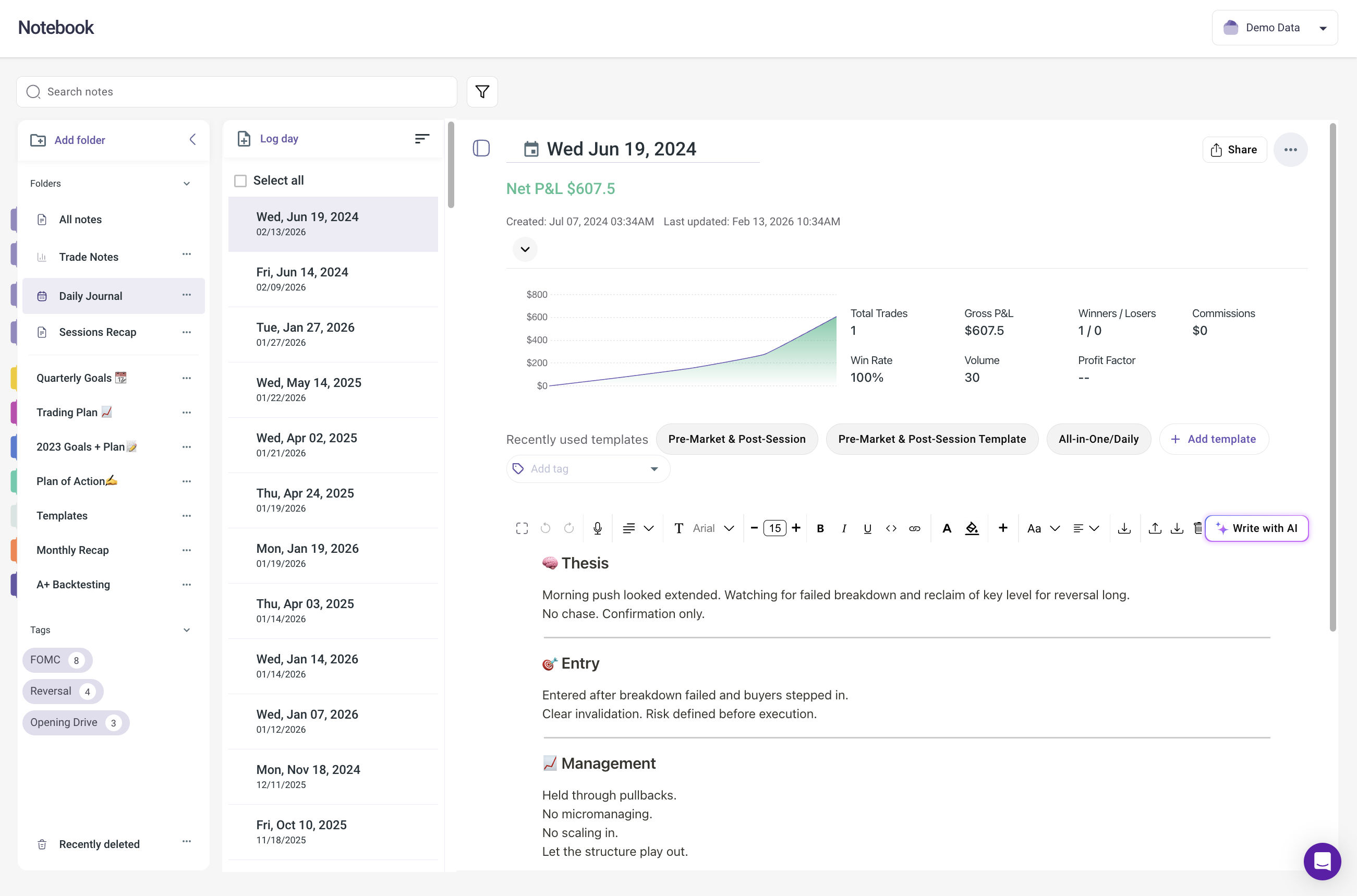
In TradeZella, the Notebook feature lets you attach written reflections directly to individual trades. Each reflection links to the trade's data, so you can see your thought process alongside entry price, exit price, R-multiple, and P&L in one view.
How Do You Size Back Up After a Losing Streak? (Phase 3: Rebuild)
The biggest mistake traders make after a losing streak ends is jumping straight back to full size. You take a winning trade at reduced size and think "I'm back," then immediately return to normal sizing and take another loss that puts you right back into the emotional spiral.
The 10-Trade Rule
Stabilization is working when you've completed 10 consecutive rule-following trades, regardless of whether they were winners or losers. Don't count 10 consecutive wins. Count 10 consecutive trades where you followed every rule: correct entry criteria, correct position size, correct stop placement, correct exit.
Graduated Size Increase
Once you hit 10 clean trades, use a graduated recovery. The drawdown management article covers the full protocol. Here is what it looks like in practice on a $50,000 account:
During the streak: $100 risk per trade (50% of normal $200)
Stage 1 (first 3-5 rule-following trades): Stay at $100 risk
Stage 2 (next 3-5 rule-following trades): Move to $150 risk (75% of normal)
Stage 3 (net positive for the week): Return to $200 risk (full size)
This approach protects you from the "double dip," where a premature return to full size turns a recovering week into another losing week. It also rebuilds confidence gradually, which matters more than most traders admit.
Track Your Recovery in the Data
In TradeZella, create a custom tag called "Recovery Phase" and tag every trade taken during Phases 2 and 3. After the rebuild, you can pull up analytics for just your recovery trades and compare win rate, profit factor, and P&L against the losing-streak period.
What to do: Create a "Recovery Phase" tag before you start Phase 2. Tag every stabilization and rebuild trade. When the recovery is complete, compare your recovery-phase analytics to the losing-streak analytics. This data becomes a permanent reference for the next time you hit a streak.
How Does Your Trading Journal Help During a Losing Streak?
If you're tracking trades in a spreadsheet, a losing streak gives you a column of red numbers and not much else. You can see that you lost money. You can't see why. This is where the difference between a trading journal vs spreadsheet becomes critical.
A dedicated trading journal like TradeZella with analytics gives you the data to diagnose the streak instead of just suffering through it.
Calendar view shows the pattern. Open your calendar and look at the last 2 weeks. Are the red days clustering? Are they on specific days of the week? Some traders consistently lose on Mondays (low conviction, easing into the week) or Fridays (overtrading before the weekend). If the streak correlates with a day-of-week pattern, track trading habits to confirm and adjust your schedule.
Strategy filter isolates the problem. If you run 3 Strategies and one of them is responsible for all the losing trades, the problem isn't "you." It's that specific strategy in the current market. Pause that Strategy and continue trading the ones that are working. Without strategy-level filtering, you might stop trading entirely when only one setup is underperforming.
Tag analytics reveal the behavioral component. Tag every trade during a streak: "A+ setup," "B setup," "FOMO entry," "revenge trade," "rule violation." After 10+ tagged trades, pull the tag report. If 60% of your losses came from trades tagged "FOMO" or "revenge," the problem is clear. Your strategy isn't broken. Your emotional response to the first few losses created the rest of the streak.
R-multiple tracking shows severity. A losing streak where every trade loses 1R (you respected your stop loss) is very different from a streak where trades lose 2R or 3R (you moved your stop or averaged down). The first is variance. The second is discipline failure. R-multiple tracking makes this distinction immediately visible.
Your trade review process should include a specific step for streaks: after 5 consecutive losses, pull up the last 30 trades, compare your current metrics to your 100-trade baseline, and run the rule-following vs rule-breaking analysis before taking another trade.
Do Prop Firm Traders Handle Losing Streaks Differently?
Yes, because the margin for error is much smaller. Understanding how prop firms work means knowing that most evaluation accounts have a maximum drawdown limit of 5 to 10%. On a $100,000 evaluation, a 5% max drawdown means you can lose $5,000 total before failing. A 5-trade losing streak at $500 risk per trade ($2,500 total) puts you halfway to the limit.
Prop firm traders need a more aggressive version of the protocol:
Level 1 (2-3 losses): Same as personal account. Review and continue.
Level 2 (4 losses): Cut size by 50% immediately. On a prop firm evaluation, you can't afford to wait for 5 losses.
Level 3 (5-6 losses): Stop trading for the day. With prop firm drawdown limits, 6 consecutive losses at full size can end your evaluation.
Level 4 (hitting 50% of max drawdown): Stop trading the evaluation entirely. Take 2-3 days off, paper trade, and return at 25% size. Protecting the remaining drawdown buffer is more important than making money right now.
If you're running multiple prop firm accounts, a losing streak on one account can bleed into the others through correlated trades and emotional tilt. TradeZella's Prop Firm Sync tracks drawdown remaining across all accounts in one dashboard, so you can see exactly how much room you have before reaching any account's limit. For a deeper look at managing evaluations, see the guide on how to pass prop firm challenge evaluations.
How trading style affects streak frequency: If you run scalping strategies and take 20+ trades per day, a 5-trade losing streak can happen in a single session, multiple times per month. If you trade swing trading strategies and take 5 trades per week, a 5-trade losing streak spans an entire week and feels much heavier psychologically. The protocol actions are the same, but the timeframes compress or expand depending on your trading frequency. High-frequency traders should base their protocol on per-session loss limits. Low-frequency traders should base it on per-week or per-month metrics.
When Should You Actually Stop Trading?
Stop if: You can't follow your own rules for 3 consecutive trades during stabilization. If you're still revenge trading or ignoring entry criteria at reduced size, you need time away from the screen, not more trades.
Stop if: Your total drawdown exceeds your pre-defined maximum (typically 10 to 15% of account). At this level of loss, you need a full strategy review and extended time off. Trying to trade your way out of a 15% drawdown under emotional pressure almost always makes it worse.
Don't stop if: You're following rules but still losing. Variance happens. If your execution is clean and your metrics are within historical range, the results will catch up. Stopping a working strategy during normal variance teaches your brain to quit during discomfort, which is the opposite of what you want.
Key Takeaways
Every losing streak has a root cause: strategy problem, execution problem, or market condition problem. Diagnose first, react second.
Losing streaks are statistically inevitable. A trader with a 55% win rate should expect at least one 5-trade losing streak per year. It doesn't mean your strategy is broken.
The real danger is the behavioral cascade. The first 2-3 losses may be variance, but frustration triggers FOMO, revenge trading, and overtrading, turning a small blip into a real drawdown.
Phase 1 (Diagnosis): Filter your losing-period trades by setup, time of day, and rule adherence using TradeZella's analytics dashboard.
Phase 2 (Stabilization): Cut position size by 50%, trade only your top 2 Strategies, set a 5-trade minimum before evaluating, and journal every trade using the Notebook.
Phase 3 (Rebuild): Complete 10 consecutive rule-following trades before scaling back. Use graduated sizing: 50% to 75% to 100%.
Prop firm traders need a tighter protocol. Trigger stabilization at 4 losses instead of 5, and stop at 5-6 losses instead of 7.
The goal during recovery is process quality, not profit. Tag every recovery trade and compare the data when you're back to full size.
For a trader with a 50 to 60 percent win rate, 3 to 5 consecutive losses is completely normal and should be expected multiple times per year. Even 7 consecutive losses can happen with a 50 percent win rate, with roughly a 0.8 percent probability per sequence. Over hundreds of trades, these streaks are a statistical certainty, not a sign of failure.
Should I change my trading strategy during a losing streak?
Not during the streak itself. Making strategy changes while emotional leads to constantly switching approaches and never building enough data on any single system. Complete the diagnosis phase first. If the data shows a genuine strategy problem over 30 or more trades, then pause that specific setup and test adjustments through backtesting before going live again.
How do I know if my losing streak is just normal variance?
Run the math. If your strategy has a 60 percent win rate, a streak of 5 losses in a row will happen roughly once in every 100 trades. Compare your current drawdown to your historical maximum drawdown. If you are within normal range and your rule-following trades are still profitable, it is likely variance. If metrics have dropped significantly over 30 or more trades, investigate further.
What is the biggest mistake traders make during losing streaks?
Increasing position size to "make it back faster." The recovery framework prescribes the opposite: reduce size during the streak and only scale back up after proving you can trade with discipline at reduced size. The second biggest mistake is changing strategies mid-streak without any data to support the switch.
How do I rebuild confidence after a losing streak?
Start by trading at reduced position size (50 percent of normal). Complete 10 consecutive rule-following trades at the smaller size. Then move to 75 percent of normal size for another set of rule-following trades. Finally return to full size. This graduated approach rebuilds confidence through demonstrated results rather than forcing yourself to "just trust the process."
How do prop firm traders handle losing streaks differently?
Prop firm traders need a tighter protocol because drawdown limits are typically 5 to 10 percent of the account. Cut position size earlier (at 4 consecutive losses instead of 5), stop trading the session earlier (at 5 to 6 losses instead of 7), and stop the evaluation entirely if you have used 50 percent of your maximum drawdown allowance. Protecting the remaining buffer is more important than trying to recover immediately.
Should I track losing streaks in my trading journal?
Yes. Create a custom tag like Recovery Phase and tag every trade during the streak and the recovery period. In journal TradeZella, you can create custom tags and pull tag analytics to see what percentage of losses came from good setups versus emotional trades. This data tells you whether the problem was variance or behavior, which determines how you prevent the next streak from spiraling