Drawdown Management: How to Survive and Recover from Trading Drawdowns
Drawdown Management: How to Survive and Recover from Trading Drawdowns
A 20% drawdown requires a 25% gain to recover. A 50% drawdown requires 100%. This guide gives you the 3-tier protocol that funded traders use: continue at full size in Tier 1, cut size by 50% in Tier 2, and stop trading entirely in Tier 3, with exact thresholds for personal and prop firm accounts.
class SampleComponent extends React.Component {
  // using the experimental public class field syntax below. We can also attach
  // the contextType to the current class
  static contextType = ColorContext;
  render() {
    return <Button color={this.color} />
  }
}
Last Updated: April 9, 2026
A 10% drawdown requires an 11.1% gain to recover. A 25% drawdown requires 33.3%. A 50% drawdown requires 100%. These numbers aren't debatable. They're math. And they're the reason drawdown management matters more than any entry signal, indicator, or strategy you'll ever learn.
Every trader experiences drawdowns. The question isn't whether you'll face one, but whether you have a protocol for when it happens. Most traders don't. They keep trading at full size until they're down 20%, panic, and dig the hole deeper.
This article gives you the three-tier drawdown management protocol. You'll know exactly when to stay the course, when to reduce risk, and when to stop trading entirely.
What Is the Drawdown Math Every Trader Should Know?
Drawdown
$ Lost ($50K Account)
Gain Needed to Recover
$ Needed to Recover
Recovery at 2%/mo
Severity
5%
$2,500
5.3%
$2,500
~3 months
Manageable
10%
$5,000
11.1%
$5,000
~6 months
Uncomfortable
15%
$7,500
17.6%
$7,500
~9 months
Painful
20%
$10,000
25.0%
$10,000
~11 months
Dangerous
30%
$15,000
42.9%
$15,000
~18 months
Critical
50%
$25,000
100.0%
$25,000
~35 months
Account Blown
Recovery time assumes consistent 2% monthly returns with no further drawdown. Actual recovery depends on strategy edge, position sizing, and market conditions.
The asymmetry is what makes this dangerous. A 5% drawdown barely requires extra effort to recover. A 20% drawdown requires 25% gain, which at 2% monthly returns takes over 11 months. A 50% drawdown is, for practical purposes, a blown account.
Use the free Drawdown Recovery Calculator to model your specific scenario. Enter your current drawdown percentage and your average monthly return, and it shows you exactly how many months recovery takes at your pace.
Preventing deep drawdowns is exponentially more valuable than trying to recover from them.
What Is the Three-Tier Drawdown Protocol?
Tier 1: Normal Variance (0 to 3% Drawdown)
Continue trading your plan exactly as written. Don't reduce size. Don't second-guess your strategy. A 2% drawdown is not a signal that something is broken.
Every strategy with a positive edge experiences losing streaks. If your win rate is 55%, you will hit 4-5 consecutive losers regularly. That's not a drawdown problem. That's normal variance. The protocol says: trust your numbers and keep executing.
What to check in Tier 1: Are you following your rules? Are you taking only your defined setups? If yes, there is nothing to change. If you are deviating (entering early, skipping stops, sizing up after wins), fix the deviation, not the strategy.
3. Review your last 15 trades. Are you following your rules?
4. Journal every trade with extra detail.
TradeZella Journal Notebook
Why 50% size reduction matters: If your normal risk is 1% per trade ($500 on a $50K account), cutting to 0.5% ($250) means you can take 10 losers in a row before reaching Tier 3. That's 10 chances to find your footing instead of 5. The reduced size doesn't just limit losses. It reduces the emotional pressure per trade, which is where revenge trading starts.
The Tier 2 diagnostic: Run a trade review on your last 15 trades. Filter by setup type. Is one setup accounting for most of the losses? Filter by time of day. Are your afternoon trades significantly worse than your morning trades? Filter by habit tags. Did you follow your entry rules on every trade, or did you start forcing entries?
The answers from this diagnostic tell you whether the drawdown is variance (your setups are fine, just a losing streak) or behavioral (you're deviating from your plan). If it's variance, stay at reduced size and let the edge play out. If it's behavioral, fix the behavior before increasing size.
Watch for overtrading. Traders in Tier 2 drawdowns often increase their trade count trying to recover. This is the opposite of what the protocol says. Fewer trades, higher quality, smaller size. If your trade count goes up while your drawdown deepens, that's a Tier 3 signal.
Tier 3: Capital Protection Mode (5%+ Drawdown)
1. Stop trading. Take the rest of the day off.
2. Run a full diagnostic. Filter by setup, time of day, and rule adherence.
3. Write a recovery plan.
4. Re-enter at reduced size. Begin at 25% of normal position size.
Why stop entirely: At 5%+ drawdown, you are in a state where emotional decision-making overrides your system. The FOMO to recover is at its peak. The temptation to size up "just this once" is overwhelming. The protocol removes the opportunity for damage by taking you out of the market.
The Tier 3 recovery plan: This isn't "get back to breakeven as fast as possible." It's a structured re-entry at 25% size. If your normal risk is 1% per trade, you re-enter at 0.25%. You stay at 0.25% until you string together 5 consecutive winning days (not trades, days). Then you move to 50%. Then back to 75%. Then full size. This graduated return rebuilds confidence and proves the edge is still working before you commit full capital.
The math of graduated recovery: At 25% size, even if you hit another losing streak, the damage is minimal. Five losers at 0.25% risk is 1.25% total, which barely moves the drawdown. But five winners at 0.25% risk with a 1.5:1 reward ratio is +1.875%. You're recovering, slowly but safely. Once you prove the system works at small size, scaling back up is a data-driven decision, not an emotional one.
IMAGE: 3-Tier Protocol VisualFile: drawdown-tiers-visual.pngAlt: Three-tier drawdown protocol showing normal variance at 0-3%, elevated risk at 3-5%, and capital protection at 5%+Placement: After Tier 3 section
How Do You Track Your Drawdown in Real Time?
In TradeZella, your analytics dashboard shows your drawdown in real time. The drawdown chart displays your current distance from your equity high.
What to do: Check your drawdown level before every trading session. If you're in Tier 2, switch to reduced-size mode immediately.
The key metric to watch alongside drawdown is profit factor. During a drawdown, your overall profit factor drops. But if you filter by the last 10 trades only, you can see whether your recent trades are trending positive (variance recovery) or still negative (systematic issue). If your last-10-trade profit factor is above 1.0 even during a drawdown, your edge is intact. Stay the course at reduced size.
How Should Prop Firm Traders Manage Drawdowns?
Standard prop firm rules: 5% maximum daily drawdown, 10% maximum total drawdown. These limits are hard. There is no buffer, no second chance. Hit the limit and your account is closed.
Tier
Personal Account
Prop Firm Account
Position Size
Action
Tier 1: Normal Variance
0-3% drawdown
0-2% drawdown
100% (full size)
Continue trading your plan. No changes.
Tier 2: Elevated Risk
3-5% drawdown
2-3.5% drawdown
50% of normal
Cut size, A-setups only, run diagnostic on last 15 trades.
Tier 3: Capital Protection
5%+ drawdown
3.5%+ drawdown
0% (stop), then 25% re-entry
Stop trading. Full diagnostic. Graduated recovery at 25% → 50% → 75% → 100%.
Prop firm thresholds are tighter because firm hard limits (typically 5% daily, 10% total) leave no room for error. Setting personal triggers at 50% of firm limits creates a protective buffer.
Why the prop firm thresholds are tighter: if your personal Tier 3 starts at 5% but the firm's hard limit is 10%, you only have 5% of room between your stop point and account termination. By starting Tier 2 at 2% (instead of 3%) and Tier 3 at 3.5% (instead of 5%), you create a larger buffer between your personal protocol and the firm's hard stop.
What Is the Daily Drawdown Trap?
Common scenario: a trader loses 2.5% in the morning, doubles size to "make it back," and burns through the remaining 2.5% in two trades. Account violated.
The fix: set a personal daily limit at 2.5% (half the firm's 5% limit). This gives you a full buffer.
This is the same revenge-to-overtrade spiral that kills most prop firm evaluations. The drawdown protocol breaks it structurally: at 2% total drawdown (prop firm Tier 2), you cut size by 50%. Even if you revenge trade at half size, the damage is capped. At 3.5% (prop firm Tier 3), you stop entirely. The protocol doesn't rely on willpower. It relies on pre-committed rules.
What to do: Set up your prop firm account in TradeZella. Set personal alerts at 50% of the firm's limits. When you hit your personal limit, stop trading.
How Does Position Sizing Change During a Drawdown?
The protocol says "cut size by 50% in Tier 2" and "re-enter at 25% in Tier 3." Here's what that looks like in dollars.
$50,000 account, normal 1% risk per trade ($500):
Tier 1 (0-3% drawdown): Risk $500/trade. Account is at $48,500-$50,000. You have room for 10 full-size losers before hitting Tier 3.
Tier 2 (3-5% drawdown): Risk $250/trade (50% cut). Account is at $47,500-$48,500. You have room for 8 reduced-size losers before hitting Tier 3. The reduced size also means your daily risk budget goes further. If you normally take 5 trades/day at $500 risk ($2,500 daily exposure), cutting to $250 means you can take 5 trades with only $1,250 daily exposure.
Tier 3 recovery (5%+ drawdown): Risk $125/trade (25% of normal). Account is at $47,500 or below. At $125 risk, even a 10-trade losing streak only costs $1,250 (2.5% of original equity). This is survivable. Your job isn't to recover fast. It's to prove the system works at small size before scaling back up.
Use the position size calculator to recalculate your exact lot size or contract count at each tier. Don't estimate. Run the formula every time you shift tiers.
What Role Does Expectancy Play During Recovery?
During Tier 2 and Tier 3, you are trading at reduced size. Your expectancy per trade doesn't change (your edge is the same), but the dollar impact does. If your normal expectancy is $0.15 per dollar risked and you normally risk $500, each trade generates $75 in expected value. At 50% size ($250 risk), each trade generates $37.50. At 25% size ($125 risk), each trade generates $18.75.
This means recovery is slow. That's intentional. The protocol prioritizes capital protection over speed. A trader who accepts $18.75 expected value per trade for 2 weeks while proving their system works will recover. A trader who sizes up to $75 expected value per trade to recover faster will blow through Tier 3 and lose the account.
Track your R-multiples during recovery. If your average R on recovery trades is positive and consistent with your historical average, your system is working. Scale up. If your average R is negative or erratic, stay at reduced size until the numbers stabilize.
What Are the Psychology Traps During Drawdowns?
How Does Loss Aversion Make Drawdowns Worse?
Losses feel approximately twice as intense as equivalent gains. During a drawdown, your feelings will tell you to do the opposite of what the protocol recommends.
At 3% drawdown, the urge is to "trade harder" and recover. At 5% drawdown, the urge is to "take one big trade" and get back to breakeven. These impulses feel productive. They are the most destructive decisions a trader can make during a drawdown.
How Does the Revenge Trading Spiral Connect to Drawdowns?
The most dangerous moment is immediately after a losing trade. The protocol breaks this cycle structurally. Cutting size in Tier 2 limits damage even from impulsive trades. Stopping in Tier 3 removes the opportunity entirely.
This is the same cascade documented in our revenge trading and overtrading guides. FOMO leads to a revenge entry. The revenge entry leads to oversizing. The oversizing leads to a daily limit breach. The drawdown protocol interrupts this cascade at the first step: when size is cut in Tier 2, the revenge entry can't do enough damage to trigger the full spiral.
Why Is Acceptance a Trading Skill?
Following the protocol feels passive. It's actually the most aggressive risk management decision you can make. Accepting a drawdown and trading at reduced size is harder than trading at full size, because it requires you to watch opportunities pass without being able to fully capitalize on them. That discipline is what separates professionals from gamblers.
How Do You Build a Drawdown Contingency Plan?
Write this plan before you need it. When you're in a drawdown is the worst time to create one.
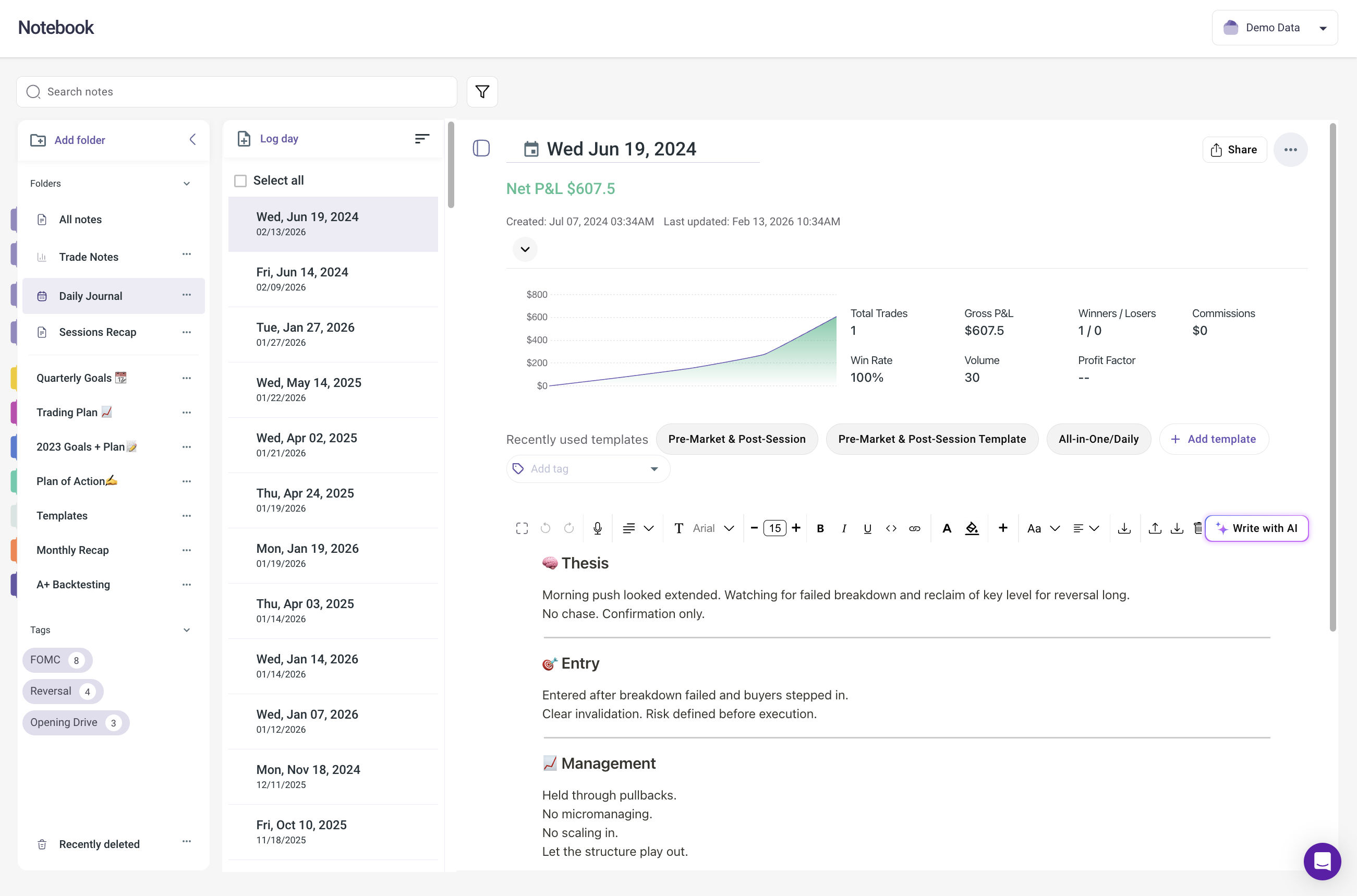
In TradeZella, document your protocol in the Notebook. Create a "Drawdown Protocol" entry with tier thresholds, loss limits, and re-entry criteria.
Your contingency plan should include:
Tier thresholds (personal account and prop firm, if applicable)
Exact position size at each tier (in dollars, not vague percentages)
Maximum trades per day at each tier
Which setups are allowed at each tier (A-setups only in Tier 2, no trading in Tier 3)
Re-entry criteria after Tier 3 (e.g., 5 consecutive winning days at 25% size)
Monthly review date (check if thresholds need adjustment based on new data)
What to do: Create your Drawdown Protocol entry today. Review it monthly.
What Are the Most Common Drawdown Mistakes?
Increasing size to recover faster. The math works against you. If you double size during a drawdown and hit another loser, you've doubled the damage. The recovery math gets exponentially worse, not better.
Changing strategies mid-drawdown. Strategy changes should be data-driven decisions made during calm review sessions. A Tier 2 drawdown is not evidence that your strategy is broken. It might be normal variance. The diagnostic (filter by setup, time of day, rule adherence) tells you whether the strategy failed or whether you failed the strategy.
Ignoring the drawdown. "It'll come back" is hope, not a plan.
Setting no loss limits. Every account needs a circuit breaker.
Recovering too aggressively. Traders who jump from 25% size back to full size after one good day often re-enter Tier 3 within a week. The graduated recovery (25% → 50% → 75% → 100%) exists because it forces you to prove consistency at each level before scaling up.
Key Takeaways
Drawdowns are asymmetric: a 20% loss requires a 25% gain to recover. A 50% loss requires 100%.
Tier 1 (0-3%) is normal variance. Continue at full size. Tier 2 (3-5%) means cut size by 50% and restrict to A-setups. Tier 3 (5%+) means stop trading entirely.
Prop firm traders should tighten thresholds: Tier 2 starts at 2%, Tier 3 at 3.5%.
Set personal loss limits stricter than any external rules.
Write your contingency plan before you need it.
The revenge trading spiral is the most common path from manageable drawdown to account blowup. The protocol interrupts it structurally by cutting size before emotions take over.
Track your drawdown daily. Use profit factor on your last 10 trades to determine if the drawdown is variance or a systematic issue.
Most profitable day traders experience drawdowns of 5 to 10% at some point during the year. If your drawdowns regularly exceed 15%, your position sizing or strategy may need adjustment.
How long does it take to recover from a drawdown?
A 5% drawdown with a strategy averaging 2% monthly returns takes roughly 3 months. A 20% drawdown with the same return rate takes over 11 months. Use the Drawdown Recovery Calculator to model your specific numbers.
Should I stop trading completely during a drawdown?
Only at Tier 3 (5%+ for personal accounts, 3.5%+ for prop firms). In Tier 2, continue at reduced size. Stopping at the first sign of drawdown can erode confidence.
How do I set drawdown limits for a prop firm challenge?
Use 50% of the firm's limits as your personal triggers. If the firm allows 5% daily and 10% total, set yours at 2.5% and 5%. This gives you a full buffer between your personal stop and account termination.
Can I trade my way out of a drawdown by taking more trades?
Almost never. Fewer, higher-quality trades at reduced size is the fastest path back. Increasing trade count during a drawdown is one of the strongest signals of overtrading, and it usually accelerates the drawdown rather than reversing it.
How do I know if my drawdown is variance or a real problem?
Run the Tier 2 diagnostic: filter your last 15 trades by setup, time of day, and whether you followed your rules. If your setups are generating the same win rate and R-multiples as your historical average but you just hit a losing streak, it's variance. If one setup is suddenly negative, or your rule adherence dropped below 80%, the drawdown has a behavioral cause that needs fixing before you resume normal size.
What's the difference between drawdown and losing streak?
A losing streak is a sequence of consecutive losing trades. A drawdown is the total decline from your equity peak, which includes losing streaks but also accounts for partial recoveries that didn't reach the previous high. You can have a drawdown without a long losing streak if you're winning some trades but not enough to recover losses from earlier ones.