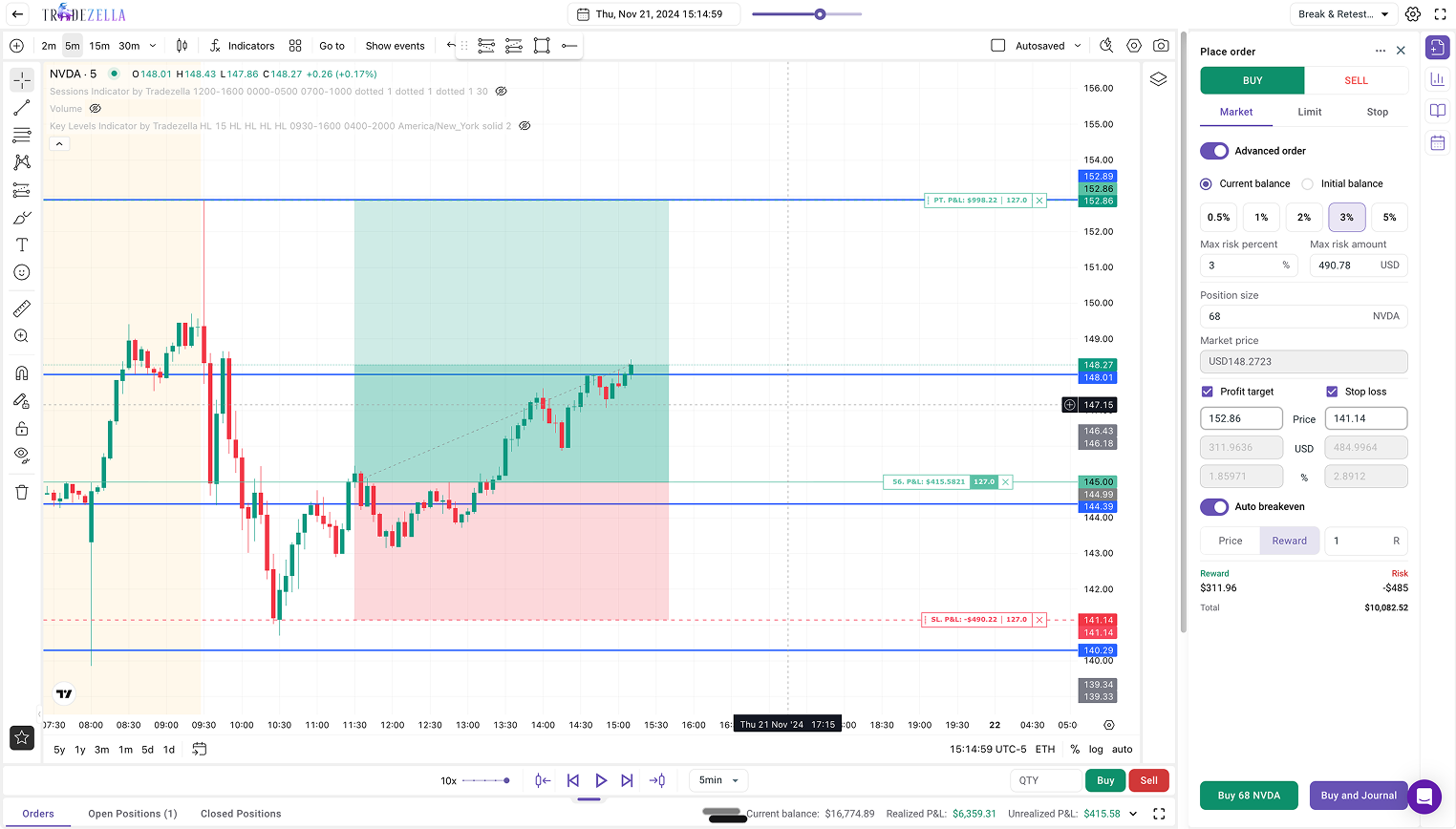
Stop Loss Strategies: How to Set, Manage, and Optimize Stop Losses for Every Trading Style
Stop Loss Strategies: How to Set, Manage, and Optimize Stop Losses for Every Trading Style
Five stop loss strategies with exact placement rules, position sizing math, and journal tracking methods. Includes dollar examples on a $50,000 account and a comparison of percentage, ATR, structure, time-based, and trailing stops.
class SampleComponent extends React.Component {
  // using the experimental public class field syntax below. We can also attach
  // the contextType to the current class
  static contextType = ColorContext;
  render() {
    return <Button color={this.color} />
  }
}
Last Updated: May 19th, 2026
A stop loss is a predetermined price level where you exit a losing trade to protect your capital. Stop loss strategies are the rules that determine where that level sits, how wide it should be, and when to adjust it. The five most common stop loss methods are percentage-based, ATR-based, structure-based, time-based, and trailing stops. Each method fits different trading styles, and the right choice depends on your strategy, the asset's volatility, and your risk per trade.
Every profitable trader has a stop loss system. Not a vague "I'll get out if it drops too much" plan, but a specific, repeatable method that removes the decision from the heat of the moment. Without one, a single bad trade can erase weeks of progress. On a $50,000 account risking 1% per trade ($500), one trade without a stop that moves 5% against you costs $2,500. That is five planned losses wiped out by one unplanned loss.
This guide covers five stop loss strategies with exact placement rules, position sizing math, and dollar examples on a $50,000 account. You will learn which method fits your trading style, how to avoid the most common stop loss mistakes, and how to track stop performance in your journal so your data tells you which approach actually works for your edge.
Ignores market structure, may be too tight or too wide
ATR-Based
Stop placed 1.5-2x ATR below entry
Day traders, futures traders
ES at 5,400, 14-period ATR = 12 pts, 1.5x = 18 pts. Stop at 5,382
Adapts to volatility automatically
Requires ATR indicator, wider stops in volatile markets
Structure-Based
Below key support level or swing low
Technical traders, all styles
AAPL support at $188, entry at $192, stop at $187.50. Risk $500 = 111 shares
Respects price action, logical invalidation
Stop distance varies per trade, requires chart reading skill
Time-Based
Exit if trade does not move within set time window
Day traders, scalpers
Enter breakout at 9:45 AM, exit by 10:15 AM if no follow-through
Prevents dead capital, forces discipline
May exit before move starts, not a price-based risk control
Trailing Stop
Follows price by fixed amount or ATR as trade moves in your favor
Trend traders, swing traders
Buy TSLA at $180, trail 2x ATR ($6). Price hits $195, stop moves to $189
Locks in profits, lets winners run
Can be stopped out on normal pullbacks
Why Does Your Stop Loss Strategy Matter More Than Your Entry?
Most traders spend 90% of their preparation on entries and 10% on exits. The math works the other way. Your entry determines where the trade starts. Your stop loss determines how much you lose when you are wrong, and you will be wrong 40 to 60% of the time in most strategies.
Consider two traders on a $50,000 account, both entering the same stock at $100.
Trader A uses a structure-based stop at $97, risking $3 per share. With a $500 risk per trade, that is 166 shares. If the stock hits the $106 target, profit is $996. If stopped out, the loss is $500. The risk-reward ratio is 2:1.
Trader B uses a mental stop "around $95" but does not place a hard order. The stock drops to $97, and Trader B thinks "it will bounce." It drops to $94, and Trader B exits in a panic at $93.50. The loss is $1,083 on the same 166 shares. That is more than double the planned risk, and it happened because the stop strategy was not defined before entry.
Over 100 trades, Trader A's controlled losses compound into consistent results. Trader B's uncontrolled losses trigger revenge trading, which triggers oversizing, which triggers a drawdown recovery spiral that can take months to fix. The stop loss is the first layer of risk management.
What Are the 5 Best Stop Loss Strategies?
Each of these five methods has a specific use case. No single approach works for every market, timeframe, or personality. The goal is to find the one (or two) that match your strategy, then track results in your journal to confirm.
1. Percentage-Based Stop Loss
How it works: Place your stop a fixed percentage below your entry price for longs (or above for shorts). Common ranges are 0.5% to 2% for day trades and 2% to 5% for swing trades.
Dollar example: You buy SPY at $520 with a 1% stop. Stop level = $520 x 0.99 = $514.80. Risk per share = $5.20. With $500 risk on a $50,000 account, position size = 96 shares. If SPY drops to $514.80, you lose exactly $500.
Best for: Beginners and swing traders who want consistent risk sizing without reading chart structure. This is the simplest method to implement and the easiest to backtest.
Limitations: A 1% stop on a low-volatility stock might be too wide (giving away profit), while the same 1% on a high-volatility stock might be too tight (getting stopped on noise). The method does not account for where price structure actually sits.
When to use it: When you are starting out and need a simple rule. When you are trading a diversified portfolio and want uniform risk across positions. When you do not have time to analyze support and resistance on every trade.
2. ATR-Based Stop Loss
How it works: Use the Average True Range (ATR) indicator to set stops based on the asset's actual volatility. Multiply the 14-period ATR by a factor (typically 1.5x to 2x) and subtract from your entry.
Dollar example: You enter ES futures at 5,400. The 14-period ATR on the 5-minute chart is 8 points. Using a 2x multiplier, your stop distance is 16 points. Stop level = 5,384. At $12.50 per point on one ES contract, risk = $200. On a $50,000 account risking 1% ($500), you could trade 2 contracts with $100 buffer.
Best for: Day traders and futures traders who need stops that adapt to changing market conditions. On a quiet Monday, ATR might be 6 points. On an FOMC Wednesday, ATR might be 18 points. The stop widens and tightens automatically. This is especially useful for traders following scalping strategies where stop precision matters.
Limitations: Requires the ATR indicator on your chart. In trending markets, ATR expands, which can make stops wider than you want. You need to recalculate position size for every trade because stop distance changes.
When to use it: When you trade assets with variable volatility (futures, forex, small-cap stocks). When you want your stops to respond to market conditions rather than using a static distance.
3. Structure-Based Stop Loss
How it works: Place your stop below a key support level, swing low, or technical structure that would invalidate your trade thesis if broken. The logic is simple: if support breaks, your reason for the trade is gone.
Placement formula: Stop Price = Key Support Level - Buffer (5-10 cents for stocks, 2-3 ticks for futures)
Dollar example: AAPL has support at $188 with a swing low at $187.80. You enter at $192. Stop = $187.50 (below the swing low with a $0.30 buffer). Risk per share = $4.50. With $500 risk on your $50,000 account, position size = 111 shares. Use the Position Size Calculator to get the exact number.
Best for: Technical traders of all styles. This is the most logically sound method because it ties the stop to an actual reason for exiting. If the level holds, the trade stays valid. If it breaks, you were wrong.
Limitations: Stop distance varies on every trade, which means position size changes on every trade. Requires chart-reading skill to identify real support versus noise. Obvious levels (round numbers, prior day low) get targeted by algorithms.
When to use it: When you have clearly defined support and resistance on the chart. When your trade thesis depends on a specific level holding. This is the method most experienced traders migrate to after starting with percentage-based stops. When combined with proper position sizing, structure-based stops produce the best risk-reward ratio because the stop is as tight as the chart allows.
4. Time-Based Stop Loss
How it works: Exit the trade if price does not move in your favor within a set time window. This is not a price-based stop. It is a time-based exit that prevents dead capital and forces you to re-evaluate.
Dollar example: You enter a breakout on NVDA at 9:45 AM. Your rule is: if the stock has not moved at least 0.5% in my direction within 30 minutes, exit at market. At 10:15 AM, NVDA is flat at your entry. You exit for a small loss or near breakeven and free up capital for the next setup.
Best for: Day traders and scalpers who depend on momentum. If a breakout does not follow through quickly, the setup is failing. Time stops prevent you from sitting in a dead trade while better opportunities pass.
Limitations: Time-based exits are not risk controls on their own. You still need a price-based stop to limit the dollar amount at risk. Time stops are best used as an additional filter layered on top of a price stop.
When to use it: For momentum and breakout strategies where speed matters. For day trading risk management when you want to limit the number of positions open at any time. Combine with a price stop: "Exit at $97 or after 30 minutes, whichever comes first."
5. Trailing Stop Loss
How it works: The stop follows price as the trade moves in your favor. It only moves in the profit direction, never back toward entry. When price reverses by the trail amount, the stop triggers.
Placement methods:
Fixed dollar/point trail: Trail by $2 on stocks or 10 points on ES
ATR trail: Trail by 1.5x to 2x ATR (adapts to volatility)
Structure trail: Move stop to below each new higher low as the trend develops
Dollar example: You buy TSLA at $180 with a $6 trailing stop (2x ATR). Initial stop = $174. TSLA rises to $190, trailing stop moves to $184. TSLA hits $198, trailing stop moves to $192. TSLA pulls back to $192, you exit. Profit = $12 per share instead of the full $18 move, but you captured 67% of the trend without guessing the top.
Best for: Swing traders and trend followers who want to let winners run. The trailing stop solves the universal problem of exiting too early. Instead of picking a fixed target, you let the market tell you when the trend is over.
Limitations: In choppy markets, trailing stops get triggered by normal pullbacks. A tight trail on a volatile stock will stop you out constantly. The trailing method only works in trending conditions. If you are primarily a scalper, fixed targets usually beat trailing stops.
When to use it: When you trade with the trend and want to maximize the move. When you have a history of cutting winners short (your journal data will show this as average winner being much smaller than it should be based on price action).
How Do You Choose the Right Stop Loss Strategy?
Your trading style determines which stop loss method fits best. Here is the decision framework:
Scalpers (holding seconds to minutes): ATR-based stops on short timeframes (1-minute or 5-minute ATR). Tight stops, small targets, high frequency. Time-based exits as a secondary filter.
Day traders (holding minutes to hours): Structure-based stops are ideal because day trading levels (VWAP, prior day high/low, opening range) provide clear invalidation points. ATR-based stops work well for momentum trades where structure is less clear.
Swing traders (holding days to weeks): Structure-based stops using daily chart support levels. Trailing stops for trend trades where the goal is to capture multi-day moves. Percentage-based stops as a cap (never risk more than 3-5% on any swing trade regardless of structure distance).
Position traders (holding weeks to months): Weekly chart structure with wider stops. Percentage-based stops as a maximum risk cap (typically 5-8%). The key is matching stop width to the timeframe. A 0.5% stop on a position trade will get triggered on the first normal pullback.
You do not have to use one method exclusively. Many traders combine structure-based placement with an ATR-based maximum. For example: "My stop goes below the swing low, but if that distance is greater than 2x ATR, I skip the trade because the risk is too wide for the reward." Define your stop rules in your trading plan before you start trading, and tag each trade in your journal by stop type so you can compare results.
How Does Stop Loss Distance Affect Position Sizing?
Your stop loss distance is one half of the position sizing equation. The other half is your dollar risk per trade. Together, they determine how many shares or contracts you trade.
Formula: Position Size = Dollar Risk / Stop Distance Per Share
Example on a $50,000 account (1% risk = $500):
Tight stop ($2 distance): $500 / $2 = 250 shares
Medium stop ($5 distance): $500 / $5 = 100 shares
Wide stop ($10 distance): $500 / $10 = 50 shares
The dollar risk stays the same ($500) regardless of the stop distance. What changes is position size. A tighter stop lets you trade more shares, which amplifies winners but also increases the chance of getting stopped on noise. A wider stop means fewer shares, smaller winners in dollar terms, but more room for the trade to work.
This is why stop loss strategy and position sizing are inseparable. If you change your stop method from percentage-based (maybe $3 distance) to structure-based (maybe $5 distance), your position size drops by 40%. Your risk per trade stays constant, which is the entire point. Use the Risk/Reward Calculator to check your ratio before entering, and the Position Size Calculator to get the exact share count.
One of the most common position sizing mistakes is keeping position size the same when stop distance changes. If you normally trade 200 shares and your stop widens from $2.50 to $5, your risk doubles from $500 to $1,000. Always calculate position size from risk, not the other way around.
What Are the 5 Most Common Stop Loss Mistakes?
Mistake 1: Not Using a Stop at All
This is the most expensive mistake in trading. Without a stop, a single trade can turn a 1% planned risk into a 5%, 10%, or even 20% actual loss. On a $50,000 account, that is $2,500 to $10,000 from one trade. The math of drawdown recovery means a 10% loss requires an 11.1% gain to recover, and a 20% loss requires a 25% gain. Always place a hard stop order before or immediately after entry.
Mistake 2: Moving Your Stop Further Away
Price drops to your stop level and you move it down "just a little" because "it will bounce." This is your brain protecting you from the pain of loss, and it is the exact behavior that turns small losses into large ones. The data signature in your journal is an actual loss significantly larger than planned risk. If you see that pattern, tag those trades and calculate the total cost. Most traders are shocked when they realize widened stops cost them $2,000 to $5,000 per month.
Mistake 3: Moving to Breakeven Too Early
Your trade moves $0.50 in your favor on a $3 target, and you move your stop to breakeven. The stock pulls back $0.30 (normal for any position), stops you out at breakeven, then rallies to your original target. This is a false sense of safety. Track how many breakeven stops would have been winners if you had not moved them. Wait until the trade is at least 1R in profit before adjusting.
Mistake 4: Placing Stops at Obvious Levels
Round numbers ($100, $50, $200), the exact prior day low, the exact swing low. Everyone sees these levels. Algorithms specifically target clusters of stop orders at obvious prices. Add a buffer: 5 to 10 cents beyond the obvious level for stocks, 2 to 3 ticks for futures. Instead of stopping at exactly $188.00, use $187.50.
Mistake 5: Using the Same Stop Distance for Every Trade
A $2 stop on every stock regardless of price, volatility, or chart structure. A $100 stock with $2 daily range and a $20 stock with $3 daily range need completely different stop distances. Match your stop to the asset's behavior, then adjust position size to keep dollar risk constant. This is the core principle of proper risk management.
Should You Use Hard Stops or Mental Stops?
A hard stop is a stop order placed with your broker that executes automatically. A mental stop is a price level you plan to exit at manually. The answer for 95% of traders is: always use hard stops.
Mental stops fail because they rely on discipline at the exact moment discipline is hardest to maintain. When price hits your stop level and you are watching it in real time, your brain generates reasons to hold: "It's at support, it will bounce." "The market is oversold." "I'll just give it a few more minutes." These are the precursors to emotional trading, and they cost traders thousands of dollars every month.
Journal data consistently shows the pattern. Traders who use mental stops hold losers 2 to 3 times longer than their plan dictates. The average "mental stop" exit happens 1.5x to 2x beyond the planned level. On a $50,000 account, that turns a $500 planned loss into a $750 to $1,000 actual loss, every single time.
The one exception is experienced scalpers in highly liquid markets who need the flexibility to read the tape and exit on price action rather than a fixed level. Even in that case, most scalpers use a "disaster stop," a hard stop placed wider than their intended exit as a safety net in case of a connectivity issue or a flash move.
Rule of thumb: if your trading discipline score is below 80%, you should be using hard stops on every trade, no exceptions. Check your journal data: filter for trades where actual loss exceeded planned loss. If that happens on more than 20% of your losing trades, mental stops are costing you money.
Stop Loss Strategies for Prop Firm Traders
Funded accounts have zero margin for stop loss errors. A single trade without a stop can breach your daily loss limit or trailing drawdown and end your account permanently.
Recommended approach for evaluations:
Use hard stops on every trade, no exceptions
Structure-based stops with ATR confirmation (stop must be within 1.5x ATR or skip the trade)
Calculate maximum contracts BEFORE entering based on daily loss limit headroom
Personal daily loss limit at 40% of the firm's limit (if the firm allows $2,000, your limit is $800)
Pre-trade checklist for funded accounts:
Where is my stop? (exact price)
What is my risk in dollars? (stop distance x contracts x tick value)
Does this risk fit within today's remaining daily limit?
Is my stop placed with the broker, not just in my head?
Use TradeZella's Prop Firm Sync feature to track your daily loss limit headroom in real time. Tag every trade with the stop type you used so you can compare which method keeps you safest inside firm rules.
How Do You Track Stop Loss Performance in Your Journal?
Your stop loss strategy is a hypothesis. Your journal data is the experiment. Without tracking, you are guessing which method works best for your specific trading style.
Three data points to log for every trade:
Planned stop level at entry (the price where you placed your stop)
Actual exit level (where you actually got out)
Whether you modified the stop during the trade (moved it closer, further, or to breakeven)
Custom tags to create:
Stop type: Percentage, ATR, Structure, Time, Trailing
Stop behavior: Held as planned, Moved closer, Moved further, Moved to breakeven, Removed
Stop quality: Hit and reversed (stop was right), Hit and kept going (stop was right), Held and won (trade worked)
Weekly review questions (takes 10 minutes):
What percentage of losing trades had the stop held as planned versus moved? If more than 20% were moved, that is costing you money.
Filter by stop type: which method produced the best win rate and risk-reward? After 50 trades per type, you will see a clear difference.
How many trades got stopped out and then reversed to hit the original target? If this happens frequently, your stops may be too tight.
What is the average slippage between your planned stop and actual fill? Track this to understand execution costs.
In TradeZella, create custom tags for each stop type and stop behavior. Use the Tags report to filter performance by stop method. The Strategy comparison report shows you how different Strategies (each using different stop methods) perform side by side. Zella AI can help you spot patterns: ask it "Which stop type has my best win rate?" or "How much did moving my stops cost me this month?" and it will pull the data from your tagged trades. The Session Review agent flags trades where actual risk exceeded planned risk, which is the clearest signal that your stop discipline needs work.
This is how you find your trading edge. Not by picking the stop method that sounds best in theory, but by running all of them for 50 trades each and letting your journal tell you which one actually works for your strategy. Connect this to your trade review process and the data will guide every decision.
How Do You Backtest a Stop Loss Strategy?
Before risking real capital on a new stop method, test it on historical data. Backtesting trading strategies applies to stop loss methods the same way it applies to entry strategies.
Backtesting process for stop loss methods:
Pick one entry strategy and keep it constant. You are testing the stop, not the entry.
Run 50 trades with each stop method using the same entry setup.
Track five metrics per method: win rate, average winner, average loser, profit factor, and maximum drawdown.
Compare results. The best stop method for your strategy will have the highest profit factor and the lowest drawdown, not necessarily the highest win rate.
Example backtest comparison on a $50,000 account (100 trades each):
Percentage-based (1%): Win rate 48%, average winner $720, average loser $500, profit factor 1.38
ATR-based (1.5x): Win rate 52%, average winner $680, average loser $500, profit factor 1.41
Structure-based: Win rate 55%, average winner $750, average loser $500, profit factor 1.65
In this example, structure-based stops win clearly: higher win rate (fewer premature stop-outs), larger average winner (stops placed at logical levels let more winners run), and the highest profit factor. The data makes the decision. Use TradeZella's backtesting feature with 11+ years of historical data to run this comparison on your specific strategy, then transition to forward testing with your journal tracking every result.
TradeZella BackTesting
Key Takeaways
Always use a hard stop order. Mental stops fail when emotions run high. Place your stop before or immediately after entry, every trade.
Match your stop method to your trading style. Percentage-based for beginners, ATR-based for volatile markets, structure-based for technical traders, time-based for momentum, trailing for trend followers.
Stop distance determines position size. Wider stops mean fewer shares. Tighter stops mean more shares. Dollar risk stays constant.
Never move your stop further from entry. This single behavior is the most expensive mistake in trading. If you move stops, your journal will show it.
Track stop performance with tags. Create tags for stop type and stop behavior. After 50 trades per method, your data will tell you which approach fits your edge.
Backtest before switching methods. Run 50 trades per stop type on historical data with the same entry strategy. Compare profit factor and drawdown, not just win rate.
Frequently Asked Questions
What is the best stop loss strategy for beginners?
The percentage-based stop loss is the best starting point for beginners. Set your stop 1 to 2 percent below your entry price for long trades. This method is simple to calculate and keeps your risk consistent across every trade. Once you gain experience reading charts, transition to structure-based stops placed below key support levels for more precise placement.
How far should I set my stop loss?
Stop loss distance depends on your strategy, the asset's volatility, and your risk per trade. For day trading stocks, stops typically range from 0.5 to 2 percent below entry. For swing trades, 2 to 5 percent is common. For futures, 1.5 to 2 times the Average True Range works well. The key rule is that your stop distance combined with your position size should never risk more than 1 percent of your total account on a single trade.
Should I use a mental stop or a hard stop?
Always use a hard stop, meaning an actual stop order placed with your broker. Mental stops rely on discipline in the moment, which breaks down after losses, during fast moves, and when emotions run high. Data from trading journals consistently shows that traders who use mental stops hold losers 2 to 3 times longer than planned. The only exception is very experienced scalpers trading highly liquid markets who need flexibility for rapid exits.
Why do my stop losses keep getting hit before the price reverses?
This is called stop hunting or getting wicked out, and it usually means your stops are too tight. If your stop sits at an obvious level like a round number or a recent low that every trader can see, market makers and algorithms will push price through those levels before reversing. The fix is to place stops slightly beyond the obvious level, add a buffer of 5 to 10 cents for stocks or 2 to 3 ticks for futures, and use ATR-based stops that account for the asset's normal price range.
Should I move my stop loss to breakeven?
Moving to breakeven too early is one of the most common stop loss mistakes. If you move your stop to breakeven after a small move in your favor, normal pullbacks will stop you out of trades that would have reached your target. A better approach is to wait until the trade has moved at least 1R in your favor before adjusting. For swing trades, let the first higher low form before trailing. Track your breakeven-stop exits in your journal to see how many would have been winners if you had waited.
What is the difference between a stop loss and a trailing stop?
A stop loss is a fixed exit point that stays where you place it. A trailing stop moves with the price as the trade goes in your favor, locking in profits along the way. For example, if you buy a stock at 100 dollars with a 2 dollar trailing stop, your initial stop is at 98 dollars. If the price rises to 110 dollars, your trailing stop moves up to 108 dollars. Trailing stops are best for trend-following strategies where you want to let winners run while protecting gains.
How do I track stop loss performance in my trading journal?
Track three data points for every trade: planned stop level at entry, actual exit level, and whether you moved your stop during the trade. Create custom tags in your journal for stop type (percentage, ATR, structure, trailing) and stop behavior (held, moved closer, moved further, removed). After 50 trades, filter by stop type to see which method produces the best risk-adjusted returns for your strategy. TradeZella lets you tag stop types, compare results by tag, and review trades with replay to see exactly what happened at your stop level.