3 Best Trading Journals for Beginners: What to Pick When You're Just Starting
3 Best Trading Journals for Beginners: What to Pick When You're Just Starting
The best trading journal for a beginner is the one you will actually use after 30 trades. This guide compares three platforms (TradeZella, TraderSync, and Tradervue) on the five features that matter most when you are new: auto-import, a simple dashboard, setup categorization, trade notes, and a weekly review surface.
class SampleComponent extends React.Component {
  // using the experimental public class field syntax below. We can also attach
  // the contextType to the current class
  static contextType = ColorContext;
  render() {
    return <Button color={this.color} />
  }
}
Last Updated: July 13, 2026
The best trading journal for beginners in 2026 is TradeZella. It combines automatic broker import from 500+ platforms, a simple analytics dashboard with the metrics beginners need, a Strategies feature for categorizing setups from the first trade, and Zella AI, a built-in AI assistant with agents that auto-tag trades, summarize sessions, and answer questions about your data. TraderSync is a solid mid-range option with a clean interface and multiple plan tiers starting at $29.95 per month, and Tradervue offers a free tier with limitations for traders who want to test journaling before committing. The right journal for a beginner is the one that removes friction from the habit. If logging a trade takes more than 30 seconds, you will stop doing it.
The best trading journal for a beginner is the one you will actually use after 30 trades. Most journals fail beginners not because they lack features but because the friction kills the habit before it forms. The platforms worth using for new traders share three traits: they import trades automatically, they show you the patterns that matter without requiring an analytics degree, and they cost less than a single revenge trade you might have prevented.
After testing every major journal against the beginner use case, three platforms stand out: TradeZella (the most complete with the right starting feature set), TraderSync (a clean, well-organized journal with flexible pricing tiers), and Tradervue (a stable, no-frills option with a free tier). Each fits a different kind of beginner. The wrong choice is also worth naming. Spreadsheets feel like a smart starter option. They are not. The data consistently shows that traders using spreadsheets abandon journaling within 60 to 90 days. For a detailed breakdown of why, read our trading journal vs spreadsheet comparison.
Our Commitment to Transparency
We built TradeZella to be the tool we wanted to use, and 100,000+ traders use it today. But we recognize different traders have different needs. Here is our honest assessment of the landscape.
TL;DR
TradeZella is best for beginners who want a journal that grows with them, with 500+ broker imports, Zella AI that tags and reviews automatically, and Strategies for setup comparison starting at $35/month ($26/month billed anually). TraderSync is a clean, organized option at $29.95/month with flexible pricing tiers and a 7-day free trial. Tradervue has a free tier (100 trades/month) for testing the habit before paying anything. Avoid spreadsheets. The abandonment rate within 60 to 90 days makes them the most expensive choice in the long run.
What Do Beginners Actually Need in a Trading Journal?
The journal industry has trained beginners to chase features they will not use for two years. AI Greek analysis, multi-leg options strategy tracking, custom indicator overlays, advanced backtesting environments. None of these matter when you have logged 12 trades. Beginners who pick a journal based on feature count end up with more clicks, more confusion, and more reasons to skip the habit entirely.
What matters for the first 100 trades comes down to five features:
Automatic broker import. This is the single most important feature for beginners. If you have to type each trade into a spreadsheet, you will skip it after a bad day. Then a bad week. Then forever. On a $10,000 account, the time you save with auto-import over 100 trades is roughly 8 to 10 hours of manual data entry. That time is better spent reviewing your trades.
A simple performance dashboard. Win rate, average winner, average loser, profit factor. That is it. You do not need 50 metrics when you are learning. You need four or five numbers that tell you whether your process is working. The deeper metrics like trading expectancy and R-multiples become useful after 50 trades, not before.
The ability to categorize trades. Whether you call them setups, Strategies, or tags, you need a way to say "this trade was a breakout" or "this trade was a VWAP bounce." Without categorization, your journal is a flat list of numbers. With it, you can see which setups make money and which do not. This is where the real learning happens. For more on building a tagging system, see our guide to track trading habits.
Notes attached to trades. A simple text field where you can write what you saw, why you took the trade, and what you noticed afterward. Three sentences per trade is enough. This is the qualitative data that numbers cannot capture, and it is where beginners discover their behavioral patterns.
A weekly review surface. A PNL calendar, daily P&L breakdown, or summary view. You need a place to sit on Sunday and look at the week without manually compiling anything. The review habit matters more than any single feature. For a complete review framework, see our trade review process guide.
Feature
TradeZella
TraderSync
Tradervue
Auto-Import
500+ brokers, all asset classes
Multiple brokers, stocks/options/futures/forex
CSV/API, stocks and futures
Dashboard Simplicity
7 views, customizable widgets
Clean visual layout, color-coded calendar
Functional but text-heavy interface
Setup Categorization
Strategies + custom tags + AI Auto-Tagger
Tags and trade grouping on all plans
Tags on Gold plan ($49.95/mo) only
Trade Notes
Notebook + per-trade notes + screenshots
Per-trade notes + screenshots on all plans
Per-trade notes, screenshots on paid plans
Weekly Review Surface
Calendar view + Strategy comparison + Zella Score
Calendar view + trade distribution charts
Calendar + win/loss charts on paid plans
AI Features
Zella AI: Auto-Tagger, Session Review, Market Briefing, conversational data assistant
AI journaling insights on Premium plan ($49.95/mo)
None
Asset Classes
Stocks, options, futures, forex, crypto
Stocks, options, futures, forex
Stocks, options, futures, forex
Pricing
Essential $35/mo, Pro $59/mo, Ultra $99/mo (save 25% annually)
Want one platform that grows with them across all markets
Want a clean, structured journal with flexible pricing tiers
Want to start free and test the journaling habit first
Which Trading Journal Is Best for Beginners in 2026?
#1: TradeZella: Best AI Trading Journal for Beginners Who Plan to Keep Trading
Best for: Beginners who plan to keep trading and want a journal that will scale with them.
TradeZella Dashboard
TradeZella is the best beginner journal because the basic feature set is excellent and the platform grows with you. The Essential tier at $29 per month (about $24 per month on annual billing) gives you everything a beginner needs: one broker connection with automatic imports from 500+ platforms, 50+ analytics reports (most of which you will ignore at first and discover later), three Strategies for setup categorization, and the Notebook feature for trade notes and reflections.
The dashboard surfaces the metrics that matter without burying them. Your first time logging in, you will see P&L over time, win rate, average winner vs. average loser, and profit factor. These four numbers are enough for the first 50 trades. As you grow, you can switch between seven dashboard views (Dollars, Percentage, R-Multiple, Ticks, Pips, Points, Privacy) to see your performance from different angles.
The Strategies feature is where TradeZella separates from every other beginner journal. You can create a "Breakout" Strategy and an "Open Range" Strategy (the Essential tier includes three). Every trade gets assigned to one, which means after 30 trades you can compare Strategies side by side and see which setup is actually making money. No other beginner-priced journal makes this comparison this easy.
TradeZella also includes Zella AI, your AI trading partner built into the platform. Zella AI can answer questions about your trading data using your actual trade history, not generic advice. Ask "which Strategy had the best win rate this month" or "what went wrong on Tuesday" and Zella AI responds with your real numbers.
The AI agents handle the work that beginners usually skip: the Auto Trade Tagger categorizes every trade based on rules you define, so your data stays organized without manual effort. The Market Sentiment Briefing agent builds a personalized pre-market plan based on how you trade, your assets, and the setups you look for, so you start every session with a plan instead of guessing. The Session Review agent compares that plan against your actual results at the end of the day and journals your entire session automatically. For a beginner, this changes everything. Instead of staring at a blank journal wondering what to write, Zella AI gives you a completed review to respond to. The tagging habit, the review habit, and the planning habit all start on day one because Zella AI does the heavy lifting while you learn.
When you outgrow Essential, the Pro tier at $49 per month (about $33 per month on annual billing) adds unlimited accounts, unlimited Strategies, 5GB storage, seconds-level backtesting data, and multi-chart functionality. For day traders specifically, see our best trading journal for day traders breakdown. For swing traders, see our best trading journal for swing traders comparison.
Pricing: Essential plan at $35/month ($26/month billed annually). Pro plan at $59/month ($44/month annually) and Ultra plan at $99/month ($74/month annually). Save 25% wiith annual billing
Best fit: Stock day traders, swing traders, anyone trading futures, forex, crypto, or options with one broker initially. TradeZella supports all asset classes and 500+ broker integrations.
#2: TraderSync: Clean Interface with Flexible Pricing
Best for: Beginners who want a clean, organized journal with flexible pricing and support for multiple asset classes.
TraderSync Dashboard
TraderSync is a well-designed journal that gives beginners a structured environment without overwhelming them. The Pro plan at $29.95 per month covers automatic imports, trade tagging, and core analytics. The Premium plan at $49.95 per month adds advanced reports and AI-powered journaling insights. The Elite plan at $79.95 per month includes everything plus priority support.
The strength is the organized interface. TraderSync breaks journaling into clear steps: import, tag, note, review. The dashboard is visual and approachable, with color-coded P&L calendars and trade distribution charts that help beginners spot patterns quickly. It supports stocks, options, futures, and forex, so you will not outgrow it if you switch markets.
The limitations for beginners: the Pro plan lacks the deeper analytics that make a journal genuinely useful for improvement. To get advanced filtering and AI features, you need Premium at $49.95 per month, which is the same price as TradeZella Pro but with fewer reports and no backtesting. There is no trade replay, no built-in backtesting, and no Prop Firm Sync. The broker import list is smaller than TradeZella's 500+ integrations.
Pricing: Pro at $29.95/month. Premium at $49.95/month. Elite at $79.95/month. 7-day free trial on all plans.
Best fit: Beginners who want a clean journaling experience across multiple asset classes and prefer a familiar, structured layout. A solid choice if TradeZella's feature depth feels like more than you need right now.
#3: Tradervue: Best Free Option for Testing the Journaling Habit
Best for: Equity-only beginners who want to test journaling before paying anything.
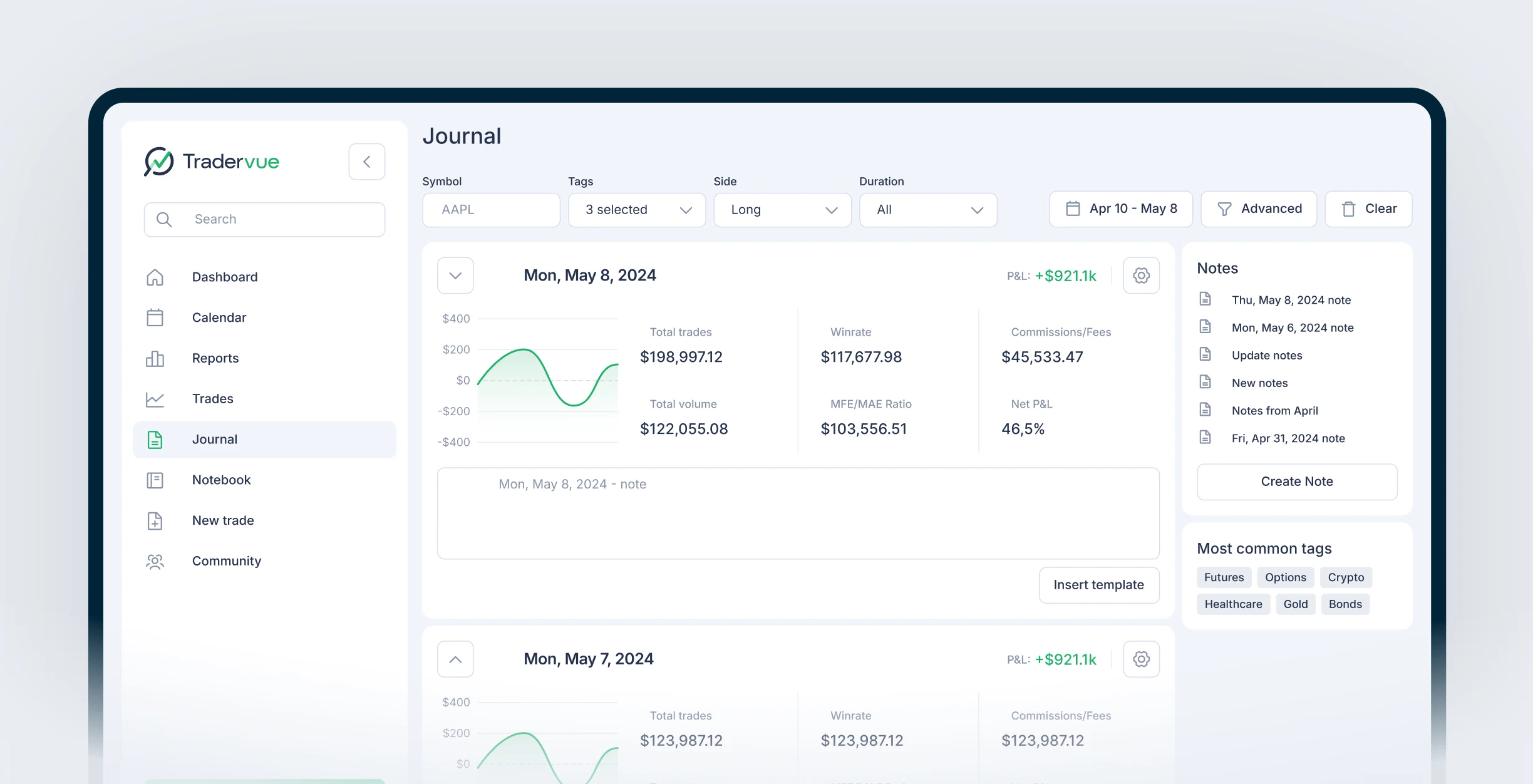
Tradervue Dashboard
Tradervue has a free tier that lets you log up to 100 stock or ETF trades per month. For a complete beginner making 2 to 5 trades per day, this free tier can last a few months. The Silver plan at $29.95 per month adds unlimited trades and 100+ advanced reports. The Gold plan at $49.95 per month adds risk tracking and exit analysis.
Tradervue's strength is reliability and the free entry point. It has been around longer than most competitors, supports automatic imports from 80+ brokers, and the basics work. TradingView charts with entries and exits marked make it easy to review what happened.
The weaknesses for beginners: the interface looks more dated than newer platforms, setup categorization is less intuitive than TradeZella's Strategies feature, and the free tier caps at 100 trades per month with basic analytics only. Once you need the deeper analytics, the Silver tier at $29.95 per month is comparable in price to TradeZella Essential but lighter on features (fewer reports, no backtesting, no trade replay, no Notebook).
Pricing: Free tier (100 trades/month, limited analytics). Silver at $29.95/month. Gold at $49.95/month. No annual discount.
Best fit: Stock and ETF traders who want to test journaling before committing to a paid plan. Best as a starting point, not a long-term platform.
Why Is a Spreadsheet the Wrong Choice for Beginners?
Half of new traders start with a spreadsheet. It feels smart. It is free, it is customizable, and it forces you to engage with every trade. This logic breaks down within 60 days.
Manual entry is tedious after a bad day. Formulas break when you add new fields. The analytics that matter (win rate by setup, performance by time of day, drawdown patterns) require more spreadsheet skill than most traders have. And the time cost adds up. On a $10,000 account, logging 5 trades per day manually takes 15 to 20 minutes. Over a month, that is 5 to 7 hours you could have spent reviewing your trades instead of typing them.
The real cost of a spreadsheet is not the time. It is the abandonment. The data consistently shows that traders using spreadsheets stop journaling within 60 to 90 days. One revenge trading spiral you could have prevented with the data is worth a year of any journal subscription. For a full breakdown of this comparison, read our trading journal vs spreadsheet analysis. If you want to start with a spreadsheet anyway, download our Trading Journal Template to at least use a structured format.
How Do You Set Up Your First Trading Journal?
Setting up your journal should take less than 15 minutes. If you have a trading plan in place, the journal becomes the tool that measures whether you are following it. If you do not have a plan yet, the journal will show you what you need to put in one.
Connect your broker. Auto-import is non-negotiable for beginners. Set it up the first day. In TradeZella, this takes about 2 minutes for most brokers.
Create 2 to 3 Strategies. Whatever your two or three main setups are, name them and start tagging. "Breakout," "Pullback," and "VWAP Bounce" is a common starter set. Do not create more than three. You can add more after 50 trades.
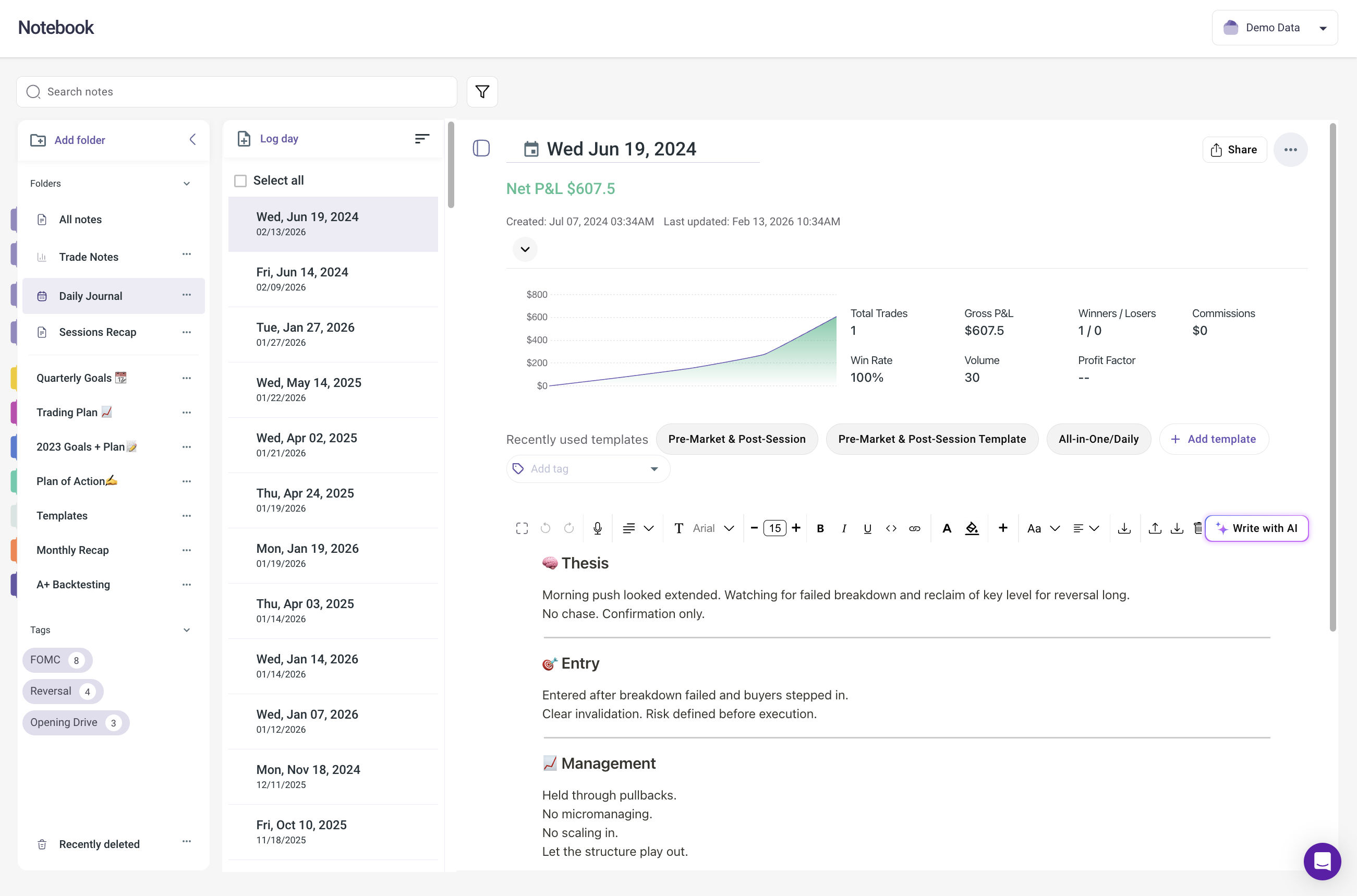
Add notes to every trade for the first 30 trades. Three sentences minimum: why you took it, what you saw, and what you noticed afterward. This builds the habit. In TradeZella, the Notebook feature lives next to your trade list, so you can write notes without leaving the trade detail view.
Schedule a 20-minute Sunday review. Same time every week. Look at the week, identify one thing that worked and one thing that did not. Write it down. For a complete review framework, see our guide on how to analyze trading performance.
Do not change your strategy based on the first 20 trades. That is too small a sample. Wait for 30 to 50 trades per Strategy before drawing conclusions about what works and what does not.
TradeZella Notebook
What Are the Most Common Beginner Journaling Mistakes?
Logging trades but never reviewing them. A journal you never look at is just a database. The review is where the learning happens. Schedule the Sunday review and protect it. For more on building this habit, see our trading discipline guide and the Rule Adherence Score framework.
Changing strategy after every losing week. The data does not have enough trades to be meaningful after one week. If you have 10 trades spread across three Strategies, you have roughly 3 trades per Strategy. That tells you nothing. Wait for 30 to 50 trades per Strategy before drawing conclusions.
Ignoring the qualitative notes. Most beginners eventually skip the notes. The notes are where you catch the emotional patterns that the numbers do not surface: FOMO trading entries, revenge trading after losses, and sizing up when you feel confident instead of following your rules. For a deeper understanding of how these patterns develop, read our trading psychology guide.
Treating the journal as homework. Frame it as feedback, not record-keeping. Each entry is data you are collecting about yourself. The journal is not something you do after trading. It is part of trading.
Picking a journal based on feature count. More features mean more clicks, more confusion, and more reasons to skip. A beginner with auto-import, three Strategies, and a Notebook will learn faster than a beginner with 200 features and no consistent habit.
Most of these mistakes appear in our broader trading mistakes guide. The journaling-specific ones are the most preventable because they are all about process, not skill.
The best trading journal for a beginner is the one that removes friction from the habit. Auto-import, simple dashboard, setup categorization, trade notes, and a weekly review surface are the only must-haves for the first 100 trades.
TradeZella is the strongest beginner choice because it does the basics well and grows with you. Essential tier at $29/month covers auto-import from 500+ brokers, 3 Strategies, 50+ reports, the Notebook, and Zella AI (Auto-Tagger, Session Review, conversational data assistant).
TraderSync is a clean, organized option at $29.95/month (Pro plan) with support for stocks, options, futures, and forex. Lacks backtesting and trade replay.
Tradervue offers a free tier (100 trades/month) for testing the journaling habit before committing to a paid plan.
Avoid spreadsheets. The abandonment rate within 60 to 90 days is too high, and the analytics gap means you miss the insights that matter.
The setup matters more than the platform. Connect your broker, categorize your setups, write notes, and review weekly. Do that for 100 trades and you will be a different trader.
Frequently Asked Questions
What is the cheapest trading journal for beginners?
Tradervue offers a free tier with up to 100 stock or ETF trades per month and basic analytics. For paid journals, TradeZella Essential at $35 per month (about $26 per month on annual billing) and TraderSync Pro at $29.95 per month are the most affordable serious options. TradeZella supports all asset classes with 500+ brokers. TraderSync supports stocks, options, futures, and forex with a smaller broker list. Avoid spreadsheets despite the appeal of free. The abandonment rate within 60 to 90 days makes them the most expensive choice in the long run.
Do I need a trading journal if I am a complete beginner?
Yes, and earlier is better. Beginners benefit most from journaling because mistake patterns form quickly in the first 50 trades. Without a journal, you repeat the same errors without realizing it. A journal shows you which setups work, which times of day are profitable, and how you behave after losses. Starting from your first live trade gives you the data to improve instead of guessing what went wrong.
Should I journal paper trades?
Yes. Most journals let you manually log paper trades, and TradeZella supports paper trading accounts through manual entry. The discipline of journaling matters more than whether the trades are real. Paper trade journaling builds the tagging, noting, and reviewing habits so they are automatic when you switch to live capital. The only difference is that emotional patterns (revenge trading, FOMO entries) are harder to detect in paper trading because the stakes feel lower.
How many trades before a journal becomes useful?
You start getting meaningful analytics around 30 to 50 trades. At 30 trades, your win rate and average winner vs. loser begin to stabilize enough to show patterns. At 50 trades per Strategy, you can make preliminary decisions about which setups to keep and which to cut. Most traders see their first genuine insight (the kind that changes how they trade) between trade 50 and trade 100.
Can I use a free trading journal and upgrade later?
Yes. Tradervue's free tier lets you test the journaling habit with up to 100 trades per month. The risk is that you build your workflow around a platform's limitations and then have to relearn when you upgrade. TradeZella does not offer a free tier, but the Essential plan at $29 per month provides a complete feature set that will not require a platform switch as you grow. The cost of switching journals (re-importing data, rebuilding tags, adjusting to a new interface) is worth considering when choosing your first platform.
What is the difference between a trading journal and a trading tracker?
A trading journal combines trade logging with notes, screenshots, and a structured review process. A trading tracker focuses on performance metrics and analytics. Many platforms do both, but the emphasis matters for beginners. You want a journal (with notes and review features) rather than a pure tracker, because the qualitative data is where beginners learn the most. For a comparison of tracking-focused platforms, see our best trading trackers guide.
Is TradeZella worth the price for a beginner?
At $35 per month on the Essential plan ($26 per month on annual billing), TradeZella costs roughly $1 per trading day. On a $10,000 account, one prevented revenge trade saves you $100 to $300, which covers three to ten months of the subscription. The value is not in the software itself. It is in the behavioral changes the data creates. If you trade at least three times per week and commit to the Sunday review habit, TradeZella will pay for itself within the first quarter.




.png)