25 Essential Trading Tips Every Beginner Needs to Know
25 Essential Trading Tips Every Beginner Needs to Know
25 specific, actionable trading tips organized by risk management, psychology, strategy, and performance tracking. Each tip includes a concrete rule, a dollar example showing exactly how to apply it, and a connection to the data-driven tracking that turns random improvement into measurable progress.
class SampleComponent extends React.Component {
  // using the experimental public class field syntax below. We can also attach
  // the contextType to the current class
  static contextType = ColorContext;
  render() {
    return <Button color={this.color} />
  }
}
Last Updated: May 12th, 2026
Trading tips for beginners are specific, actionable rules that protect your capital, build consistent habits, and create a data-driven feedback loop from your first trade forward. The best tips are not vague motivational advice. They are concrete rules with exact numbers, like risking no more than 1% per trade on a $10,000 account ($100 maximum loss), setting a 2% daily loss limit ($200 cap), and journaling every single trade so your data shows you exactly what to fix.
Every profitable trader started exactly where you are right now: overwhelmed by information, unsure which advice to trust, and wondering whether they would ever figure this out.
The difference between traders who make it and traders who quit is not talent or luck. It is the habits they build in their first six months. The 25 tips below are not generic "be patient" advice. Each one is a specific, actionable rule with a real example showing you exactly how to apply it.
These tips are organized by category: risk management (because protecting your capital comes first), trading psychology (because your biggest opponent is your own brain), strategy and execution (because a plan without execution is just a wish), and performance tracking (because you cannot improve what you do not measure). If you want to avoid the most expensive lessons, start with the 10 common trading mistakes that cost beginners the most money, then come back here for the rules that prevent them.
Category
Tip
Key Rule
Dollar Example ($25K Account)
TradeZella Feature
Risk Management
1% Per Trade
Max loss = account x 0.01
$250 max loss per trade
Position Size Calculator
Stop Loss First
Define exit before entry
$2 stop = 125 shares max
Risk/Reward Calculator
Daily Loss Limit
Stop at 2-3% daily
$500 daily cap (2%)
Calendar View
No Averaging Down
Never add to losers intraday
$150 loss stays $150, not $400
Trade Replay
Equal Position Sizes
Same risk per trade
$250 risk on every trade
R-Multiple View
Small Losses = Tuition
Accept planned losses
45% WR at 2:1 = $3,500 profit/100 trades
Analytics Dashboard
Know the PDT Rule
3 day trades per 5 days under $25K
Fund to $25K+ or trade futures
Multi-Broker Import
Psychology
Tag Emotional State
Label every trade: calm, FOMO, anxious
FOMO trades cost ~$180/month avg
Custom Tags + Tags Report
2-Loss Break
Walk away after 2 consecutive losses
Prevents $500 day from becoming $1,200
Calendar View
No Revenge Trading
Never trade to recover losses
$300 loss stays $300, not $1,200
Day Replay
Independent Trades
Each trade is a new event
60% WR = 5 losses in a row is normal
Analytics Dashboard
Pre-Market Plan
Write plan before market opens
5 minutes saves 3-5 impulsive trades/week
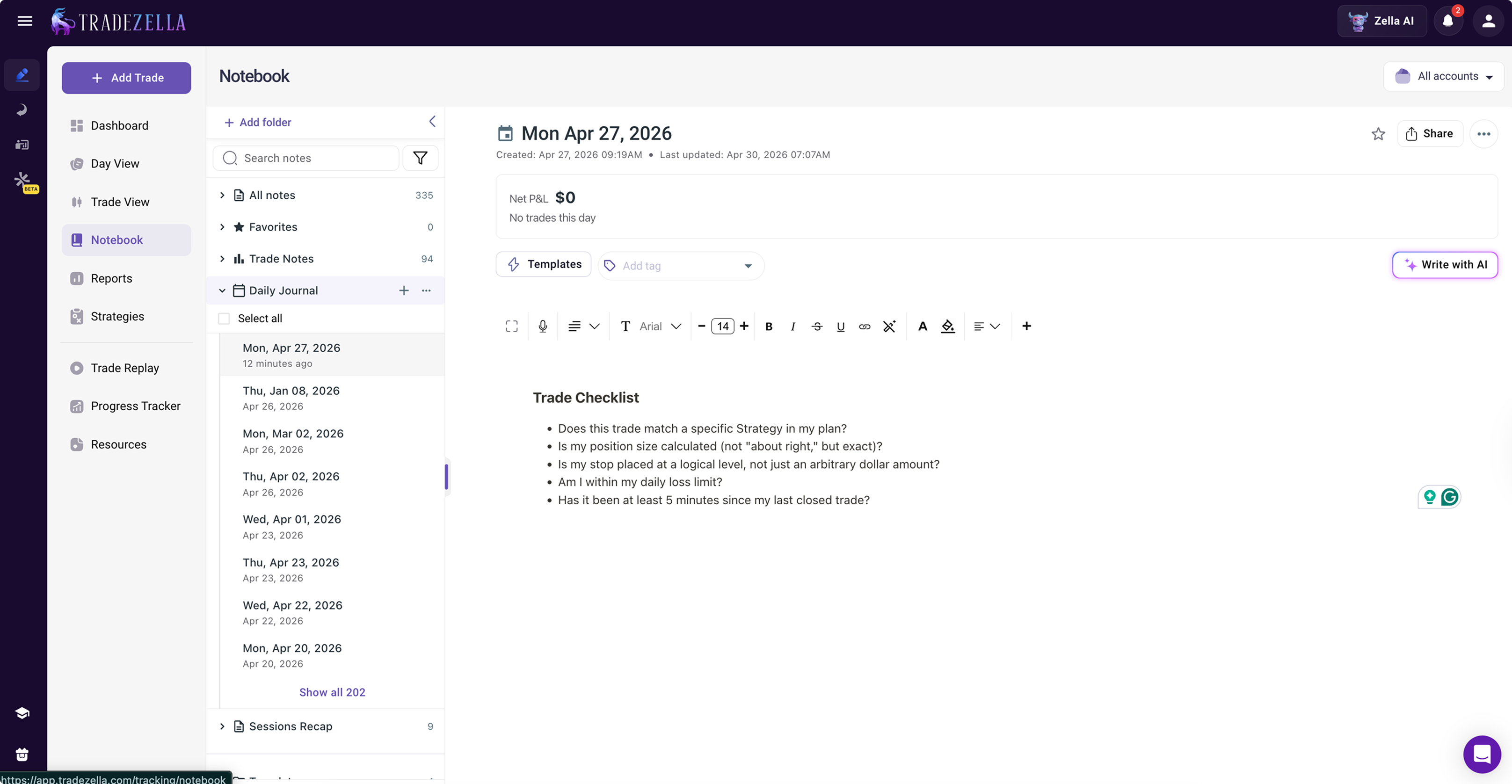
Notebook
Ignore P&L Comparisons
Focus on % and R, not dollars
$50 on $5K = 1% = same as $5K on $500K
R-Multiple View
Accept Missed Trades
Missing a trade costs $0
Chasing costs $150-$400 avg per chase
Missed Trade Log (Notebook)
Strategy
One Strategy First
50 trades minimum before adding
50 trades at $250 risk = $12,500 tested
Strategies
Written Setup Rules
Specific, measurable entry criteria
Vague setups = 35% WR; defined = 55%+ WR
Strategy Entry Rules
Trade Best Hours Only
First/last hour; avoid midday chop
Cut 11:30-2:00 PM = ~$600/month saved
Day & Time Report
Check Bigger Timeframe
Daily chart before 5-min chart
With-trend trades: +1.8R avg vs against: -0.3R
Multi-Timeframe Charts
Limit Orders Only
Never use market orders in volatile moments
$0.20 slip x 200 trades = $4,000/year
Execution Analytics
Tracking
Journal Every Trade
Auto-import, tag, annotate daily
5 min/day = 25 hrs/year of data
500+ Broker Import
Track by Setup Type
Compare strategy performance
65% WR setup vs 35% WR setup visible
Strategy Comparison
Time-of-Day Analysis
Find profitable hours, cut losing hours
60-80% of losses in 2-3 hours
Day & Time Report
Weekly Review
30 min every Sunday
Best trade + worst trade + 1 pattern
Calendar + Notebook
Rule Adherence Score
5 yes/no questions per trade
Below 60% = system problem; 85%+ = elite
Custom Tags + Tags Report
Data Kills Bad Habits
Tag behaviors, track P&L per tag
FOMO tag: 28% WR, -$2,100/month
Tags Report + Analytics
What Are the Most Important Risk Management Tips for Beginners?
Risk management is the foundation of every successful trading career. Without it, no strategy, no edge, and no amount of market knowledge will save your account. These seven tips establish the rules that keep you in the game long enough to learn everything else. For a deeper breakdown, read the full guide to risk management rules every day trader needs.
1. Never Risk More Than 1% Per Trade
On a $10,000 account, your maximum loss per trade is $100. On a $25,000 account, it is $250. On a $50,000 account, it is $500. This rule keeps any single trade from doing serious damage. The formula: position size = (account x 0.01) / (entry price - stop loss price). Use a Position Size Calculator to run this math in seconds before every entry.
If you are buying AAPL at $185 with a stop at $183, your risk per share is $2. On a $10,000 account (1% = $100), you can buy 50 shares. Not 200. Not "however many feels right." Fifty.
2. Set Your Stop Loss Before You Enter
Not after. Not "when it starts going against you." Before. Define your exit level, calculate your position size, place the stop order, then enter the trade. This sequence removes emotion from your risk management. Your risk-reward ratio depends on knowing your stop distance before entry. A 2:1 ratio means your target is twice the distance of your stop. If your stop is $2 away, your target needs to be $4 away. You cannot calculate this after the fact.
3. Use a Daily Loss Limit
Pick a number (most traders use 2-3% of their account) and stop trading for the day when you hit it. A $25,000 account with a 2% daily limit means you stop at $500 in losses. A $10,000 account at 2% means $200. A $50,000 account at 2% means $1,000. This prevents the spiral of revenge trading that turns a $200 loss day into a $1,200 loss day.
If you blow through your daily limit more than twice in a month, the limit is not the problem. The behavior underneath is the problem. Read about drawdown management protocol for a three-tier system that scales your response to the severity of the drawdown.
4. Never Average Down on a Losing Day Trade
Your trade on TSLA is down $150. Adding more shares at a lower price feels smart because you are "getting a better price." In reality, you are doubling your risk on a trade that is already proving you wrong. If your thesis was correct, the stock would not be at the lower price. This is one of the fastest ways to blow past your daily loss limit and trigger a chain of overtrading that compounds the damage.
5. Keep Position Sizes Equal
Do not bet big on "sure things" and small on everything else. Your conviction about a trade has almost no correlation with the outcome until you have 50+ data points proving otherwise. Equal sizing across all trades creates cleaner data and prevents oversized losses. Track your results in R-multiple terms (actual gain or loss divided by planned risk) to compare trades on equal footing regardless of position size.
6. Understand That Small Losses Are the Cost of Business
A $100 loss on a properly sized trade is not a failure. It is tuition. The problem is not losing trades (every strategy has them). The problem is letting small losses become big losses. Accept the small loss, log it, and move to the next setup. A strategy with a 45% win rate and a 2:1 risk-reward ratio is still profitable. The math: 45 wins x $200 = $9,000 minus 55 losses x $100 = $5,500. Net profit: $3,500 over 100 trades. Losses are part of the equation, not a sign that something is broken.
How Does Trading Psychology Affect Beginners?
Your biggest opponent is not the market. It is your own brain. Fear, greed, frustration, and overconfidence will cost you more money than any bad strategy ever will. These seven tips address the psychological patterns that destroy beginner accounts. For a complete framework, read the guide on how to stop emotional trading with a five-system approach.
8. Tag Your Emotional State on Every Trade
Before you close your journal entry, tag how you felt: calm, anxious, FOMO, frustrated, overconfident. After 30 days, filter your trades by emotional tag. You will discover that your "calm" trades have a dramatically higher win rate than your "FOMO" or "anxious" trades. That data changes behavior faster than any discipline technique.
This is the foundation of tracking trading habits. Tags turn vague feelings into measurable data. After 30 trades, the numbers speak for themselves.
9. Walk Away After Two Consecutive Losses
Two losses in a row signals one of two things: the market conditions do not match your strategy right now, or your judgment is impaired by the first loss. Either way, a 30-minute break costs you nothing and prevents the third (and fourth, and fifth) loss. This is the simplest defense against trading tilt, the state where frustration overrides your trading rules and every decision gets worse.
10. Never Trade to "Make Back" What You Lost
This is revenge trading, and it has the worst win rate of any trading behavior. When you lose $300 and immediately scan for another setup with bigger size, you have stopped trading your plan and started trading your emotions. The money is gone. Accept it and start fresh tomorrow. On a $25,000 account, revenge trading after a $300 loss commonly turns into a $900-$1,200 loss day because size increases and setup quality decreases simultaneously.
11. Treat Every Trade as Independent
The outcome of your last trade has zero impact on the probability of your next trade. A winning streak does not mean you are "hot." A losing streak does not mean you are "broken." Each trade is a new probability event. Keep your size and process consistent regardless of recent results. Even a 60% win rate strategy will produce five consecutive losses roughly once every 100 trades. That is math, not a sign to change everything. Track your profit factor over 50+ trades to know whether your strategy is actually working.
12. Write Down Your Pre-Market Plan
Every morning before the market opens, write down: what setups you are looking for, what stocks or instruments are on your watchlist, and what your risk limits are for the day. This 5-minute exercise prevents reactive trading throughout the session. Your trading plan should fit on one page: market, setups, risk rules, daily limits, and session times. If you cannot describe your plan in six sections, it is either too complicated or too vague.
13. Stop Comparing Your P&L to Others
The trader on social media posting $5,000 daily profits has a $500,000 account and 8 years of experience. Comparing your $50 gain on a $5,000 account to their results is like a first-year medical student comparing themselves to a surgeon. Focus on your process metrics, not your dollar P&L. A $50 gain on a $5,000 account is a 1% return. That is the same percentage as a $5,000 gain on a $500,000 account. Percentages and R-multiples are the honest comparison, not raw dollars.
14. Accept That You Will Miss Good Trades
You will watch stocks gap up 15% without you. You will see perfect setups you did not take because you were already in another trade. This is normal. Missing a trade costs you $0. Chasing a missed trade after the move costs you real money. The fear of missing out, known as FOMO trading, is the most common trigger for emotional entries. Every trader experiences it. The ones who survive are the ones who recognize the feeling and do nothing.
What Strategy and Execution Rules Should Beginners Follow?
A strategy without clear rules is just guessing with a chart open. These five tips turn vague "I buy breakouts" approaches into specific, trackable, improvable systems. The goal is not to find the perfect strategy. The goal is to define one strategy clearly enough to measure whether it works.
15. Learn One Strategy Before Adding Another
Pick one setup, one timeframe, one market. Trade it 50 times before even considering a second strategy. You need enough data to know whether the strategy works for you, and 50 trades is the minimum for statistical relevance. This is the first phase of learning to build a trading system: define your hypothesis, test it with enough sample size, and let the data tell you whether to keep it or discard it.
16. Define Your Setup in Writing
"I buy breakouts" is not a trading plan. "I buy when price breaks above a daily resistance level that has been tested at least twice, with volume at least 1.5x the 20-day average, during the first 2 hours of the session, with a stop at the last pullback low" is a trading plan. The more specific, the easier it is to execute and track. In TradeZella, save this as a Strategy with entry rules, so every trade tagged to that Strategy produces clean performance data. After 50 trades, you will know the exact win rate, average gain, and profit factor for that specific setup.
17. Trade the First Hour or the Last Hour
For day traders, the highest-probability moves typically happen in the first 60-90 minutes and the last 60 minutes of the session. The midday chop between 11:30 AM and 2:00 PM eats accounts. If your data shows you are unprofitable between those hours, stop trading them. Pull up your time-of-day performance report after 50 trades. Most beginners discover that 60-80% of their losses come from two or three specific hours. Cutting those hours is the easiest way to improve results without changing anything else about your strategy.
18. Always Check the Bigger Timeframe
If you are day trading on a 5-minute chart, check the daily chart first. Are you trading with the trend or against it? A bullish setup on the 5-minute chart that is fighting a clear downtrend on the daily chart has much worse odds than one that aligns with the larger trend. This applies to every market. Futures traders check the weekly before the daily. Swing traders check the monthly before the weekly. The bigger timeframe sets the direction. Your timeframe picks the entry.
19. Use Limit Orders, Not Market Orders
Market orders during volatile moments can fill cents or even dollars away from the price you intended. Limit orders guarantee your entry price (or better). Yes, you might miss some entries. That is better than getting a terrible fill. On a 100-share position, a $0.20 slippage from a market order costs $20 per trade. Over 200 trades in a year, that is $4,000 in unnecessary costs. On a $25,000 account, that is 16% of your capital lost to execution, not to bad trades.
How Should Beginners Track Their Trading Performance?
Tracking is the multiplier that makes every other tip work. Without data, you are guessing which tips to follow, which habits to change, and which setups to keep. With data, you have proof. These six tips build the feedback loop that separates traders who improve from traders who repeat the same mistakes for years. For the full framework, read the guide on how to analyze your trading performance using five core metrics and five filtering dimensions.
20. Journal Every Single Trade
Not just the winners. Not just the big losses. Every trade. Auto-import from your broker makes this effortless. The five minutes you spend tagging and annotating each day is the highest-ROI activity in your trading practice. If you are debating between a trading journal vs spreadsheet, the short answer is: spreadsheets work until you are taking more than 5 trades per week. After that, the manual data entry kills consistency. Automated import means your trades are logged whether you feel like journaling or not.
21. Track Performance by Setup Type
Your overall 52% win rate means nothing. What matters is which specific setups are profitable. Maybe your VWAP bounces win 65% of the time while your gap fills win only 35%. Without this breakdown, you keep taking both equally, and the losing setup drags you down. This is how you find your trading edge. Tag every trade by strategy, accumulate 50 instances per setup, and compare. Your edge lives in the breakdown, not in the average.
22. Review Your Time-of-Day Performance
Pull up your analytics by hour after 50+ trades. Most traders have a "hot window" and a "dead window." If your data shows you are profitable before 10:30 AM and unprofitable after lunch, you have just found an easy way to improve your results: stop trading after lunch. TradeZella's Day and Time report breaks this down automatically. You do not have to build pivot tables or write formulas. Filter by strategy, date range, or tag, and the time-of-day breakdown updates instantly.
23. Do a Weekly Review Every Sunday
Block 30 minutes. Pull up your calendar view and review the week's trades. Identify your best trade, your worst trade, and one pattern you noticed. Write down one specific adjustment for the coming week. This simple habit compounds into massive improvement over months. Follow the structured weekly trade review process: best trade, worst trade, one pattern, one adjustment. Thirty minutes, every Sunday, no exceptions.
24. Track Your Rule Adherence
Create a tag for trades that followed your rules vs. trades that did not. After a month, compare the two groups. You will almost certainly find that your rule-following trades outperform your improvisations. That data makes it much easier to stick to your plan. This is the Rule Adherence Score: five binary yes/no questions per trade, averaged weekly. Score below 60%? You have a system problem. Score above 85%? You are trading with discipline that most professionals would respect.
25. Let Data Kill Your Bad Habits
Every bad trading habit (oversizing, chasing, afternoon trading, skipping stops) becomes visible when you track it. Tag the behavior, accumulate 30 instances, and look at the P&L. When you see that your "FOMO chase" tagged trades have a 28% win rate and cost you $2,100 last month, the behavior stops feeling tempting and starts feeling expensive.
The 25 tips above follow a deliberate progression: protect your capital first (tips 1-7), manage your psychology second (tips 8-14), build a clear strategy third (tips 15-19), and track everything fourth (tips 20-25). You do not need to master all 25 at once. Start with the risk management tips. They will keep you in the game long enough to apply everything else.
Risk management comes first. The 1% rule and daily loss limits keep you in the game. On a $25,000 account, that means $250 max per trade and $500 max per day.
Your psychology is your biggest edge or your biggest weakness. Tag emotions and let data change your behavior. Calm trades outperform FOMO trades in nearly every data set.
One strategy, mastered and tracked, beats five strategies traded randomly. Fifty trades minimum before judging any setup.
Define every setup in specific, written rules. Ambiguity kills execution. Save setups as Strategies in your journal with entry rules and conditions.
Journal every trade, not just the ones you want to remember. Automated import makes this effortless.
Track by setup type, time of day, and emotional state. The breakdown reveals insights the averages hide.
Weekly reviews (30 minutes on Sunday) are the highest-ROI habit in trading. Best trade, worst trade, one pattern, one adjustment.
Let your data, not your feelings, decide what to change. Tag the behavior, track the cost, fix the most expensive habit first.
Frequently Asked Questions
What is the number one tip for beginner traders?
The most impactful tip is to never risk more than one percent of your account per trade. On a $10,000 account, that means a maximum loss of $100 per trade. This single rule prevents catastrophic losses, keeps you in the game through inevitable losing streaks, and gives you enough runway to learn. Combined with a hard stop loss on every trade, the one percent rule is the foundation that makes all other improvements possible.
How much money do I need to start trading?
You can begin with $500 to $5,000 depending on the market. Stock day traders in the United States benefit from having $25,000 or more to avoid the Pattern Day Trading rule, but you can start with less using cash accounts or by trading futures, which have no PDT requirement. The most important thing is using money you are prepared to lose while learning, and sizing your trades at one percent risk regardless of account size.
Is trading really that risky for beginners?
Trading carries real financial risk, especially for beginners who have not developed their risk management skills yet. The risk is manageable when you follow position sizing rules (one percent per trade), use stop losses on every trade, and set daily loss limits (two to three percent of your account). The traders who lose big are typically the ones who skip these protections, not the ones who follow them.
What percentage of traders actually make money?
Studies consistently show that 70 to 90 percent of retail traders lose money over time. However, this statistic includes people who never develop a structured approach, never journal their trades, and never review their data. Traders who journal consistently, review their data weekly, and make evidence-based adjustments have significantly better odds. The key differentiator is having a feedback loop, not just placing trades.
Should I use a trading journal or a spreadsheet?
Both can work, but a dedicated trading journal with automated broker import, tagging, and analytics saves significant time and provides deeper insights. With a spreadsheet, you spend hours on data entry and formula building. With an automated journal, trades import from your broker in seconds, and analytics are ready instantly. The easier your tracking system is, the more likely you will actually use it consistently.
How long does it take to become a profitable trader?
Most traders who follow a structured approach (one strategy, consistent journaling, weekly reviews) start seeing measurable improvement within three to six months. Consistent profitability typically takes six to twelve months for traders who track their data and make evidence-based adjustments. Traders who skip the tracking process often repeat the same mistakes for years without improving.
What should I track in my trading journal?
At minimum, track every trade with entry price, exit price, stop loss level, position size, strategy name, and emotional state tag. After 30 trades, add time-of-day analysis and setup-type comparison. The five most revealing data points are win rate by strategy, profit factor by time of day, average win versus average loss, rule adherence score, and emotional tag performance. These five numbers tell you exactly what to fix first.