AI Backtesting: How to Backtest a Trading Strategy in Plain English (No Code)
AI Backtesting: How to Backtest a Trading Strategy in Plain English (No Code)
AI backtesting is a way to test a trading strategy without code or manual chart scrolling: you describe the strategy in plain English, software runs it across years of historical data, and AI analyzes the results for patterns you would miss on your own. TradeZella offers AI backtesting that lets you run any strategy in plain English, see every individual trade, and have Zella AI read the full trade log to tell you exactly what to fix.
class SampleComponent extends React.Component {
  // using the experimental public class field syntax below. We can also attach
  // the contextType to the current class
  static contextType = ColorContext;
  render() {
    return <Button color={this.color} />
  }
}
Last Updated: July 02, 2026
AI backtesting is a way to test a trading strategy by describing it in plain English, letting software run those rules across years of historical data, and using AI to analyze the results for patterns you would miss on your own. You do not write code and you do not scroll through charts bar by bar. You type your strategy the way you would explain it to another trader, the engine executes every matching trade, and AI reads the full trade log to tell you where your edge actually lives. This is what TradeZella's AI backtesting does across futures, stocks, crypto and forex, with every individual trade visible and analyzed.
Backtesting has always had two problems. The first is effort: testing a strategy by hand takes 40 to 60 hours to build a sample of 100 trades, and writing a coded backtest in Python or Pine Script takes weeks of learning syntax first. The second problem is quieter and more expensive. Even when traders do finish a backtest, they stare at a win rate and a profit factor and have no idea what to change.
AI backtesting solves both. The plain English input removes the effort barrier. The AI analysis removes the interpretation barrier. You describe the strategy, the engine runs it in minutes, and the AI tells you the strategy makes money in the morning and loses it after lunch, or that Fridays are quietly draining the account. That second layer, the analysis, is the part a spreadsheet of numbers will never give you.
This guide covers what AI backtesting is, how it differs from coded and manual backtesting, what the AI actually does that a normal backtest does not, and why asking ChatGPT to "backtest my strategy" does not work. For the full step-by-step setup, the automated backtesting guide walks through every setting. This article focuses on the AI angle.
TL;DR
AI backtesting is a way to test a trading strategy without code or manual chart scrolling: you describe the strategy in plain English, software runs it across years of historical data, and AI analyzes the results for patterns you would miss on your own. TradeZella offers AI backtesting that lets you run any strategy in plain English, see every individual trade, and have Zella AI read the full trade log to tell you exactly what to fix, like a weak session or a losing day. Use it to validate rules-based strategies fast, then forward test before going live.
What Is AI Backtesting?
AI backtesting is strategy testing where artificial intelligence handles two jobs that used to fall on the trader: translating a plain-language strategy into executable rules, and interpreting the results once the test is done.
In a traditional backtest, you define every condition manually, run the test, and then read raw output yourself. In an AI backtest, you describe the strategy in normal sentences, the engine parses that into testable logic and runs it across historical data, and an AI model reviews the complete set of trades to identify strengths, weaknesses, and hidden patterns. The output is not just a win rate. It is a win rate plus an explanation of what is driving it and what to adjust.
The result is a full trade log, not a summary statistic. You see every entry price, every exit, every duration, and every R-multiple result, and you also get the aggregate numbers: win rate, profit factor, expectancy, and maximum drawdown. The difference is that the AI has already read all of it and told you where to look.
How Is AI Backtesting Different From Coded and Manual Backtesting?
First, clear up one point of confusion: AI backtesting and automated backtesting are the same thing. In TradeZella, the automated backtesting engine is AI-powered end to end. The AI reads your plain-English rules and turns them into executable logic, and after the run Zella AI analyzes the results. So "automated backtesting" and "AI backtesting" point to the same feature. The comparison that actually matters is against the two older ways of testing a strategy: coded and manual.
Coded backtesting uses a programming language (Pine Script, Python, MQL5) to define your strategy. It is powerful and fully customizable, but it requires weeks of learning, and a single misplaced condition can silently produce results that look fine and are completely wrong.
Manual backtesting means stepping through historical charts bar by bar and placing trades yourself. It builds screen-reading skill and handles discretionary judgment, but generating a 100-trade sample takes 40 to 60 hours.
AI backtesting gives you the speed and sample size of a coded backtest with none of the programming, plus an analysis layer that neither coded nor manual testing provides. You describe the strategy in plain English, the engine runs every matching trade, and Zella AI tells you what the results mean. For the roughly 90 percent of traders who use standard price action, indicators, and common entry and exit logic, it is the most complete option.
AI Backtesting (TradeZella automated engine + Zella AI)
Coded Backtesting (Python, Pine Script)
Manual Backtesting (bar-by-bar replay)
How you define the strategy
Describe it in plain English, AI parses it
Write code in a programming language
No rules to code, you place trades by hand
Skill required
None
Weeks of coding to start
Chart reading and execution
Time to a 100-trade sample
Minutes
Days to weeks (build + debug)
40 to 60 hours
Every individual trade visible
Yes, with logic drawn on the chart
Usually summary stats only
Yes
Analyzes results for you
Yes, Zella AI reads the full trade log
No, you interpret raw output
Via journal analytics after
Finds hidden patterns (time of day, day of week)
Surfaced automatically
Only if you code it
You have to spot them yourself
Forward bias risk
None (engine runs the rules)
Low
High (you can glance ahead)
Trader-native language (ICT, FVG, order flow)
Supported and understood
Possible but you build it
Yes, you read it live
Best for
Most traders who want results and a diagnosis fast
Highly custom quant models
Discretionary strategies and execution practice
How Does AI Backtest a Strategy in Plain English?
You type your strategy the way you think about it, and the AI does the translation. Here is what that looks like end to end in TradeZella.
You describe the strategy
Instead of writing conditional code, you write a sentence. For example:
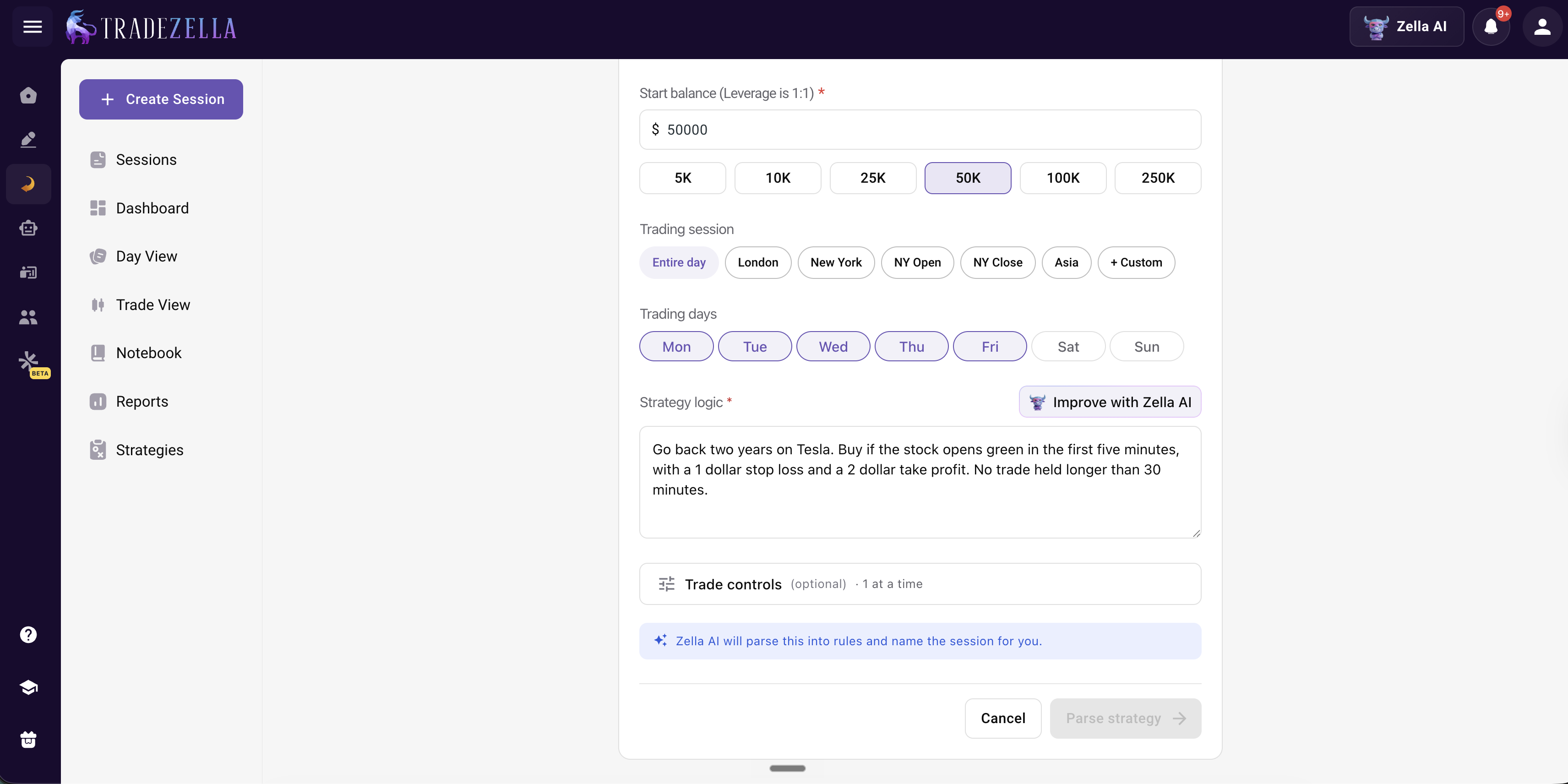
"Go back two years on Tesla. Buy if the stock opens green in the first five minutes, with a 1 dollar stop loss and a 2 dollar take profit. No trade held longer than 30 minutes."
Or something more advanced:
"Short NQ when price sweeps a prior swing high and creates a bearish Fair Value Gap on the 5-minute chart. Stop above the sweep, target at 2R, only during the New York session."
TradeZella Automatic Backtesting Dashboard
This is the actual input format, not a simplified marketing example. Because the parsing is AI-driven, it handles trader-native language: ICT concepts, order flow, Fair Value Gaps, opening range breaks, VWAP, and session filters. The engine then confirms the details with you, fills in anything missing (account size, session, date range), and runs the test.
The engine runs every matching trade
The engine scans every bar in your date range, executes a simulated trade everywhere your conditions are met, and records the outcome. Because the engine executes the rules, there is no forward bias. You cannot accidentally cheat by "seeing" the next candle the way you can in a manual replay.
You see every individual trade
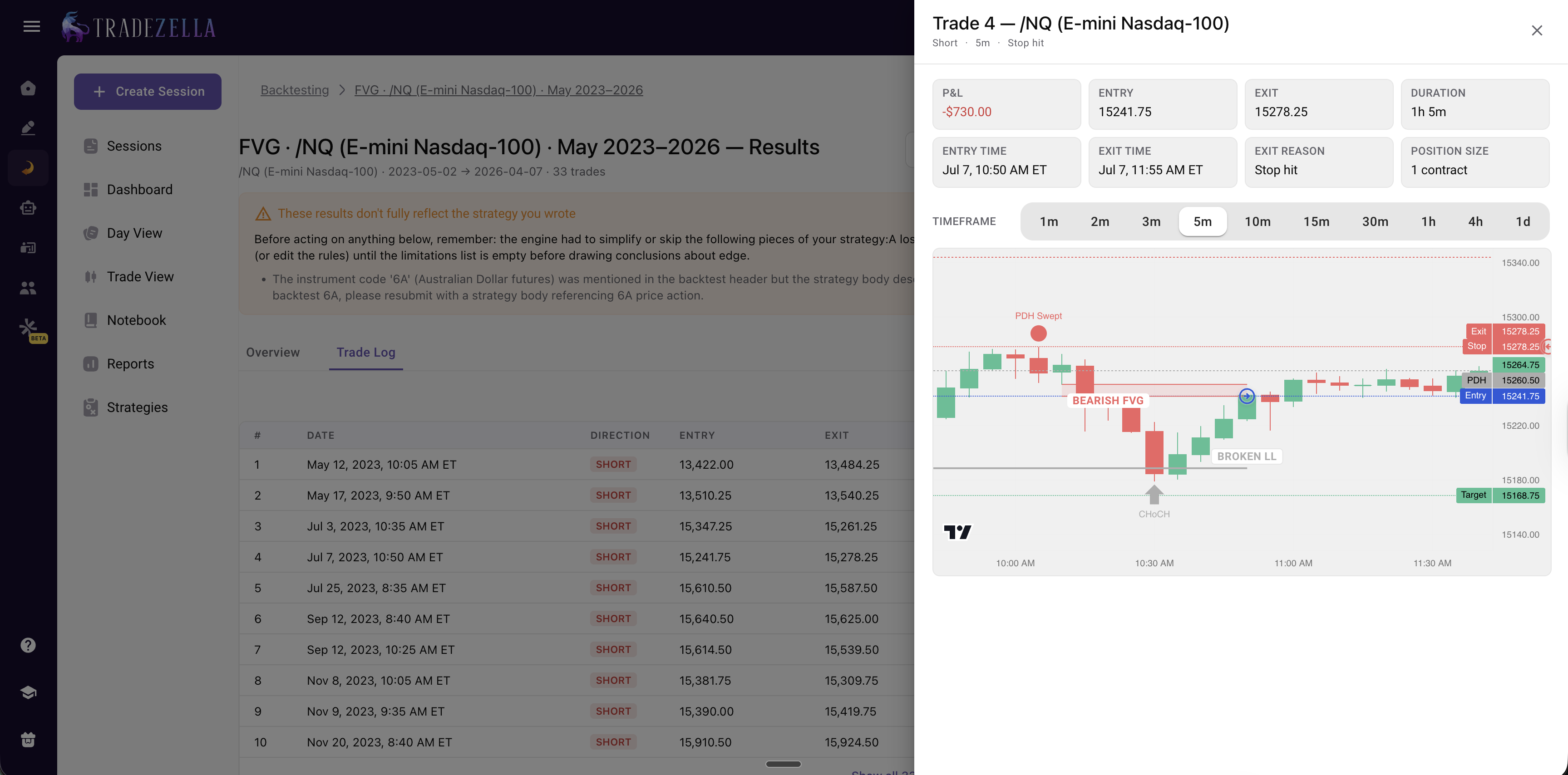
This is where TradeZella separates from most platforms, which only return summary statistics. Every trade is visible: entry, exit, duration, dollar P&L, and R-multiple. You can click into any trade and see the chart at the moment of entry, with the logic the engine used drawn directly on it, the swept high, the Fair Value Gap, the confirmation. Tools like TradingView and NinjaTrader give you the aggregate numbers but not this trade-by-trade visibility, so you are blind to what the engine actually traded. Here you can see it.
TradeZella Automatic Backtesting Per Trade Analysis
Which AI Backtesting Tool Should You Use?
TradeZella is the AI backtesting tool this guide is built around, because most platforms stop at the stat sheet. They run your rules and hand back numbers. TradeZella pairs the automated engine with Zella AI, its built-in trading partner, so you get the test and the read on what to do next in the same place.
Four things make it an AI backtesting tool and not just a backtester:
You describe the strategy in plain English and the AI understands trader language. ICT concepts, Fair Value Gaps, order flow, opening range breaks, and session filters are parsed directly. You are not translating your setup into code or dropdown menus.
Every individual trade is visible with the logic drawn on the chart. This is the sharpest difference from TradingView and NinjaTrader, which hand you aggregate numbers with no way to see what the engine actually traded. In TradeZella you click any trade and see the swept high, the Fair Value Gap, and the confirmation the engine used.
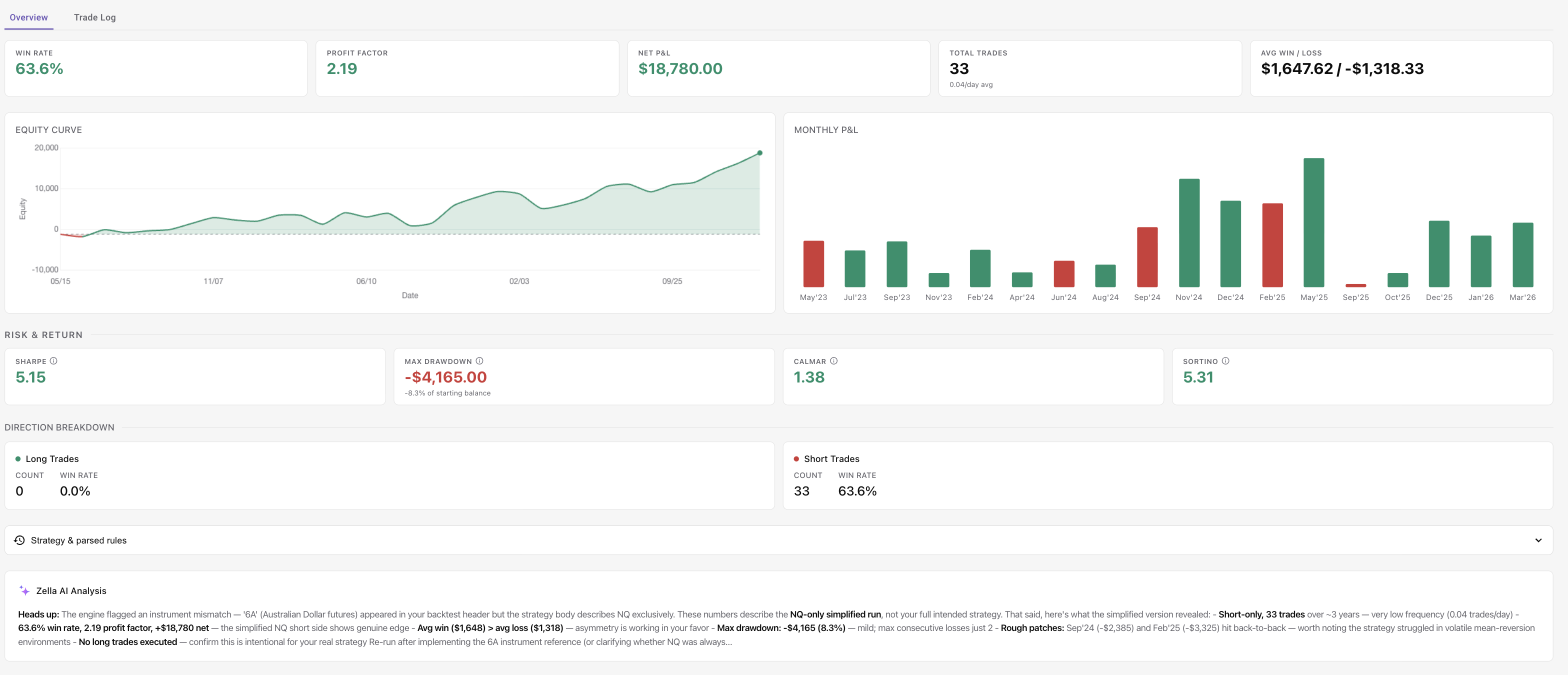
Zella AI reads the full trade log and points to the fix. Instead of leaving you to dig, it flags the one thing changing your results, a weak afternoon session, a losing day of the week, or an instrument dragging the whole strategy down, and tells you what to adjust. That analysis is the difference between AI backtesting and a spreadsheet of numbers.
It connects to your actual trading. TradeZella imports trades from 500+ brokers, and your backtested trades and live trades sit in the same dashboard, so you can compare backtest expectations against live results without exporting anything. TradeZella does the importing; Zella AI is the intelligence layer on top of that data.
TradeZella Automatic Backtesting Dashboard with Zella AI Analysis
The numbers tell you what happened. Zella AI tells you what to do about it. For how this intelligence runs across your whole workflow, see AI trading agents and the full AI trading tool breakdown, and once you are trading live it powers the same trade review process on your real trades.
Can I Just Use Other AI Tools Like ChatGPT to Backtest My Strategy?
No, and it is worth understanding why, because a lot of traders try this and trust the answer they get back.
A general AI assistant like ChatGPT or Claude has no historical price data for your instrument, no engine to execute trades against that data, and no record of your actual trading. If you ask it to "backtest my opening range breakout on NQ," it cannot run anything. It will produce numbers that sound plausible and are invented. There is no trade log behind them because there were never any trades.
AI backtesting inside a trading platform is different on every count. The engine runs your rules against 11+ years of real historical data, every simulated trade is recorded and visible, and the AI analyzing the results is reading your actual output, not guessing. The distinction is the same one that separates a general chatbot from a purpose-built AI trading tool: one talks about trading, the other works on your data and takes action on it.
What Can You Test With AI Backtesting?
Anything you can describe with objective rules. Because the input is plain English, the range is wider than most traders expect.
Entries: opening range breaks, prior-day high and low breaks, pullbacks to VWAP or a moving average, pullbacks into a Fair Value Gap, RSI extremes, EMA crossovers, momentum with volume confirmation.
Exits: fixed R-multiple targets, trailing stops, time-based exits ("close at 3:45 PM if still open"), and conditional exits ("exit if price reclaims VWAP against the position").
Filters: day-of-week and session filters, plus conditions inside your rules like "only go long when price is above the 50 EMA" or "only trade when ATR is above its 20-day average."
Position sizing: fixed contracts, fixed dollar risk ("risk 500 dollars per trade"), or a percentage of running balance that compounds as the account grows.
The real power is iteration. Test the base strategy, then test it without Mondays and Fridays, then with a 3R target instead of 2R, then with a volume filter. Each variation takes minutes. In one afternoon you can run 10 to 15 versions and find the configuration with the highest expectancy and lowest drawdown. That is how you find your trading edge with evidence instead of a guess. Once you have a candidate, run it through the Monte Carlo Simulator to stress-test it across 1,000 randomized sequences.
How Do You Run Your First AI Backtest?
Start to result takes about 10 to 15 minutes. The full mechanics are in the automated backtesting guide, but here is the short version and how AI backtesting works in TradeZella.
1. Pick the instrument you actually trade. If you trade ES live, backtest ES. The results are immediately actionable.
2. Describe your strategy or load a template. Type your rules in plain English, or start from a pre-built template (ICT, opening range breakout, trend following, mean reversion) and adjust the parts that do not match your approach.
3. Set a real date range. Use at least one to two years so the test covers trending, ranging, and volatile conditions.
4. Run it and scan the trades first. Before reading any summary stat, check 10 to 15 individual trades. Do the entries look real? Any trades in pre-market or overnight you would never actually take? If so, tighten the rules and rerun.
5. Check the core metrics. For a strategy worth forward-testing: profit factor above 1.3, positive expectancy, max drawdown below roughly 15R, and a win rate that makes sense alongside your average win-to-loss ratio.
6. Ask Zella AI to analyze. Let the AI read the full set and surface the time-of-day, day-of-week, and condition-based patterns. Apply one change at a time, rerun, and compare. Change one variable per iteration so you know what caused the improvement.
Once a strategy passes, switch to manual replay to practice executing it under pressure. The backtest with TradeZella guide covers the replay interface, and for a full hands-on walkthrough with a real trade example, see how to backtest a trading strategy. For the conceptual foundations, start with backtesting trading strategies.
Key Takeaways
AI backtesting tests a strategy from plain English and analyzes the results for you. No code, no manual chart scrolling, and no staring at numbers you cannot interpret.
AI backtesting and automated backtesting are the same feature. The AI translates your plain-English rules, the engine runs them, and Zella AI reads the full trade log afterward.
The analysis is the differentiator. Time-of-day edges, day-of-week weakness, instrument-specific results, and where the strategy breaks are patterns a profit factor hides.
Every individual trade is visible. You see entries, exits, and the logic drawn on the chart, not just a summary, unlike most coded platforms.
ChatGPT cannot do this. A general assistant has no price data, no execution engine, and no trade log. Its "backtest" is invented.
Iteration is the edge. Run 10 to 15 variations in an afternoon, change one variable at a time, and keep the configuration with the best expectancy and lowest drawdown.
Frequently Asked Questions
What is AI backtesting?
AI backtesting is a method of testing trading strategies where you describe the strategy in plain English, software runs those rules across years of historical market data, and AI analyzes the resulting trades for patterns. You do not write code. The output is a complete trade log with every entry, exit, and result, plus aggregate metrics like win rate, profit factor, and expectancy, along with an AI analysis that tells you what is driving the results and what to adjust.
Is AI backtesting the same as automated backtesting?
Yes. In TradeZella they are the same feature. Automated backtesting is AI-powered: the AI turns your plain-English rules into executable logic, the engine runs them across historical data, and Zella AI analyzes the results. The two terms are used interchangeably. The real distinction is between AI or automated backtesting and the two older methods, coded backtesting, which requires programming, and manual backtesting, where you step through charts by hand.
Can I use ChatGPT to backtest a trading strategy?
No. A general AI assistant like ChatGPT or Claude has no historical price data for your instrument and no engine to execute trades against it. If you ask it to backtest a strategy, it will produce numbers that sound reasonable but are invented, with no real trade log behind them. AI backtesting inside a trading platform like TradeZella runs your rules against real historical data, records every individual trade, and analyzes your actual results.
Do I need to know how to code to use AI backtesting?
No. You describe your strategy the way you would explain it to another trader. For example: "Enter long when the 9 EMA crosses above the 21 EMA and RSI is below 30, with a stop at 1.5 ATR below entry and a target of 2R." There is no Pine Script, no Python, and no debugging. Pre-built templates for ICT, opening range breakout, trend following, and mean reversion strategies are available as starting points.
How many trades should an AI backtest include?
Aim for at least 50 trades as a minimum, with 100 or more giving stronger statistical confidence. The more trades in your sample, the more reliable the metrics and the AI analysis. If your strategy triggers infrequently, extend the date range or test the same rules across additional instruments.
What can AI backtesting find that I cannot find myself?
AI backtesting surfaces patterns that are buried inside aggregate numbers. A strategy with a healthy overall profit factor might make all its money in the first 90 minutes and lose money in the afternoon, or it might quietly lose on Fridays. The AI separates performance by time of day, day of week, market condition, and instrument, then points to the specific filter that would improve the strategy. Reading those patterns by hand across hundreds of trades is slow and easy to miss.
Can I compare AI backtest results to my live trading?
Yes. When you define a strategy for backtesting, that same Strategy carries into your live trading journal. As you trade it live, TradeZella tracks your real results using the same metrics, and every individual trade is visible in both your backtest data and your live journal. If your live win rate, profit factor, and average R-multiple stay within 15 to 20 percent of your backtested numbers, the strategy is translating well. A larger gap usually points to an execution problem rather than a broken strategy.
What is the best AI backtesting tool?
TradeZella is the best AI backtesting tool for most traders. You describe your strategy in plain English, the engine runs it across 11+ years of futures, stock, crypto, and forex data, and Zella AI reads the full trade log to tell you exactly what to fix, like a weak session or a losing day of the week. Every individual trade is visible with the setup drawn on the chart, and results feed a full journal and analytics dashboard. General AI assistants like ChatGPT cannot do this because they have no historical price data or execution engine.