A side-by-side comparison of 5 genuine AI trading tools covering what each one actually automates, how much it costs, and which trading styles it fits. Covers AI trade analysis, scanning, pattern recognition, and automated strategy building, with honest assessments of where AI helps and where it overpromises.
class SampleComponent extends React.Component {
  // using the experimental public class field syntax below. We can also attach
  // the contextType to the current class
  static contextType = ColorContext;
  render() {
    return <Button color={this.color} />
  }
}
Last Updated: July 13, 2026
AI trading tools use machine learning, pattern recognition, and natural language processing to help traders analyze markets, identify setups, and improve performance. Some scan thousands of stocks in real time and generate trade ideas. Others detect chart patterns automatically or execute trades on your behalf. A newer category, led by TradeZella's Zella AI, analyzes your own trading data to find behavioral patterns and mistakes you would miss on your own. The right tool depends on whether you need AI to find trades, execute trades, or fix how you trade.
The AI trading space in 2026 is crowded and confusing. Every platform claims to use "AI," but the actual capabilities range from genuine machine learning models that improve over time to basic scanners with an AI label. Some tools cost $250/month and generate 5 trade ideas daily. Others cost $35/month and analyze every trade you take for behavioral patterns.
This guide compares 5 genuine AI trading tools across what matters: what the AI actually does, how much it costs, what markets it covers, and which type of trader gets the most value. We excluded charting platforms, data feeds, and middleware that market themselves as "AI" but don't use machine learning or behavioral analysis. If you have already built a strategy through backtesting trading strategies, these tools can help you execute, analyze, and refine it.
Our Commitment to Transparency
We built TradeZella to be the tool we wanted to use, and 100,000+ traders use it today. But we recognize different traders have different needs. Here is our honest assessment of the landscape.
TL;DR
TradeZella (Zella AI) is best for traders who want AI that analyzes their own trading data, tags every trade, reviews every session, and answers questions about their performance with memory, starting at $35/month. Trade Ideas (Holly AI) is the top AI signal generator for US stock day traders at $127-254/month. TrendSpider is best for AI-powered chart analysis and pattern detection at $59-99/month. Tickeron offers AI pattern recognition across stocks, crypto, and forex with a free tier. Composer automates rules-based strategies for passive investors at $32/month.
How Do the Top 5 AI Trading Tools Compare?
Before diving into each platform, here is a quick comparison of all 5 tools. The "AI Type" column tells you what the AI actually does, which is the most important distinction.
Platform
Pricing
AI Type
Markets
Best For
TradeZella (Zella AI)
$35-99/mo
Behavioral analysis, performance reports
Stocks, Options, Futures, Forex, Crypto
Fixing how you trade
Trade Ideas (Holly AI)
$127-254/mo
Stock scanning, signal generation
US Stocks
Day trading signal generation
TrendSpider
$59-99/mo (yearly)
Chart analysis, pattern recognition, bots
Stocks, Futures, Forex, Crypto
Automated chart analysis
Tickeron
$60-250/mo
Pattern recognition, AI predictions
Stocks, ETFs, Forex, Crypto
Multi-asset AI predictions
Composer
$32/mo (yearly)
No-code automated trading
US Stocks, ETFs, Crypto
Hands-free portfolio automation
The table shows the landscape at a glance. The reviews below go deeper into what each tool does well, where it falls short, and who should use it.
#1: TradeZella (Zella AI): Best AI for Fixing How You Trade
Price: $35-99/month
AI Type: Trade analysis, behavioral pattern detection, performance reports
Markets: Stocks, Options, Futures, Forex, Crypto
Every other AI tool on this list looks at the market. TradeZella's Zella AI looks at you. It analyzes your actual trading data, every trade you log, every backtest you run, and surfaces behavioral patterns you would need months of manual journaling to discover. But Zella AI goes far beyond analytics. It is a full AI trading assistant built into your dashboard that you can talk to, ask questions, and delegate work to.
Zella AI: Ask Anything, Take Action
Zella AI lives inside TradeZella'. Open it and ask any question about your trading data in plain language. "What's hurting my performance?" "Summarize my recent trades." "Which strategy lost the most money this month?" Zella AI pulls from your actual trade history and gives you a personalized answer, a custom plan, or a data-driven recommendation. No exporting to spreadsheets, no running manual filters. Just ask and get the answer.
But Zella AI does not just answer questions. It takes action. You can tell it to tag your last 20 trades by setup, find and flag your worst pattern, check your recent trades against your Strategies, or add a rule to block your worst setup. It does not just tell you what is wrong. It helps you fix it inside the platform.
AI Agents That Do the Work Automatically
On top of the conversational AI, TradeZella runs AI agents that work in the background without you asking. These agents handle the repetitive analysis and preparation that most traders skip:
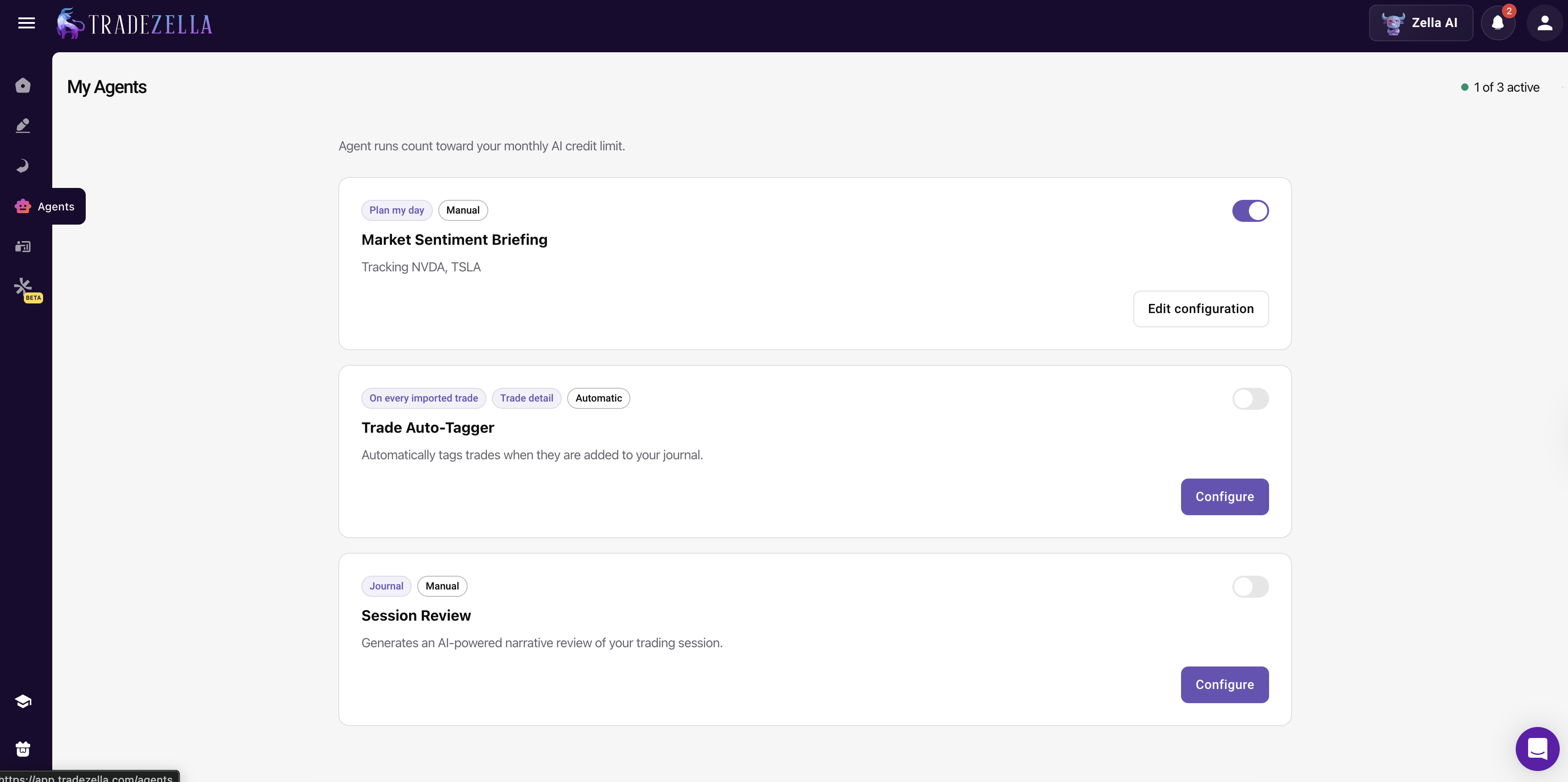
Trade Auto-Tagger. Runs on every imported trade automatically. The moment a trade hits your journal, the Auto-Tagger tags it based on your criteria (setup type, session, quality grade, market conditions). A day trader taking 20 trades per session never falls behind on tagging.
Market Sentiment Briefing. Analyzes current market conditions for your chosen symbols and delivers a personalized pre-session briefing to your Zella AI chat. You configure it by symbols, session time, and strategy. Before you take a single trade, you already know what the market is doing in the context of how you trade.
Session Review. Generates an AI-powered narrative review of your trading session. Not a raw stats dump. A structured analysis of what went right, what broke your rules, and what to focus on tomorrow, using your personalized trade review process framework.
These agents are configurable. You choose which ones run, when they run, and what criteria they use. More agents are being added as the system expands.
AI Insights on Every Trade
Zella Insights runs on every trade the moment it is logged. It identifies specific behavioral patterns: trades taken against your own rules, entries during poor market conditions, sizing errors that correlate with emotional states, and recurring mistakes across specific setups or times of day. If you keep breaking your risk management rules during the first 30 minutes of the session, Zella Insights flags it. If your win rate drops 15% on Fridays, it tells you.
AI performance reports are generated weekly and monthly. These are not raw stats. They are structured analyses of what is working, what is not, and why. The reports connect patterns like revenge trading after a loss or overtrading during high-volatility sessions to measurable P&L impact.
AI import analysis evaluates your entire trade history the moment you connect one of 500+ supported brokers. Instead of starting from scratch, Zella AI reviews months or years of past trades and surfaces patterns immediately: your strongest and weakest strategies, your best and worst trading times, the setups where you consistently leave money on the table.
All of this sits on top of TradeZella's full platform: 50+ analytics reports with a full trading dashboard, backtesting with 11+ years of data and built-in ICT indicators, automatic trade journaling, Strategies tracking for your profit factor and trading expectancy per setup, R-multiple tracking across every trade, economic calendar, Trade Replay, Day Replay, Prop Firm Sync for traders who understand how prop firms work, drawdown management analytics, and the ability to track trading habits by filtering any dimension (strategy, symbol, time, tags, risk level). The AI analysis feeds directly into the same dashboard where you plan, execute, and review. There is no exporting, no switching tools, no manual data entry.
Best for: Any trader who wants the most complete AI trading tool available. TradeZella is the only platform that combines a conversational AI assistant (ask any question about your data), AI agents (auto-tagging, pre-session briefings, session reviews), AI insights on every trade, and a full analytics and journaling platform in one system. Every other AI tool on this list does one thing. TradeZella does all of it.
#2: Trade Ideas (Holly AI): Best AI Signal Generator for US Stocks
Price: $127-254/month
AI Type: Stock scanning, trade signal generation, automated trade ideas
Markets: US Stocks
Trade Ideas has been in the AI stock scanning space since 2003, and its Holly AI system is the most established AI signal generator for day traders. Holly backtests millions of trading scenarios overnight and delivers 5-8 curated, high-probability trade ideas before the market opens each day. Each idea includes specific entry, exit, and stop loss levels with historical probability data.
The real-time scanner is where most active day traders spend their time. It runs dozens of pre-configured scan channels filtering for momentum, volume spikes, gap plays, and unusual price action across thousands of US stocks. The OddsMaker lets you backtest any scan configuration to see its historical performance before committing real capital.
Money Machine is Holly's second-generation layer. You select a momentum direction (upside, downside, or both), and the system monitors stocks in real time, ranking the top opportunities as they develop. It moves closer to execution than the original Holly signals.
The Eagle Elite plan ($254/month or $178/month annually) is expensive, and that price is justified only if you are an active day trader who acts on intraday signals daily. If you trade fewer than 3-4 times per week, the cost per trade idea is hard to justify. The platform also only covers US stocks, so futures, forex, and crypto traders need to look elsewhere.
Best for: Active US stock day traders who want AI-generated trade ideas before market open and real-time momentum scanning throughout the day. The highest quality AI signal generator available, but the price matches.
#3: TrendSpider: Best AI for Automated Chart Analysis
Price: $59-99+/month (billed yearly)
AI Type: Automated chart analysis, pattern recognition, AI strategy building, LLM assistant
Markets: Stocks, Futures, Forex, Crypto
TrendSpider packs the most AI features into a single platform. The automated trendline detection draws up to 2,000 trendlines per chart, plus support/resistance levels and Fibonacci retracements across multiple timeframes simultaneously. It recognizes 220+ chart patterns and 150+ candlestick patterns automatically, removing the subjectivity of manual chart reading.
The AI Sidekick (powered by an LLM) lets you review charts, read SEC filings, compare fundamentals, find key levels, and get explanations of price action in conversational language. The AI Strategy Lab trains machine learning models for any market, timeframe, or strategy without coding. The AI Coding Assistant translates plain English into indicators: describe what you want, and it builds it.
The platform also deploys AI-powered trading bots that execute trades directly in your brokerage account based on your strategy rules. The Enhanced plan offers up to 50 bots running simultaneously.
TrendSpider's weakness is that it does everything but goes deep on nothing. The AI features are broad but thin compared to specialized tools. Holly AI generates more focused stock signals. TradeZella's Zella AI does deeper behavioral analysis. TrendSpider is better described as an AI-augmented charting platform than a pure AI trading tool. It is best for traders who want AI to speed up their chart analysis workflow, not replace their decision-making.
Best for: Technical traders who want AI to automate chart analysis, detect patterns, and deploy trading bots. Strong for swing trading strategies where multi-timeframe pattern detection matters.
#4: Tickeron: Best AI Pattern Recognition Across Multiple Markets
Price: $60-250/month
AI Type: Pattern recognition, price predictions, AI trading bots
Tickeron's AI focuses on pattern recognition and price predictions. The Real Time Patterns (RTP) engine scans thousands of instruments every minute across multiple timeframes (5m, 15m, 30m, 1h, daily) and outputs target prices, breakout prices, and confidence ratings backed by historical statistics. The Kai Score is a proprietary ranking system that evaluates securities based on fundamental, technical, and alternative data.
Tickeron offers three types of AI bots: Signal Agents for real-time copy trading, Virtual Agents for portfolio and risk management, and Brokerage Agents for direct trade execution using tick-level data. The 2026 updates added high-frequency 5-minute and 15-minute AI Agents for intraday trend detection.
The breadth of coverage is wide: approximately 4,000 stocks, 1,000 ETFs, 30,000 mutual funds, 500 cryptocurrencies, and 100 forex pairs. Paper trading is available for risk-free testing. Pricing ranges from $60/month (Investor) to $250/month (Expert), with a free tier for basic preview.
The concern with Tickeron is transparency. AI predictions with "confidence ratings" can feel like a black box. You see a prediction and a number, but the reasoning behind it is not always clear. If your trading plan requires you to understand why you are entering a trade, AI-generated signals without clear logic can undermine discipline. Use Tickeron's predictions as a filtering layer on top of your own analysis, not as standalone trade decisions.
Best for: Traders who want AI pattern recognition across multiple asset classes with confidence ratings. Works best as a supplementary signal tool alongside your own analysis.
Composer: No-Code Automated Strategy Execution
Price: $32/month (billed annually)
AI Type: No-code automated trading, AI strategy builder
Markets: US Stocks, ETFs, Crypto
Composer lets you build, backtest, and execute trading strategies without writing code. The platform uses a drag-and-drop builder where you define conditions (if RSI drops below 30, buy; if price crosses above 200-day MA, hold), backtest them against historical data, and then deploy them for fully automated execution.
The AI component helps you create strategies by describing what you want in plain English. The system translates your description into a logic-based strategy that you can review, modify, and deploy. Prebuilt strategies are available for traders who want to start immediately.
Composer supports Individual Taxable accounts, Roth IRAs, and Traditional IRAs, which makes it one of the few AI tools on this list that handles tax-advantaged accounts. Crypto trading has no subscription fee, just a 0.2% trade commission. A 14-day free trial lets you test the platform before committing.
The limitation is that Composer is designed for longer-term, rules-based investing rather than active trading. If you run scalping strategies or need intraday execution, Composer is too slow. It is best for traders who want to automate a set-it-and-check-it strategy across stocks and ETFs.
Best for: Passive and semi-active investors who want fully automated, no-code strategy execution across stocks, ETFs, and crypto. Good for systematic portfolio management, not active day trading.
How Do You Choose the Right AI Trading Tool?
AI trading tools fall into three categories, and knowing which one you need is the first step:
"Find me trades" tools scan markets and generate signals. Trade Ideas (Holly AI) and Tickeron fall here. They look at market data and tell you what to buy or sell. TrendSpider sits between scanning and analysis, using AI to detect chart patterns and automate technical work. These are most valuable for active traders who need idea generation and real-time scanning.
"Execute my trades" tools automate strategy execution. Composer falls here. It does not think for you. It does what you have already decided, automatically. This is most valuable for traders with a proven, rules-based strategy who want to remove manual execution.
"Fix how I trade" tools analyze your actual performance and identify behavioral patterns. TradeZella's Zella AI is the only tool in this category. It does not scan markets or generate trade ideas. It looks at your trading data, your journal entries, your mistakes, your patterns, and tells you what is actually costing you money. This is the most underused category and arguably the most impactful.
Here is the reality most traders miss: finding trades is not the hard part. Most traders already have more ideas than they can execute. The hard part is executing consistently, managing risk, and not repeating the same trading mistakes week after week. That is why AI that analyzes your behavior, like Zella AI, often delivers more P&L improvement than AI that generates new signals.
If you are not sure where to start, ask yourself: "Am I losing money because I cannot find good setups, or because I keep making the same mistakes?" If it is the latter, TradeZella's AI will do more for your account than any scanner. If you genuinely need help finding setups, Trade Ideas or TrendSpider are the strongest options depending on your market.
AI is a tool, not a strategy. No AI trading tool replaces the need for a written trading plan, proper drawdown management, and a consistent trade review process. The traders who get the most from AI are the ones who already have a framework and use AI to sharpen it. If you are still building your framework, start with the fundamentals: track trading habits, build a plan, and use your journal data to identify what needs fixing. Then let AI accelerate the process.
Key Takeaways
TradeZella's Zella AI is the only tool that analyzes your trading behavior: Every other AI on this list looks at market data. Zella AI looks at your trades, your patterns, and your mistakes, then tells you exactly what is costing you money.
Not all "AI" is created equal: Some tools use genuine machine learning. Others are scanners with an AI label. Always ask: what does the AI actually do?
Signal generators are expensive: Trade Ideas ($127-254/month) and Tickeron ($60-250/month) are priced for active day traders. If you trade a few times per week, the cost per actionable signal is hard to justify.
Behavioral analysis has the highest ROI: Most traders lose money because of emotional mistakes, not because they lack signals. Fixing how you trade (TradeZella) typically improves P&L more than finding new trades (everything else).
Start with what you can afford: TradeZella starts at $35/month and Tickeron has a free tier. You don't need a $250/month tool to start getting value from AI in your trading.
AI does not replace discipline: Every tool on this list works better when paired with a trading plan, journal tracking, and regular performance review.
TradeZella's Zella AI is the best starting point for beginners because it analyzes your trades and identifies mistakes as you learn, rather than overwhelming you with signals. You can ask Zella AI any question about your trading data in plain language, and it gives you personalized answers pulled from your actual trade history. The AI agents handle tagging automatically, so beginners get organized data from day one without knowing what tags to create. Most beginners do not need an AI stock scanner. They need to understand what they are doing wrong, and Zella AI shows you exactly that.
Do AI trading tools actually make money?
AI trading tools improve your odds, but none of them guarantee profits. Signal generators like Trade Ideas provide statistically backed trade ideas, but your execution, risk management, and emotional discipline determine whether those ideas become profitable trades. Behavioral AI like TradeZella's Zella AI helps you stop repeating costly mistakes, which directly improves your bottom line. The most realistic expectation: AI saves you time, removes bias from analysis, and highlights patterns you would miss manually.
How much do AI trading tools cost?
Prices range from free (Tickeron free tier) to $254 per month (Trade Ideas Eagle Elite). Most tools fall in the $35 to $100 per month range. TradeZella starts at $35 per month and includes AI analysis alongside backtesting, journaling, and analytics. The value depends on how actively you trade and how much you use the tool. A $250 per month tool used daily by an active day trader can pay for itself. The same tool used twice a week rarely does.
Can AI replace a human trader?
Not for discretionary trading. AI excels at scanning, pattern recognition, and data analysis, but it cannot replicate the contextual judgment that experienced traders bring to ambiguous market conditions. AI works best as a co-pilot: it handles the data-heavy analysis while you make the final decisions. Fully automated AI trading (like Composer) works for systematic, rules-based strategies, but someone still needs to design, test, and monitor those rules.
What is the difference between AI trading signals and AI trade analysis?
AI trading signals (Trade Ideas, Tickeron) tell you what to buy or sell based on market data. AI trade analysis (TradeZella Zella AI) tells you what you are doing wrong based on your own trading data. Signals help you find trades. Analysis helps you fix how you trade. Most traders benefit more from analysis because their losses come from behavioral mistakes, not from a lack of trade ideas.
Do I need AI if I already use a trading journal?
A trading journal vs spreadsheet comparison shows that manual journaling captures the data but requires you to do all the analysis yourself. AI-powered journaling, like TradeZella with Zella Insights, does the analysis for you. It spots patterns across hundreds of trades that would take hours to find manually. If you already journal, adding AI analysis is the natural next step. If you do not journal yet, TradeZella gives you both the journal and the AI in one platform.
Which AI trading tool has the best backtesting?
TrendSpider's AI Strategy Lab builds and tests strategies without code. TradeZella combines backtesting with 11+ years of data, automatic journaling, built-in ICT indicators, and AI analysis of your backtest results. Composer lets you backtest no-code strategies against historical data before deploying them live. For a full comparison of backtesting platforms, see our best backtesting software guide.