The 6 tools funded traders rely on daily to manage drawdown limits, track performance across multiple accounts, and turn funded capital into consistent payouts. Includes the specific workflow funded traders follow from pre-market prep through post-session review.
class SampleComponent extends React.Component {
  // using the experimental public class field syntax below. We can also attach
  // the contextType to the current class
  static contextType = ColorContext;
  render() {
    return <Button color={this.color} />
  }
}
Last Updated: May 18th, 2026
A funded trader toolkit is the specific combination of software, calculators, and systems that prop firm traders use to protect their drawdown limits, track performance across multiple accounts, and convert funded capital into consistent payouts. Platforms like TradeZella consolidate most of these tools into one system, including prop firm account syncing, risk calculators, backtesting, trade replay, and performance analytics. Unlike personal account trading where the only risk is your own money, funded trading operates under strict firm rules where one bad day can terminate the account entirely.
Passing a prop firm challenge proves you can follow rules for 30 days. Staying funded proves you have the systems to follow them permanently. The difference between traders who collect payouts for years and traders who lose funded accounts within weeks almost always comes down to one thing: whether they built the right toolkit before going live.
Most funded traders who fail after passing don't fail because of bad strategy. They fail because they didn't have the systems to track daily drawdown across three accounts simultaneously, or they couldn't see that their Friday losses were eating their Monday profits, or they had no way to calculate position size against a trailing drawdown that moves every day. These are tool problems, not skill problems.
Here are the six tools that funded traders who stay funded are actually using, why each one matters specifically for funded accounts, and how they work together as a daily system.
What Tools Do Funded Traders Need That Regular Traders Don't?
Every trader needs a chart and a way to place orders. Funded traders need more because they operate under constraints that personal account traders never face.
A personal account trader who loses 5% in a day has a bad day. A funded trader who loses 5% in a day might lose the account permanently. That single difference changes the entire toolkit. When you understand how prop firms work, you realize the rules create specific tool requirements that don't exist anywhere else in trading.
Here's what funded accounts require that personal accounts don't:
Daily drawdown tracking against a hard limit. Most firms set daily loss limits between 4% and 5%. On a $100,000 account, that's $4,000 to $5,000. You need to know exactly where you stand after every trade, not at the end of the day.
Multi-account risk aggregation. Running three $100,000 accounts means $300,000 in exposure. If all three are long NQ when it drops 200 points, you could lose all three accounts in a single session. You need a tool that shows total exposure across accounts, not just per-account P&L.
Trailing drawdown awareness. Some firms use trailing drawdown, where the maximum loss floor rises as your account makes money. A $100,000 account with a $5,000 trailing drawdown that profits $3,000 now has a floor at $98,000 instead of $95,000. Your buffer just shrank from $5,000 to $2,000 without you losing a single dollar. You need a tool that calculates this in real time.
Consistency rule compliance. Topstep's consistency target means your best day cannot exceed 50% of total profit. If you have one $3,000 day and the rest are $200 days, you fail even if total profit hits the target. You need analytics that flag consistency violations before they happen.
These requirements create a funded trader toolkit that looks very different from what someone trading a personal $25,000 account needs. Here are the six categories, in order of importance.
Tool 1: A Trading Journal With Prop Firm Account Tracking
This is the single most important tool in the funded trader toolkit, and it's the one most funded traders either skip or do poorly. A trading journal built for prop firm accounts does three things a regular journal doesn't: it tracks daily drawdown against the firm's hard limits, it consolidates multiple accounts into one dashboard, and it separates evaluation performance from funded performance.
On a personal account, a journal is useful. On a funded account, a journal is survival. Here's why: the difference between a $200 loss and a $4,000 loss on a $100,000 funded account is roughly 20 minutes of revenge trading without a system to stop it. A journal that shows your running daily P&L after every trade, color-coded against the firm's daily limit, is the difference between catching the spiral at trade three and catching it at trade eight when the account is already dead.
What to look for in a prop firm journal
Automatic trade import from your broker. Manual entry doesn't work at funded account scale. If you're running two or three accounts, logging trades by hand means you'll skip it on losing days, which are exactly the days you need the data most. TradeZella imports trades automatically from over 500 brokers including NinjaTrader, Tradovate, Interactive Brokers, and the platforms most prop firms use.
Multi-account dashboard. You need to see all your funded accounts in one place. Not three separate logins, not three spreadsheets. One view that shows: Account A is up $800 today, Account B is down $400, Account C hasn't traded yet, total exposure is 4 NQ contracts long. TradeZella's Prop Firm Sync connects your prop firm accounts and consolidates everything into a single dashboard.
Daily drawdown visualization. The P&L calendar shows daily profit and loss at a glance. For funded traders, this is where you spot the patterns that kill accounts: three red days in a row, Friday losses that erase the week, post-loss clusters where one bad trade triggers four more. These patterns are invisible in a spreadsheet but obvious on a calendar.
Evaluation vs. funded separation. Your evaluation performance and funded performance are different datasets. The strategies that passed the challenge might not be the strategies that sustain the funded account. You need to track them separately and compare them. Read more about this in our guide to prop firm trading journal setups.
TradeZella Prop Firm Sync
Tool 2: Risk Management Calculators
On a personal account, position sizing is about risk tolerance. On a funded account, position sizing is math with zero margin for error. Risk too much on one trade and you burn through the daily loss limit. Risk too little and you can't hit the profit target before the evaluation expires.
Funded traders need to work backward from the firm's limits, not forward from their own preferences. Here's the math on a $100,000 account with a 5% daily loss limit ($5,000) and a 10% total drawdown limit ($10,000):
Personal daily limit: Set yours at $3,500 (3.5%), not $5,000. That $1,500 buffer protects against slippage, commissions, and the one trade that moves faster than you can exit. This is fundamental drawdown management.
Risk per trade: At $500 to $750 per trade (0.5% to 0.75%), you get 5 to 7 losing trades before hitting your personal daily limit. That's enough room for a bad morning without a catastrophic day.
Position size: $500 risk on ES with a 10-point stop means 1 contract ($12.50 per point × 10 points × 4 ticks = $500). $500 risk on NQ with a 20-point stop means 1 contract ($5.00 per point × 20 points × 4 ticks = $400). The calculator does this instantly.
Three calculators matter most for funded traders:
Position Size Calculator— Enter your account size, the firm's rules, and your stop distance. Get exact lot size or contract count. No mental math, no rounding errors.
Drawdown Recovery Calculator— Shows how many winning trades you need to recover from a drawdown at your current win rate and average win. Critical for deciding whether to keep trading or stop for the week.
Prop Firm ROI Calculator— Calculates the actual return on your evaluation fee based on expected payouts, pass rate, and time to profit. Helps you decide which firm gives the best value before you spend money.
For a deeper dive into how all five risk management tools work together, including the giveback rule and daily loss limit calculation, read our complete guide.
Tool 3: A Charting Platform With Fast Execution
This is the tool funded traders already have. You can't pass an evaluation without a charting platform, so by the time you're funded, you've already chosen one. The question isn't which platform to use. The question is whether your platform is optimized for funded account execution.
What matters for funded traders specifically:
Speed. Funded futures traders typically use NinjaTrader, Tradovate, or the firm's native platform (DXTrade, TradeLocker, cTrader). Execution speed matters because on a funded account, slippage on a $500 risk trade can turn a 1R loss into a 1.5R loss. Over 50 trades, that's an extra $12,500 in drawdown.
Bracket orders. Set your stop and target the moment you enter. No mental stops. No "I'll move it later." Hard brackets mean the risk you planned is the risk you take. This is especially critical for funded accounts where moving stops is the fastest way to blow through a daily limit.
Chart templates. Same charts, same indicators, same timeframes every day. Consistency in what you see leads to consistency in what you do. Funded traders who switch setups mid-evaluation or mid-funded period almost always underperform.
The charting platform is the one tool in this list where TradeZella is not the answer. TradeZella is your journal, analytics, and risk tracking layer. Your charting platform is where you execute. The two work together: you trade on NinjaTrader or TradingView, and your trades import automatically into TradeZella for tracking and analysis.
Tool 4: Backtesting and Trade Replay
Funded traders cannot afford to test strategies with real funded capital. Every losing trade during a "test" is real drawdown that doesn't reset. This is why backtesting and replay are essential, not optional, for funded accounts.
There are two distinct tools here, and funded traders need both:
Backtestingtests a strategy against historical data before you risk any funded capital. You define the rules (entry, stop, target), run them across months of data, and get the metrics: win rate, profit factor, expectancy, maximum drawdown. If the backtest shows a max drawdown of 8% on historical data, running that strategy on an account with a 10% drawdown limit gives you only a 2% buffer. That's not enough. You need to know this before the first live trade, not after the account is halfway to termination.
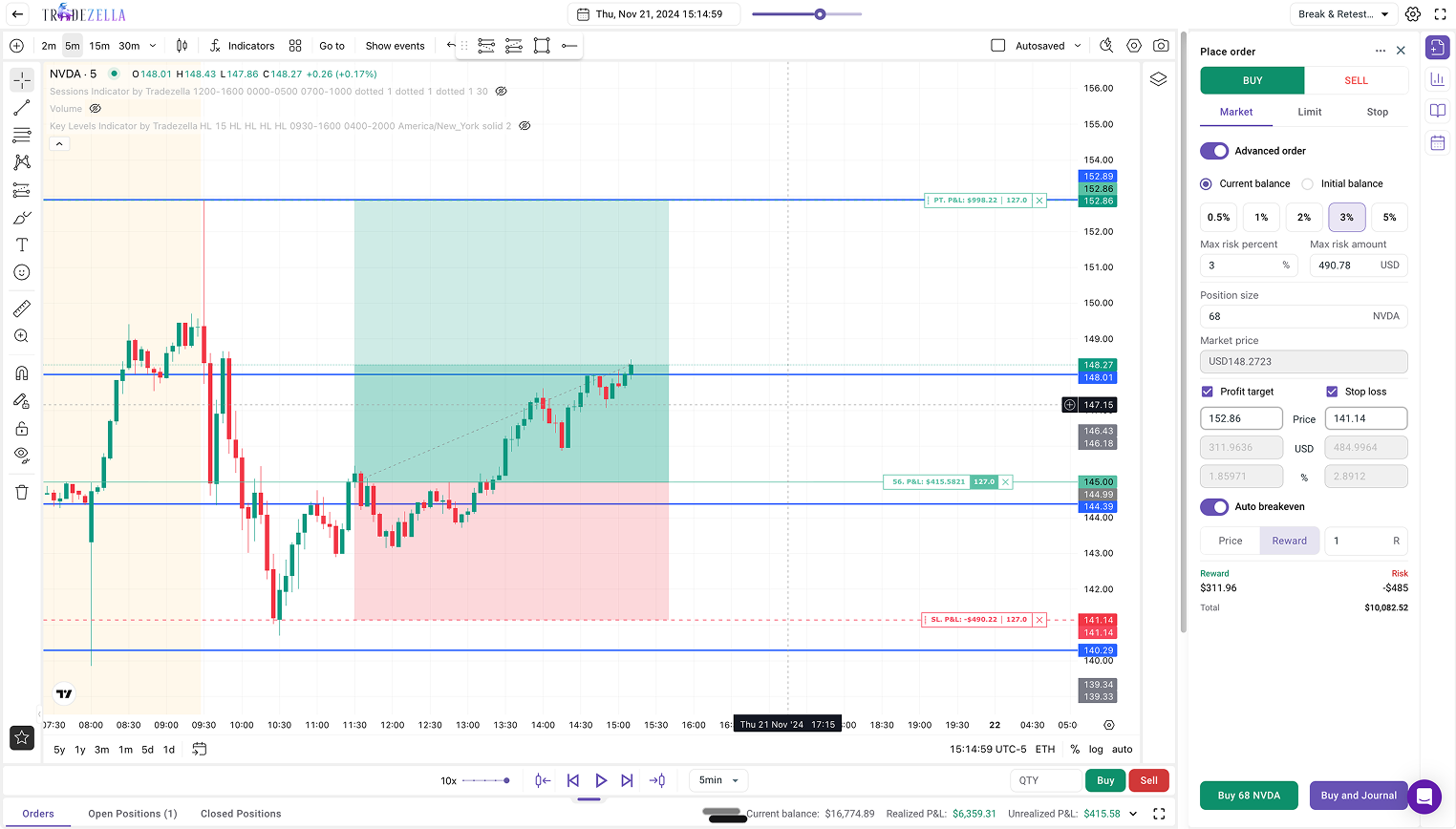
In TradeZella, you can backtest with TradeZella using over 11 years of historical data, all order types, and automatic position sizing. Every backtest trade gets logged with the same analytics as live trades, so you can compare backtest expectations against actual funded performance later.
TradeZella Backtesting
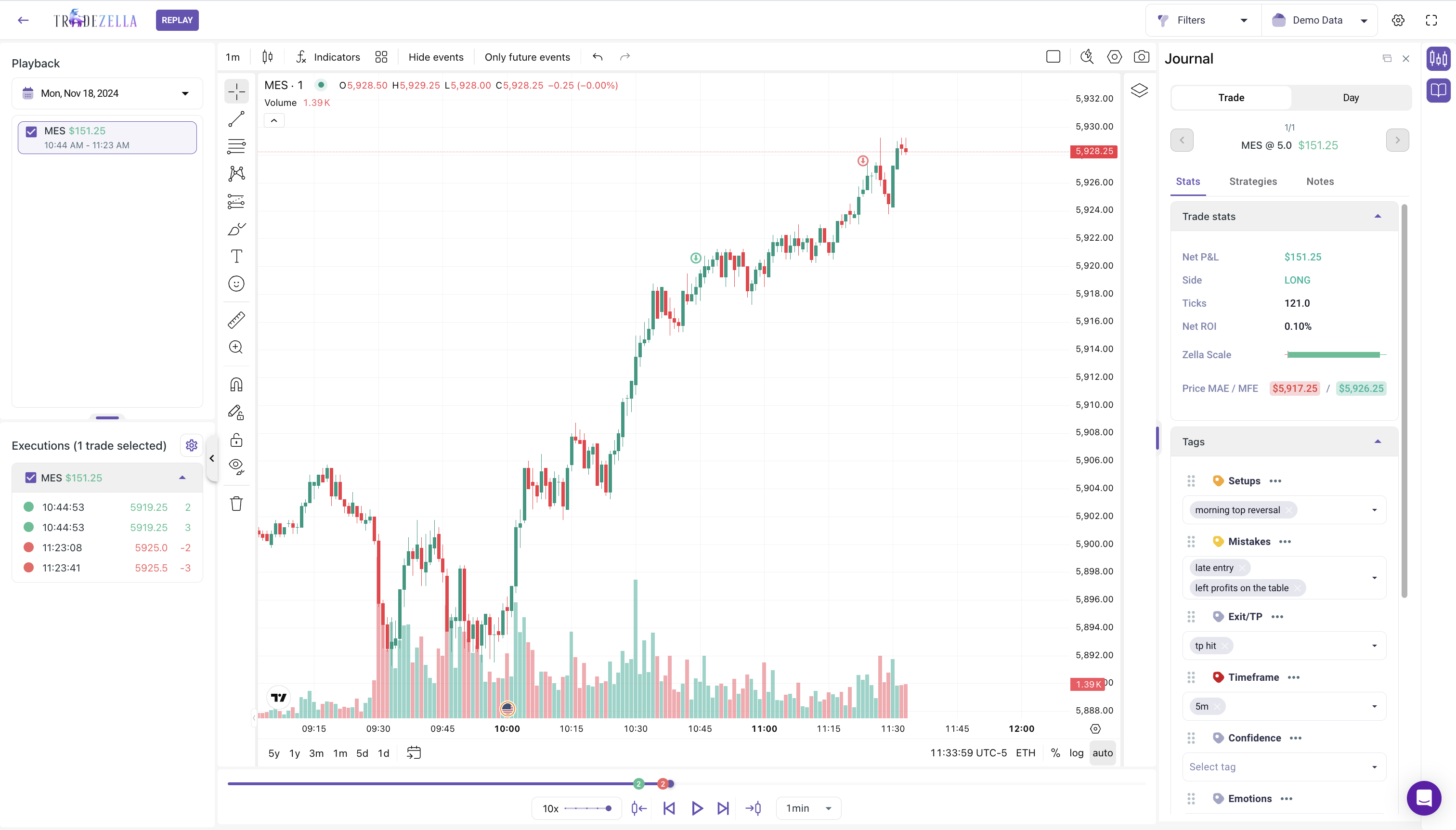
Trade replay is different. Replay walks you through past trading sessions bar by bar, so you can review your actual funded trades and see where execution broke down. Did you enter early? Did you move the stop? Did you add to a loser? Replay shows exactly what happened in a way that a P&L number alone never will.
TradeZella Trade Replay
The funded trader workflow is: backtest the strategy before going live, then use replay weekly to audit the trades you actually took. Backtesting answers "does this strategy work?" Replay answers "did I execute the strategy correctly?" TradeZella handles both in one platform, and every backtest and replay trade feeds into the same analytics dashboard as your live funded trades, so comparison is automatic.
Tool 5: An Economic Calendar
This is the simplest tool on the list and the one most funded traders underestimate. A single news event can move ES 50 points in 30 seconds. That's $2,500 on two contracts, which is half the daily loss limit on most $100,000 accounts.
Most prop firms have rules about trading through high-impact news. Some prohibit it outright. Others allow it but won't forgive losses from news events that blow through the daily limit. Either way, funded traders need to know what's coming every morning before the session opens.
The pre-market check takes two minutes:
Open the economic calendar ( TradeZella, TradingView, Forex Factory, or Investing.com all have one).
Check for red-flag events during your trading session (FOMC, CPI, NFP, GDP, jobless claims).
If a high-impact event falls during your session, either skip that session entirely or flatten all positions 15 minutes before the release.
This isn't about predicting the number. It's about protecting the funded account from the 3-second move that wipes out a week of gains. Smart funded traders treat news events the way poker players treat bad hands: fold pre-flop and wait for the next one.
TradeZella includes an economic calendar built into the platform, so you can check upcoming events without switching tabs. Tag trades taken during news events and filter the Tags report to see whether news trading is helping or hurting your funded account. Most funded traders discover it's costing them money and stop.
TradeZella Economic Calendar
Tool 6: Performance Analytics
The difference between funded traders who collect payouts for years and those who lose accounts within months is almost always the same: weekly review. Analytics turn raw trade data into decisions about what to change, what to keep, and what to stop doing.
For funded traders specifically, analytics answer these questions every week:
Which Strategies are making money and which are bleeding? Most funded traders have two or three setups. Usually one is carrying the account and the others are dragging it down. The Strategy comparison report shows this instantly. If your breakout strategy has a 2.1 profit factor and your reversal strategy has a 0.7, you know exactly what to cut.
What time of day am I most profitable? Funded futures traders often find that 80% of their profits come from the first 90 minutes. The Day & Time report shows per-hour performance. If your afternoon trades have a negative expectancy, stopping at 11:30 AM could be the single biggest improvement to your funded account.
Am I following my rules? Tag every trade with "Rules Followed" or "Rules Broken." Filter the Tags report monthly. If your rules-followed trades have a 1.8 profit factor and your rules-broken trades have a 0.4, the data tells you exactly how much rule-breaking is costing in real dollars. On a $100,000 account, that's often $2,000 to $5,000 per month.
How close am I to consistency targets? If your best day is $2,400 and total profit is $4,000, your best day is 60% of total, which violates Topstep's 50% consistency rule. Analytics catch this before the firm does.
Analyze your trading performance weekly using the trading dashboard to see all these metrics in one view. The R-Multiple view is especially useful for funded traders because it normalizes results across different position sizes and account balances. TradeZella's analytics are built specifically for this kind of funded account review: 50+ reports, 7 dashboard views, and filtering by Strategy, time of day, tags, and date range so you can isolate exactly what's working and what's costing you drawdown.
TradeZella Strategies Reports
How Do These Six Tools Work Together as a Daily System?
The tools above aren't useful in isolation. The value comes from how they connect into a daily workflow. Here's what a typical funded trader's day looks like with the complete toolkit in place:
Pre-market (15 minutes before open)
Check the economic calendar. Flag any high-impact events. Decide whether to trade the session or sit out.
Review yesterday's P&L and running drawdown. Open TradeZella. Check the calendar. Know exactly how much room you have today before you place the first trade.
Review the trading plan. Which Strategies are you trading today? What's the maximum risk per trade? What's the daily loss limit? Write it in the Notebook as a pre-session commitment.
Calculate position size. Use the Position Size Calculator based on today's stop distance and the firm's current drawdown buffer.
During the session
Execute on your charting platform. Bracket orders on every trade. No exceptions.
Monitor daily P&L.TradeZella imports trades as they happen. After each trade, check where you stand against the daily limit.
Stop when you hit the daily loss limit or the giveback rule floor. This is non-negotiable on funded accounts. Continuing to trade after hitting the limit means you're one trade away from account termination.
Post-session (10 minutes after close)
Tag every trade. Rules Followed or Rules Broken. Emotional state. Strategy name. These tags become the data you analyze on Sunday.
Log notes in the Notebook. What went well, what went wrong, one thing to improve tomorrow.
Weekly review (Sunday, 30 minutes)
Review the P&L calendar. Look for day-of-week patterns, post-loss clusters, and giveback days.
Check Strategy performance. Kill or reduce sizing on strategies with negative expectancy.
Check time-of-day performance. Consider narrowing your trading window if afternoon hours are unprofitable.
Run trade replay on your worst trade. Find the exact moment execution broke down and make a rule to prevent it next week.
Calculate Rule Adherence Score. If it's below 80%, the problem isn't the market. It's discipline. Read more about building trading discipline through data.
This workflow takes about 30 minutes per day on top of actual trading time. That investment protects the funded account and compounds over weeks and months into measurably better performance.
What Are the Most Common Mistakes Funded Traders Make With Their Tools?
Having the tools isn't enough. Funded traders make specific mistakes in how they use them.
1. Not tracking across accounts. Running three $100,000 accounts and only checking P&L on each one individually. If all three are in the same instrument, same direction, your true risk is three times what any single account shows. Use a multi-account dashboard or you're flying blind on aggregate exposure.
2. Skipping the journal on losing days. This is the most common and most expensive mistake. Losing days contain the most valuable data: what triggered the overtrading, where the stop got moved, what emotional state led to the revenge trade. If you only journal winning days, you're studying the wrong half of your trading.
3. Backtesting after going live. Too many funded traders start the evaluation, lose 3%, and then decide to backtest. By that point, 30% of the drawdown budget is gone. Backtest first, prove the strategy works on historical data, then go live. Every dollar lost during "live testing" on a funded account is real drawdown you can't get back.
4. Ignoring the trailing drawdown math. Traders who don't track trailing drawdown in real time get surprised when their buffer shrinks. A $100,000 account that profits $4,000 with a $5,000 trailing drawdown now has a floor at $99,000. The buffer went from $5,000 to $1,000. One normal losing day and the account is terminated. Your journal should show this number every day.
5. No weekly review. Using the tools daily but never stepping back to see the patterns. A funded trader who reviews weekly catches the "my Fridays are -$800 on average" pattern by week three. A funded trader who doesn't review catches it in month two, after it has cost $6,000+ in drawdown.
The pattern behind all five mistakes is the same: funded traders treat their accounts like personal accounts. They aren't. A funded account is a business arrangement with specific rules, and the toolkit needs to match the rules, not your personal trading habits.
This is why most funded traders who stay funded long term consolidate as much of their toolkit as possible into one platform. TradeZella covers five of the six categories (journal with Prop Firm Sync, risk calculators, backtesting and replay, economic calendar, and performance analytics), which means fewer logins, fewer manual steps, and data that flows automatically from trade execution to weekly review. The charting platform is the only piece you need separately.
Calculates position size, drawdown recovery, and ROI
Size trades against firm limits, not personal preference
$2,000-5,000/month from oversizing
Position Size, Drawdown Recovery, Prop Firm ROI calculators
Charting Platform
Charts, order execution, bracket orders
Fast execution, hard stops, consistent templates
Slippage adding $500-1,000/month
Auto-imports from NinjaTrader, Tradovate, etc.
Backtesting & Replay
Tests strategies on historical data, reviews past trades
Prove strategy works before risking funded capital
3-5% drawdown from untested strategies
11+ years data, Trade Replay, Day Replay
Economic Calendar
Shows scheduled news events and data releases
Avoid holding through events that can move 50+ points in seconds
One news event can hit the daily limit
Use free calendars (TradingView, Forex Factory)
Performance Analytics
Filters performance by strategy, time, tags
Identifies which setups and hours to keep or cut
$3,000-6,000/quarter in preventable losses
50+ reports, Strategy comparison, Day & Time, Tags
Key Takeaways
Funded traders need six specific tools: a prop firm journal, risk calculators, a charting platform, backtesting and replay, an economic calendar, and performance analytics.
The journal is the most important tool because it tracks daily drawdown, consolidates multiple accounts, and captures the behavioral data that prevents account termination.
Position sizing on funded accounts works backward from the firm's limits: set your personal daily limit 30% below the firm's hard limit, then size trades to allow 5-7 losses before hitting it.
Backtesting and replay serve different purposes. Backtest before going live to prove the strategy works. Use replay weekly to audit execution quality.
The daily workflow (15 minutes pre-market, monitoring during session, 10 minutes post-session, 30-minute Sunday review) is what separates traders who collect payouts from traders who lose accounts.
The five most common toolkit mistakes all share one root cause: treating funded accounts like personal accounts instead of recognizing the tighter constraints.
TradeZella covers five of the six tool categories (journal, calculators, backtesting and replay, economic calendar, analytics) with Prop Firm Sync built in, so funded traders can manage the entire workflow from one platform.
What is the most important tool for funded traders?
A trading journal with prop firm account tracking is the most important tool for funded traders. It tracks daily drawdown against the firm's hard limits, consolidates multiple accounts into one dashboard, and captures the behavioral patterns like revenge trading and overtrading that cause most account terminations. Without a journal, funded traders cannot see how close they are to the daily loss limit after each trade, cannot detect cross-account risk, and cannot identify the specific days, times, and setups that are costing them money. TradeZella's Prop Firm Sync connects prop firm accounts automatically and shows all this data in one view.
How many tools does a funded trader actually need?
Funded traders need six tools across six categories: a trading journal with prop firm tracking, risk management calculators, a charting platform with fast execution, backtesting and trade replay software, an economic calendar, and performance analytics. Some of these overlap in a single platform. For example, TradeZella covers the journal, backtesting, replay, and analytics categories in one tool. The charting platform and economic calendar are separate. The total number of software subscriptions is typically two to three, not six.
Should I use the same tools during evaluation and after getting funded?
Yes, use the same tools during evaluation that you plan to use when funded. The evaluation period is where you build the habits and workflows that sustain the funded account long term. Traders who pass an evaluation without a journal, then try to add one after getting funded, usually struggle because they are changing their process at the exact moment the stakes increase. The one change to make after getting funded is tighter risk parameters: reduce your personal daily loss limit and risk per trade by roughly 20 to 30 percent compared to evaluation settings.
How do I track drawdown across multiple prop firm accounts?
Use a trading journal that supports multi-account tracking with automatic trade import. In TradeZella, Prop Firm Sync connects each prop firm account separately, then the dashboard shows per-account and aggregate data. Check three things daily: each account's daily P&L against its individual daily loss limit, total correlated exposure across accounts (how many contracts in the same direction across all accounts), and each account's remaining buffer to the trailing drawdown floor. Without a multi-account view, funded traders routinely underestimate their true risk by two to three times.
Can I use a spreadsheet instead of a dedicated funded trader toolkit?
A spreadsheet works during evaluation when you are trading one account with a simple strategy. It breaks down when you are funded across multiple accounts, trading 10 to 20 times per day, and need real-time drawdown tracking. Manual entry creates three problems: you skip logging on losing days (when the data matters most), you cannot calculate running drawdown after each trade without complex formulas, and you cannot filter performance by strategy, time of day, or tags without rebuilding the spreadsheet every week. Most funded traders who start with spreadsheets switch to dedicated software within the first month of funded trading.
What should I check before every trading session on a funded account?
Check four things in 15 minutes before every session. First, check the economic calendar for high-impact news events during your trading hours. Second, review yesterday's P&L and your current remaining drawdown buffer in your journal. Third, review your trading plan and decide which Strategies you will trade today. Fourth, calculate position size using a risk calculator based on today's stop distance and your current drawdown buffer, not your starting account size. This pre-session routine prevents the two most common funded account killers: trading into news events and oversizing based on stale calculations.
How much time per day should I spend on tools and review as a funded trader?
Plan for 15 minutes of pre-market preparation, real-time monitoring during the session (which adds no extra time since it happens alongside trading), and 10 minutes of post-session tagging and note-taking. That is roughly 25 minutes per day on top of actual trading time. Add 30 minutes every Sunday for a weekly review of your P&L calendar, Strategy performance, and time-of-day analytics. The total weekly investment is about three hours. Funded traders who skip this process lose an average of two thousand to five thousand dollars per month in preventable mistakes, making the time investment one of the highest-return activities in trading.



.png)