10 Deadly Trading Mistakes (And How to Avoid Every One)
10 Deadly Trading Mistakes (And How to Avoid Every One)
Roughly 70 to 90 percent of retail traders lose money, not because the market is rigged, but because they repeat the same 10 preventable mistakes until there's nothing left to trade with. This guide breaks down each mistake with dollar examples, explains why traders make them, and gives you the specific system or rule that fixes each on
class SampleComponent extends React.Component {
  // using the experimental public class field syntax below. We can also attach
  // the contextType to the current class
  static contextType = ColorContext;
  render() {
    return <Button color={this.color} />
  }
}
Last Updated: April 15th, 2026
The most common trading mistakes are trading without a stop loss, oversizing positions, revenge trading after a loss, not journaling trades, ignoring setup-level performance, trading at the wrong time of day, moving stop losses further away, overtrading, chasing entries after missing a move, and never reviewing trades. Each of these mistakes has a specific fix, and traders who implement even 3 or 4 of them typically see measurable improvement within a month.
Most traders don't blow up their accounts because of one bad trade. They blow up because of the same 10 mistakes, repeated over and over, until there's nothing left to trade with.
Here's the uncomfortable truth: roughly 70 to 90 percent of retail traders lose money. Not because the market is rigged or because they picked the wrong strategy. They lose because they keep making preventable errors that compound over weeks and months.
The good news? Every mistake on this list has a concrete fix. Not "just be more disciplined" advice, but specific systems and rules you can put in place today. Some of these fixes take five minutes. Others require a mindset shift. All of them will save you money if you actually implement them.
#
Mistake
Severity
Typical Cost ($25K Account)
The Fix
1
No Stop Loss
Critical
$500-$2,000+ per occurrence
Hard stop order before every entry
2
Oversizing Positions
Critical
$1,000-$2,500 per occurrence
Fixed 1% risk per trade, always
3
Revenge Trading
Critical
$500-$1,500 per episode
Daily loss limit + cooling off rule
4
Ignoring Journal
High
Hidden (compounds all other mistakes)
Auto-import trades from broker
5
No Setup Tracking
High
$200-$800/month from bad setups
Tag every trade by Strategy type
6
Wrong Time of Day
High
$300-$600/month from dead zones
Trade only during proven hours
7
Moving Stop Away
Critical
$250-$750 per occurrence
Stops only move in your favor
8
Overtrading
High
$400-$1,000/month in late trades
Daily trade limit from journal data
9
Chasing Entries
High
$200-$500 per chased trade
Missed trade list, accept $0 cost
10
No Weekly Review
High
Hidden (prevents all improvements)
30-min Sunday review, every week
Cost estimates based on a $25,000 account with standard day trading frequency. Actual impact varies by account size and trading style.
What Are the 10 Biggest Trading Mistakes?
1. Trading Without a Stop Loss
This is the single fastest way to destroy a trading account. You enter a trade on AAPL at $185 because it looks like a clean breakout. It pulls back to $184. Then $183. You tell yourself it'll come back. By $180, you've lost $500 on a trade that should have cost you $100.
Why traders do it: Fear of getting stopped out and watching the stock reverse without them. It feels like the stop loss is the problem, when the real problem is undefined risk.
The fix: Before you enter any trade, define your stop loss level. Not a mental stop. An actual order sitting in your broker's system. If you're risking 1% of a $25,000 account, that's $250 max per trade. Calculate your position size based on the distance between your entry and your stop.
Traders who set hard stops before entering positions lose less per trade and stay in the game longer. The math is simple: a $250 loss is recoverable. A $2,000 loss because you "held and hoped" takes weeks to recover from. At a 2% monthly return, recovering a $2,000 loss on a $25,000 account takes over 4 months. That's 4 months of perfect trading just to get back to where you started.
What to do: Set your stop loss before every single trade. Log it in your journal so you can track whether you actually honored your levels.
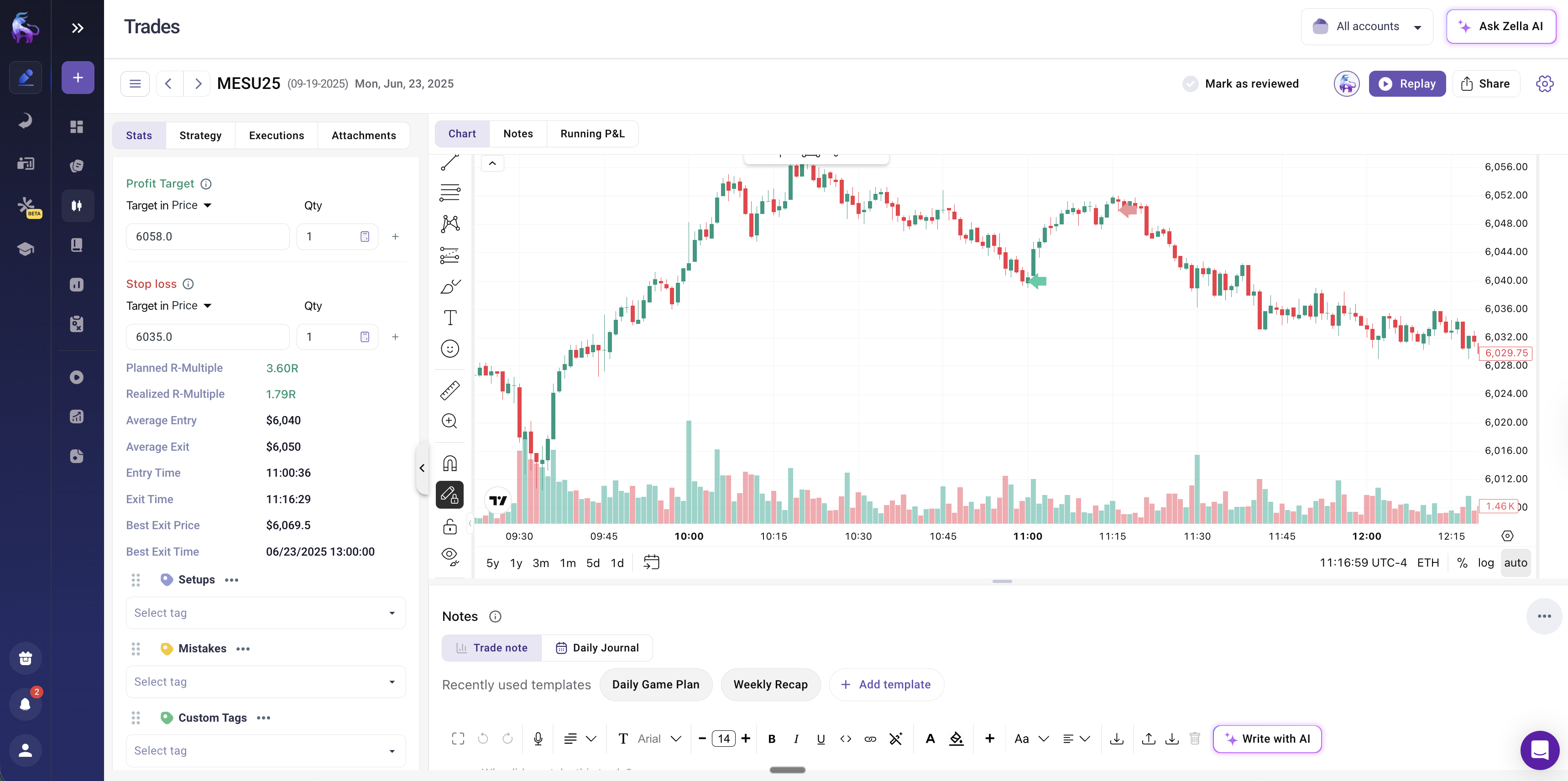
In TradeZella, you can set your stop loss and profit target after importing each trade, using five different methods: price, price movement, ticks, P&L, or points. Over time, you can track whether you are actually following your planned levels or moving them, and see how that behavior affects your results.
TradeZella Trade View
2. Oversizing Positions
You found what looks like a perfect setup. Everything aligns: the chart pattern, the volume, the news catalyst. So you go big. Instead of risking your normal 1%, you put 5% of your account on this one trade.
The trade goes against you by 2%, and suddenly you've lost 10% of your account in a single position. A 10% drawdown requires an 11.1% gain to recover. Two oversized losers in a row and you're looking at months of recovery time.
Why traders do it: Overconfidence on "high conviction" setups. The problem is that your conviction about a trade has almost zero correlation with its outcome.
The fix: Fixed fractional position sizing. Risk the same percentage on every trade, regardless of how good it looks. Most professionals risk 0.5% to 2% per trade, with 1% being the standard for developing traders.
Here's the math for a $25,000 account risking 1% per trade: your max loss is $250. If your stop is $2 away from entry on a stock, you can buy 125 shares. If your stop is $5 away, you buy 50 shares. Use the Position Size Calculator to run this formula automatically.
What to do: Calculate your position size before every trade using the formula: shares = (account size x risk %) / (entry price - stop price).
3. Revenge Trading After a Loss
You just lost $300 on a clean trade that went against you. Instead of stepping away, you immediately scan for another setup. You find something that's "close enough" and enter with bigger size to make back what you lost. Twenty minutes later, you're down $700 for the day.
Why traders do it: The loss triggers an emotional response. Your brain wants to undo the pain by getting the money back immediately.
The fix: Set a daily loss limit and a "cooling off" rule. If you hit your max daily loss (many successful traders use 2 to 3 percent of their account), you're done for the day. Period.
Tag every trade you suspect was revenge-driven. Our full guide on revenge trading walks through the psychology, the cascade that follows, and the structural fixes that work better than willpower. After 30 days, pull up your journal and filter by that tag. When you see that your revenge trades have a 25% win rate and cost you $3,200 while your planned trades ran at 62% and made $4,800, the data makes the behavioral change easy.
What to do: Create a "revenge trade" tag in your trading journal. Review the data weekly.
4. Ignoring Your Trading Journal
You track your trades in a spreadsheet... sometimes. Or you have a journal you haven't opened in two weeks.
Why traders do it: Journaling feels like homework. It's easier to take the next trade than to sit down and analyze why the last one worked or didn't.
The fix: Automate as much of the journaling process as possible. If your journal auto-imports trades from your broker, the barrier drops to near zero. Our journal vs spreadsheet comparison shows exactly where manual tracking breaks down at different trade volumes. If you're not ready for a full journal yet, start with our free trading journal template to build the habit.
What to do: Connect your broker to a journal like TradeZella that auto-imports your trades. Spend 5 minutes at the end of each trading day tagging and annotating.
TradeZella auto-imports your trades and gives you a full breakdown for each one, including entry and exit prices, R-multiples, profit target, stop loss, and time stamps. You can tag each trade with setups, mistakes, and custom tags, then add notes using Trade Note or Daily Journal templates right inside the trade view
TradeZella Trade View
5. Not Tracking Performance by Setup Type
You know your overall win rate. Maybe it's 52%. But that single number hides everything important. Your VWAP bounce trades might have a 68% win rate while your gap-and-go plays sit at 35%.
The fix: Create a Strategy for each setup you trade. Give it a name, define the entry criteria, define the exit rules. Then track each trade against its specific Strategy.
After 30 trades per setup, the data becomes meaningful. Compare using profit factor: any setup below 1.0 is losing money. Any setup above 1.5 is worth keeping. Most traders discover that 2 of their 5 setups generate all their profits. The other 3 are actively destroying the edge.
What to do: Define your top 3 setups as Strategies with specific rules. Tag every trade with its setup type.
In TradeZella, go to Reports and open the Strategies tab to see your best and worst performing setups side by side. Compare net P&L, trade count, and win rate for each strategy to find which setups are making you money and which ones to cut.
TradeZella Report Strategy Performance
6. Trading at the Wrong Time of Day
A day trader's performance is rarely consistent across the entire session. Most traders have a "hot zone" where their strategy works best and a "dead zone" where they give back profits.
The fix: Track every trade's entry time and analyze performance by hour. You might discover that your win rate is 60% before 10:30 AM and 38% after lunch. That single insight could flip your monthly P&L from negative to positive.
What to do: Review your time-of-day analytics after 50+ trades. Only trade during your proven hours.
In TradeZella, go to Reports and filter by time of day to see which hours you perform best and worst. Drag the time range to isolate your morning session, midday, or afternoon, and compare win rate and average P&L across each window
TradeZella Reports Time Performance
7. Moving Your Stop Loss Further Away
You entered a trade on TSLA at $245 with a stop at $243. The price drops to $243.50 and starts hovering near your stop. Instead of letting the stop do its job, you move it to $241. Now your $500 risk has become a $1,000 risk.
The fix: A simple rule: stops only move in your favor, never against you. This connects directly to mistake #1. If you defined your risk at entry ($500), moving the stop doubles your risk to $1,000. You've now oversized the trade retroactively. Log every stop adjustment in your journal, with the original stop and the new stop, so you can see the dollar cost of moving stops over time.
What to do: Write this rule in your trading plan. Track stop adjustments in your journal. Use habit tags to mark trades where you moved your stop. After 20 tagged trades, compare P&L on moved-stop trades vs. honored-stop trades. The data will end the habit.
8. Overtrading
You've taken 12 trades today. The first 4 were solid setups. Trades 5 through 12 were increasingly desperate. By the end of the day, your first 4 trades made $600 and your last 8 trades lost $900. Net result: down $300 on a day that should have been profitable.
The fix: Set a maximum daily trade count based on your data. Most traders will see that their first 3 to 5 trades of the day are profitable and everything after goes negative. Our full guide on overtrading walks through the exact process for finding your optimal trade count using journal data.
What to do: Review your P&L by trade number. Set a daily trade limit at the point where your edge disappears.
9. Chasing Entries After Missing a Move
The stock you've been watching gaps up 8% at the open. Your planned entry at $150 is already at $162. Instead of accepting that you missed it, you buy at $162.
Why traders do it:FOMO. Watching a stock run without you triggers the same emotional response as losing money.
The fix: Accept one fundamental truth: there is always another setup. The market gives you new opportunities every single day. A missed trade costs you $0. A chased entry at a bad price can cost you hundreds. Your journal data will prove this: pull up every trade where you entered more than 2% above your planned price and check the P&L. Almost always negative.
What to do: Keep a "missed trade" list in your notebook. Log the ticker, your planned entry, the price when you noticed it, and what happened next. After 30 entries, you'll see that most "life-changing" moves you missed either pulled back to your entry level or reversed entirely. The missed trade list turns FOMO into data.
10. Never Reviewing Your Trades
This is the meta-mistake that allows every other mistake on this list to persist. Without a structured trade review process, you can't identify patterns, can't measure improvement, and can't make data-driven decisions about what to change. You're trading blind.
The fix: Schedule a 30-minute weekly review every Sunday. Pull up your calendar view, sort trades by winners and losers, and write down 3 observations.
What to look for in your weekly review: Your worst trade of the week (was it a rule break or normal variance?). Your best trade (did you follow your plan, or did you get lucky?). Any patterns in your losing trades (same time of day, same setup, same emotional state?). Your R-multiples for the week (are you cutting winners early or letting losers run?).
The compound effect: One weekly review doesn't change much. But 12 consecutive weekly reviews, with each one identifying one fixable mistake, means 12 specific improvements in 3 months. That's how traders who review consistently improve faster than traders who don't.
What to do: Block 30 minutes every Sunday for your weekly review. Do this consistently for 4 weeks, and you'll see measurable improvement.
TradeZella's calendar view and dashboard make weekly and monthly reviews easy. Filter by date range, sort by winners and losers, and see your net P&L, win rate, profit factor, and streaks all in one place.
TradeZella Dashboard for monthly and weekly review
These 10 mistakes don't happen in isolation. They cascade. Here's the most common sequence:
You trade without a stop loss (mistake #1). The loss grows larger than expected. You revenge trade to recover (mistake #3). The revenge trade uses too much size (mistake #2). You take 5 more trades trying to get back to breakeven (mistake #8). By the end of the day, a $250 planned loss has turned into a $1,500 account hit.
This is the same FOMO-to-revenge-to-overtrade cascade we document in our psychology cluster. The drawdown protocol interrupts this cascade structurally: at 3% drawdown you cut size by 50%, at 5% you stop entirely. The protocol doesn't rely on willpower. It relies on pre-committed rules.
The fix for the cascade is the same fix for each individual mistake: define the rule before you need it. Write down your stop loss before you enter. Calculate your size before you trade. Set your daily loss limit before the session. A one-page trading plan puts all these rules in one place so you commit to them before the market opens. When the rule is pre-committed, emotions don't get a vote.
Track your expectancy monthly. If your expectancy is positive but you're still losing money, the problem is almost always one of these 10 mistakes leaking profit. The journal data tells you which one.
If you want to test whether your fixes actually work before risking capital, backtest your strategy against historical data. Run your updated rules across 100 or more trades in a backtest environment. If the backtest shows improvement, you know the fix works. If it doesn't, you saved yourself weeks of live losses. This applies whether you trade scalping setups on the 1-minute chart or swing trades held for days.
Key Takeaways
Always set a hard stop loss before entering any trade. A $250 planned loss is recoverable. A $2,000 unplanned loss takes months.
Risk 1% or less per trade, regardless of how confident the setup looks. Use the position size formula every time.
Set daily loss limits (2 to 3% of account) and walk away when you hit them.
Automate your journaling to remove the friction. Auto-import eliminates the biggest barrier to consistent tracking.
Track performance by setup type, not just overall win rate. Most traders have 2 profitable setups and 3 that destroy the edge.
Analyze your time-of-day performance. Trade only during your proven hours.
Never move a stop loss further from your entry. Stops only move in your favor.
Set a daily trade limit based on when your P&L starts declining. Your first 3 to 5 trades are usually your best.
Never chase a missed entry. Log it, learn from it, move on. FOMO entries are almost always negative.
Schedule a 30-minute weekly review. Twelve consecutive reviews means 12 specific improvements in 3 months.
Frequently Asked Questions
What is the biggest mistake beginner traders make?
The most damaging mistake for beginners is trading without a stop loss. Without defined risk, a single trade can wipe out weeks of progress. Setting a hard stop before every entry keeps each loss small and your account intact. Combined with proper position sizing (1% risk per trade), this one habit prevents catastrophic losses.
How many trades should a day trader take per day?
Most day traders perform best on 3 to 5 quality setups per day. Review your P&L by trade number across 30 or more trading days to find where your edge disappears. Let your journal data set the number, not your gut. Traders who set a maximum daily trade count based on their data consistently outperform those who trade without limits.
How do I know if I am overtrading?
Track your cumulative P&L by trade number across 30 or more trading days. If your first few trades are profitable but later trades erase those gains, you are overtrading. The pattern typically shows peak profitability around trade 3 to 5, with declining returns after that. Setting a hard daily limit at your optimal trade count is the simplest fix.
Why do I keep making the same trading mistakes?
Without a structured review process, mistakes stay invisible. The fix is a weekly trade review where you identify your worst trade of the week and write down a specific rule to prevent it from happening again. Tagging mistakes in your journal (revenge trade, FOMO entry, moved stop) lets you quantify the dollar cost of each mistake over time, which makes behavioral change much easier.
What is the fastest way to stop losing money in trading?
Set a hard stop loss on every trade and risk no more than 1% of your account per position. These two rules alone prevent the catastrophic losses that wipe out most beginners. You can implement both today with zero cost. After that, start a trading journal and review your trades weekly. Within 30 days you will have enough data to see which specific mistakes are costing you the most, and you can fix them one at a time.
Should I track my mistakes in a trading journal?
Yes. Tag every trade with the specific mistake involved, such as "no stop," "revenge trade," "FOMO entry," or "moved stop." After 30 or more tagged trades, filter by tag to see the dollar cost of each mistake. This turns abstract problems like "I need more discipline" into concrete data like "my revenge trades cost me $2,400 last month." The data makes behavioral change much easier because you can see exactly what each mistake costs you in real dollars.
How long does it take to become a profitable trader?
Most traders who eventually reach consistent profitability take 1 to 3 years of dedicated effort. The timeline depends heavily on how structured your review process is. Traders who review their performance weekly and use journal data to make specific improvements consistently reach profitability faster than those who trade without tracking or reviewing.





.png)

