Trading Tilt: How to Recognize When Your Emotions Are Costing You Money
Trading Tilt: How to Recognize When Your Emotions Are Costing You Money
In poker, "tilt" is when emotions override rational decision-making. The same thing happens in trading, but most traders have no framework for identifying it. This guide covers 4 types of trading tilt, the data trail each type leaves in your journal, a 30-second real-time check, and a post-session audit that shows you the exact dollar cost of emotional trades.
class SampleComponent extends React.Component {
  // using the experimental public class field syntax below. We can also attach
  // the contextType to the current class
  static contextType = ColorContext;
  render() {
    return <Button color={this.color} />
  }
}
Last Updated: April 22nd, 2026
Trading tilt is a state where emotions override your trading plan, causing you to make irrational decisions that deviate from your defined rules. The term comes from poker psychology, where "tilt" describes a player making loose, aggressive bets after a bad beat instead of following their strategy. In trading, tilt manifests as revenge trading after losses, oversizing after wins, re-entering stopped-out trades to "prove" your analysis, or extending your session because you feel you "deserve" a winning day. There are four distinct types of tilt, each with a different trigger, a different data trail, and a different defense.
Tilt is responsible for more blown accounts than any bad strategy. The trader who loses 2 percent and revenge trades into a 7 percent drawdown is on tilt. The trader who hits a hot streak and doubles their position size without adjusting their plan is on tilt. The trader who takes a perfect setup, gets stopped out, and immediately re-enters the same direction with a bigger position is on tilt.
The problem is that most traders have no vocabulary for what is happening. They know they "traded emotionally" but cannot identify the specific type, the trigger, or the cost. Without a framework, they cannot fix it. This article gives you that framework: 4 tilt types, the data trail each one leaves in your journal, a 30-second real-time check, and a post-session audit that quantifies exactly how much tilt is costing you.
Tilt Type
Trigger
Data Trail
Defense
Loss Tilt
Consecutive losses or a single large loss. Frustration drives the need to "get it back."
Position size increases after losses. Trade frequency spikes. Win rate drops 10+ points on post-loss trades.
Daily loss limit (hard stop). Walk away after 2 consecutive losses. Review before next trade.
Win Tilt
Winning streak inflates confidence. You take setups you would normally skip or increase size without plan changes.
R-multiple spikes upward on streak days. Trades outside strategy tags increase. Profit factor drops on high-win days.
Fixed position size cap regardless of streak. Daily trade limit. Log confidence level pre-trade.
Injustice Tilt
A "perfect" setup fails. You followed every rule and still lost. Feels unfair, so you re-enter to prove you were right.
Same ticker re-entry within minutes. Same direction as stopped-out trade. "Rules Followed" tag present on initial trade.
One-and-done rule per ticker per session. Accept that correct trades can lose. Move to next setup.
Entitlement Tilt
You did the work (prep, research, journaling) and feel you "deserve" a green day. When it does not come, you force trades.
Extended session time on losing days. Trades taken in final hour that break setup rules. Low-quality entries late in the day.
Hard session cutoff time. No trades after your defined window. Separate effort from outcome in your journal notes.
What Are the 4 Types of Trading Tilt?
Type 1: Loss Tilt
Loss tilt is the most common type. You take a loss, frustration builds, and you start making decisions based on needing to "get it back" rather than following your plan.
How it shows up: Increased trade frequency after losses. Larger positions following losses. Entries without valid setups. Abandoning stop losses. Taking trades in the opposite direction of your analysis out of frustration.
Dollar example: You are trading a $50,000 account with $500 risk per trade. You lose two trades in a row for a $1,000 loss. Loss tilt kicks in. You double your next position to $1,000 risk "to make it back." That trade also loses. Now you are down $2,000 instead of $1,500, and the emotional spiral accelerates. Three more trades at inflated size and you are down $4,000, an 8 percent drawdown that started as a normal 2 percent dip. This is exactly the cascade described in our losing streak guide.
Data trail: In TradeZella, filter trades taken within 30 minutes of a losing trade. Compare the win rate and profit factor of these post-loss trades against your overall numbers. If win rate drops by 10 or more percentage points on post-loss trades, loss tilt is in your data. Also check if position size increases after losses by using the R-Multiple View to see if risk-per-trade spikes.
Type 2: Win Tilt
Less obvious but equally dangerous. You are winning, confidence surges past healthy levels, and you take risks you normally would not.
How it shows up: Position sizes creep up without a plan-based reason. You skip your pre-trade checklist. You trade setups that are "close enough" instead of A+ quality. You hold winners too long hoping for a bigger move instead of taking your target.
Dollar example: You start the day with three winners totaling $1,800. Feeling unstoppable, you increase your risk from $500 to $800 on the next trade. It loses. You take another at $800 because "I'm still up." It loses. Now your $1,800 gain is a $200 gain, and the emotional shift from confidence to frustration can trigger loss tilt on top of win tilt.
Data trail: Look at P&L on days where you had 3 or more consecutive winners early. In TradeZella, use the Calendar view to find your biggest winning mornings, then check afternoon performance on those same days. Many traders discover that their best mornings lead to their worst afternoons because win tilt erodes discipline after the early streak.
Type 3: Injustice Tilt
You feel the market "did something wrong." Your setup was textbook, your analysis was solid, but the trade lost anyway. Instead of accepting variance, you fight the market.
How it shows up: Re-entering the same trade immediately after getting stopped out. Larger positions to "prove" your analysis was correct. Refusing to take setups in the opposite direction even when your plan says to. Arguing with the chart.
Dollar example: Your analysis says SPY breaks above $520. You enter long, get stopped for a $500 loss. The setup was valid, the execution was clean, but the market reversed. Injustice tilt says "I was right, the market is wrong." You re-enter long with $750 risk. Stopped again. You enter a third time. Stopped. Three trades on the same thesis, $2,000 lost, when your plan says one entry per setup. The first loss was variance. The $1,500 after it was tilt.
Data trail: In TradeZella, filter by Symbol and look for 3 or more trades on the same ticker in the same direction within an hour. If this pattern appears regularly, injustice tilt is a problem. The Symbol report will show you which tickers trigger it most frequently.
Type 4: Entitlement Tilt
You have been putting in the work, studying, journaling, following your plan, and you feel like you "deserve" to be rewarded. When the market does not cooperate, frustration builds.
How it shows up: Extending trading hours on a losing day because "I've been so disciplined, I deserve a winner." Taking marginal setups because "I've been patient for two hours, something should work." Anger at the market for not producing setups that match your criteria.
Dollar example: Your plan says trade 9:30 to 11:00 AM only. By 10:45, you have zero setups and zero trades. Entitlement tilt says "I sat here for over an hour, I need to trade something." You force a marginal entry at 10:55. It loses. You take another at 11:15 (outside your window). Another loss. Two trades, $1,000 lost, on a day where your plan said zero trades. The opportunity cost of patience would have been $0.
Data trail: In TradeZella, use the Day & Time report to check P&L on trades taken outside your normal trading window. If trades after your planned stop time consistently lose money, entitlement tilt is pulling you past your session limits.
How Do You Catch Tilt in Real Time?
The 30-second tilt check is a pre-trade pause that catches emotional decisions before they become real losses. Before every trade, ask three questions:
Question 1: Am I taking this trade because it meets my criteria, or because of how I'm feeling? If the honest answer involves any variation of "I need to make back," "I'm on a roll," "this should have worked," or "I deserve this," the trade is tilt-driven.
Question 2: Would I take this exact trade if my last trade had the opposite outcome? If your last trade was a loss and the answer is "probably not if I was winning," loss tilt is influencing you. If your last trade was a winner and you are sizing up beyond your plan, win tilt is influencing you.
Question 3: Does this trade match my trading plan? Correct setup, correct time window, correct position size (use the position size calculator if needed). If any element is off, the trade does not qualify regardless of how good it "feels."
If any answer involves emotional motivation or does not match your plan, the trade is off. No exceptions. This takes 30 seconds and is the single highest-ROI habit you can build. Write these three questions on a sticky note next to your screen or use TradeZella's Progress Tracker to build them into your pre-trade checklist.
How Do You Audit Tilt After Your Session?
Step 1: Tag Your Trades
During your daily review, go through each trade and tag any that were influenced by tilt. In TradeZella, create four custom tags: "Tilt: Loss," "Tilt: Win," "Tilt: Injustice," and "Tilt: Entitlement." This is the same tagging approach described in our track trading habits guide, applied specifically to emotional patterns.
The test for each trade: "If I was completely calm and following my plan, would I have taken this trade the same way, with the same size, at the same time?" If the answer is no, tag it with the appropriate tilt type.
Step 2: Measure the Cost
After two weeks of tagging, pull up tag analytics in TradeZella. Compare tilt-tagged trades against clean trades across three metrics: win rate, profit factor, and net P&L.
What most traders find: Tilt trades have a win rate 15 to 25 percentage points lower than clean trades. Tilt trade profit factor is typically below 0.5 (meaning you lose $2 for every $1 you make on emotional trades). Eliminating tilt trades alone would improve monthly P&L by 15 to 30 percent for most traders.
Dollar example: In a month of 80 trades, 15 are tagged as tilt. Those 15 trades have a combined P&L of negative $2,800. The remaining 65 clean trades have a combined P&L of positive $3,500. Your account shows a net gain of $700, but without tilt you would be up $3,500. The tilt cost is $2,800, or 5.6 percent of your $50,000 account, in a single month. For a deeper look at how to analyze your trading performance by filtering tags, see our full guide.
Step 3: Identify Your Dominant Type
After 2 to 4 weeks of tagging, one tilt type will appear more frequently than the others. This is your primary vulnerability. Build a targeted defense:
Loss tilt defense: Mandatory 15-minute break after 2 consecutive losses. Strict daily loss limit of 2 percent ($1,000 on a $50,000 account). When the limit hits, you are done for the day. No exceptions. See our drawdown management guide for the full tiered protocol.
Win tilt defense: Position size cap: never exceed your planned risk per trade regardless of how well the day is going. Use the Position Size Calculator to lock in size before the session. Forced checklist before every post-win trade. Review risk management rules before each session.
Injustice tilt defense: "One entry per ticker per session" rule. If you get stopped on SPY, you do not re-enter SPY today. Move to a different setup or wait for tomorrow. This rule eliminates the re-entry spiral.
Entitlement tilt defense: Hard stop time. When your planned trading hours end, your session ends. It does not matter if you had zero trades or ten trades. Close the platform. The market will be there tomorrow.
How Does Tilt Connect to Other Trading Problems?
Revenge trading is loss tilt in action. You lost, you are frustrated, and you take a poorly planned trade to recoup. FOMO trading is a form of win tilt or entitlement tilt: you see others profiting (or the market running without you) and feel you deserve to participate even without a valid setup. Overtrading can stem from any tilt type: loss tilt drives excessive attempts to recover, win tilt drives excessive attempts to capitalize, injustice tilt drives re-entries, and entitlement tilt extends sessions.
By tracking tilt as the root cause, you address all of these symptoms at their source. Instead of trying to fix revenge trading, FOMO, and overtrading as three separate problems, you fix the one underlying pattern: the specific tilt type that triggers your emotional cascade. This is why tilt connects to every article in the psychology cluster, and why your Rule Adherence Score is the most reliable tilt detector. A sudden drop from 85 percent to 60 percent adherence in a single session almost always signals a tilt episode.
How Do You Build a Tilt-Resistant Routine?
Pre-Session: Rate Your Emotional State
Before you open the charts, rate yourself honestly:
Green: Calm, focused, no carryover emotions from yesterday or outside life. Full execution capacity. Trade your normal plan with normal size.
Yellow: Slightly off. Bad sleep, argument with someone, frustration from yesterday's session. Reduce trade count to maximum 2 trades and reduce size by half. Your edge still exists, but your execution buffer is smaller.
Red: Emotionally compromised. Major life stress, anger, significant loss carryover. Do not trade. Use the session for reviewing past trades, backtesting, or studying. A red day with zero trades costs $0. A red day with forced trading costs hundreds or thousands.
In TradeZella, use the Progress Tracker to log your daily emotional rating before the session starts. Over time, you will see a direct correlation between your pre-session color rating and your daily P&L.
TradeZella Progress Tracker
During the Session: Run the Check and Take Breaks
Run the 30-second tilt check before every trade. After 2 consecutive losses, take a mandatory 15-minute break. Step away from the screen. Walk. The purpose is not relaxation. It is creating a gap between the emotional trigger (the loss) and your next decision (the next trade). Most tilt-driven trades happen within 5 minutes of the trigger. A 15-minute gap eliminates the majority of them.
Post-Session: Tag, Rate, Reflect
Tag all trades for tilt type. Rate the session's overall tilt level (green, yellow, red). Then write one sentence about a tilt moment you caught in real time and one sentence about a tilt moment you only identified in review.
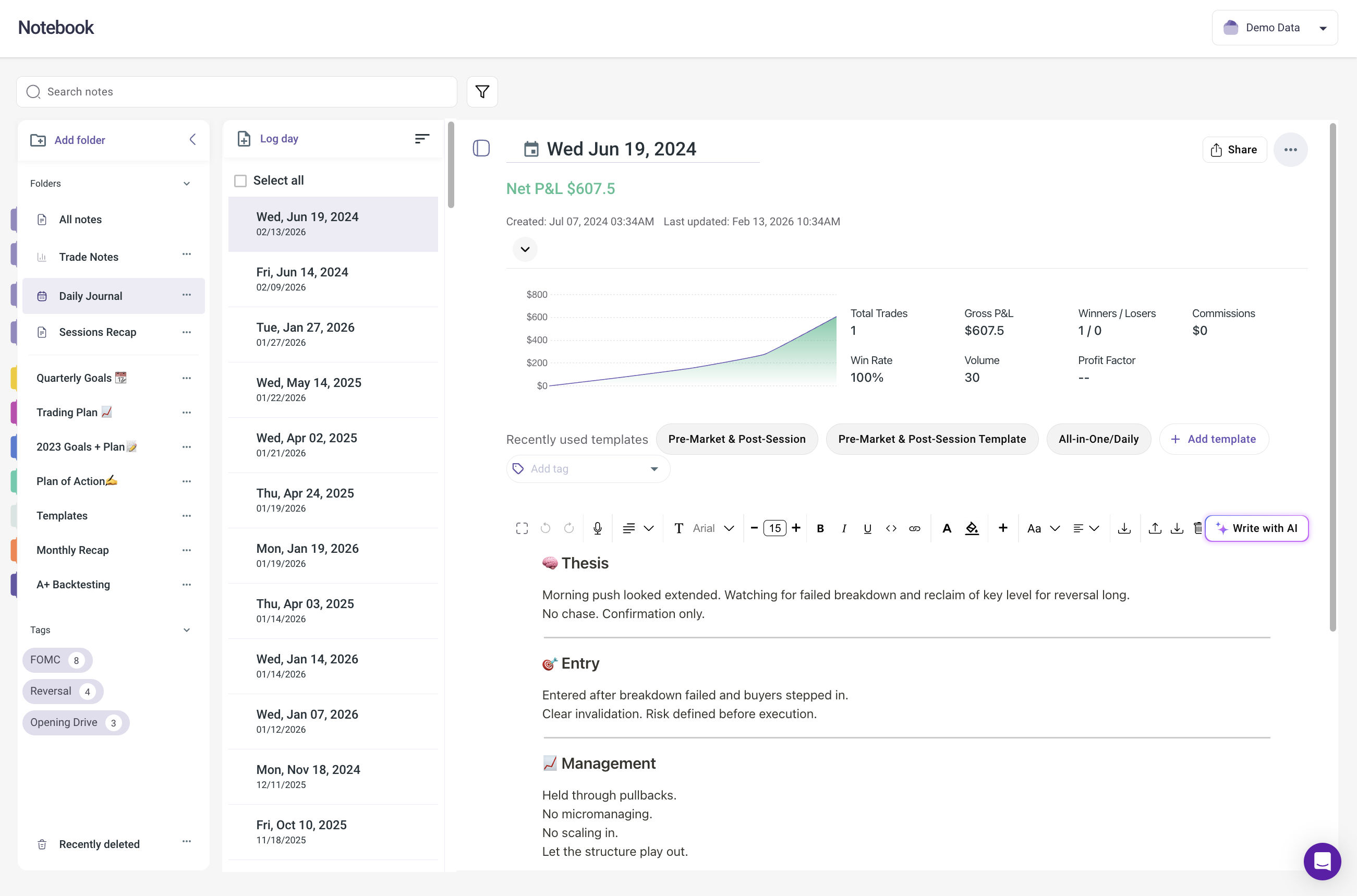
In TradeZella's Notebook, create a session reflection template: emotional color rating, tilt moments caught, tilt moments missed, and one adjustment for tomorrow. After 30 sessions, you will have a detailed tilt profile that shows your triggers, your most common type, and your improvement trajectory.
TradeZella Notebook
Tilt on a Prop Firm Account, Tilt on a funded account is an emergency. Prop firms have hard drawdown limits of 5 to 10 percent, and a single tilt episode can blow through that in one session. If you trade prop firm accounts, your tilt defenses should be twice as strict: 1 percent daily loss limit instead of 2, mandatory break after 1 loss instead of 2, and zero tolerance for trading outside your plan. Track each account's drawdown in real time using TradeZella's Prop Firm Sync.
Key Takeaways
Tilt has four distinct types: Loss tilt (chasing losses), win tilt (overconfidence after gains), injustice tilt (fighting the market), and entitlement tilt (feeling you deserve wins).
Loss tilt is most common. Win tilt is most overlooked. Every trader knows the danger of revenge trading after losses. Few recognize that a winning streak can be equally destructive.
The 30-second check catches tilt in real time. Three questions before every trade: Am I emotional? Would I take this trade if my last trade had the opposite result? Does this match my plan?
Tag trades for tilt type. After 2 weeks, your tag analytics show the exact dollar cost. Most traders would improve P&L by 15 to 30 percent by eliminating tilt trades.
Identify your dominant type and build a specific defense. Loss tilt needs daily loss limits. Win tilt needs size caps. Injustice tilt needs a one-entry rule. Entitlement tilt needs a hard stop time.
Tilt is the root cause. Revenge trading, FOMO, and overtrading are all symptoms. Fix the tilt type and the symptoms resolve.
How is "tilt" different from just being emotional?
Feeling nervous before a trade is normal. Feeling disappointed after a loss is normal. Tilt is specifically when emotions change your behavior and override your trading plan. The distinction is action. If you feel frustrated but still follow your rules, you are emotional but not on tilt. If frustration causes you to double your position size, skip your checklist, or trade outside your plan, that is tilt.
Can experienced traders still go on tilt?
Yes. Experience reduces the frequency but does not eliminate it. Professional poker players who have played millions of hands still have tilt protocols. Professional traders still have daily loss limits and cooling-off rules. The difference is that experienced traders recognize tilt faster, have defenses in place, and measure the cost with data. They do not assume they are immune.
How do I know if I'm on tilt in the moment?
The 30-second check is the most reliable real-time test. If you cannot articulate why you are taking a trade beyond emotional reasoning ("I need to make it back," "I'm on fire," "this should have worked"), that is tilt. Physical signals also help: racing heartbeat, clenched jaw, leaning toward the screen, clicking faster than usual. These are your body telling you that emotion has taken over.
What should I do if I have been tilting all session?
Stop immediately. Close all open positions. Walk away for at least 30 minutes. Then come back and do the post-session tilt audit: tag every trade for tilt type, calculate the session cost, and write a reflection. Do not re-enter the market. The session is over. Tomorrow you can trade again with a green-light emotional state.
Is tilt always bad?
Mild emotional engagement sharpens focus. The best trading sessions often involve a calm intensity. The problem is when intensity crosses into irrational decision-making, when emotions change your behavior rather than support it. Below that threshold, emotions are fine. Above it, they are destructive. The tilt framework helps you identify exactly where that line is for you personally.
How long does it take to build tilt resistance?
Most traders see meaningful improvement in 4 to 6 weeks of consistent tagging and the 30-second check. You will not eliminate tilt entirely, but you will catch it earlier and reduce its cost. After 30 sessions of tagging, you will know your dominant type, your most common triggers, and the exact situations where your defenses need to be strongest. If you are brand new, start with the basics in our trading tutorial for beginners before layering in tilt tracking.
Can I track tilt without a dedicated trading journal?
You can keep a basic tilt log in a spreadsheet, but the power of tilt tracking comes from comparing tilt-tagged trades against clean trades across metrics like win rate, profit factor, and expectancy. That comparison requires a tool that calculates metrics per tag automatically. In TradeZella, tag analytics do this instantly. In a spreadsheet, it requires complex formulas and manual filtering that most traders abandon within two weeks.