AI Trading Bots vs AI Trading Agents: What Actually Works and What Is Hype
AI Trading Bots vs AI Trading Agents: What Actually Works and What Is Hype
AI trading bots execute trades automatically based on coded rules, and they work well in institutional settings with deep capital and low latency. For most retail traders, bots fail because of slippage, regime changes, overfitting, and the reality that markets adapt faster than static rules. AI trading agents take a different approach: instead of trading for you, they improve how you trade by tagging every trade, reviewing every session, generating your plan, and answering questions about your actual data with memory across sessions.
class SampleComponent extends React.Component {
  // using the experimental public class field syntax below. We can also attach
  // the contextType to the current class
  static contextType = ColorContext;
  render() {
    return <Button color={this.color} />
  }
}
Last Updated: June 5, 2026
An AI trading bot is software that executes trades automatically based on pre-programmed rules or machine learning models. It buys and sells for you without human input. An AI trading agent is software that improves your trading by analyzing your data, tagging your trades, reviewing your sessions, and helping you make better decisions, but it does not place trades for you. These are fundamentally different tools solving fundamentally different problems. Most traders searching for an "AI trading bot" actually need an AI trading agent, because the bottleneck in their trading is not execution speed. It is knowing what works, what does not, and what to do about it.
The AI trading space is full of promises. Automated profits. Passive income while you sleep. Algorithms that beat the market. Some of it is real, in very specific contexts. Most of it is marketing. This article gives you an honest breakdown of where bots work, where they fail, what agents actually do, and how to decide which one fits your situation. No sales pitch. Just the data.
If you have already explored AI trading tools or read our comparison of AI trading assistants vs agents, this article goes deeper into the bot side of the equation and clarifies where each approach creates real value.
TL;DR
AI trading bots execute trades for you. They work for institutional firms with millions in infrastructure and for retail traders with validated quantitative strategies, deep capital, and the skill to monitor them constantly. Most retail bots fail within 6 months due to overfitting, slippage, and regime changes. AI trading agents do not place trades. They tag your trades, review your sessions, generate your pre-market plan, and answer questions about your actual data with memory across sessions. For most discretionary traders, the bottleneck is not execution speed. It is knowing what works and what does not. Bots optimize execution. Agents optimize the trader. Zella AI is an AI trading agent built into TradeZella.
What Does an AI Trading Bot Actually Do?
An AI trading bot connects to your broker through an API and places trades on your behalf based on rules you define or a model it has learned. At its simplest, a bot might follow a rule like "buy when the 20-period EMA crosses above the 50-period EMA and RSI is below 30." At its most complex, a bot uses machine learning to identify patterns in historical data and execute positions based on statistical probability.
The bot handles the entire execution cycle: it monitors price data, identifies signals, calculates position size, places the order, manages the trade (stop loss, take profit, trailing stops), and closes the position. You are not involved in any of these steps while the bot is running.
This is appealing for obvious reasons. No emotions. No hesitation. No revenge trades after a loss. No FOMO entries. The bot follows its rules regardless of how the market feels. For a deeper look at how emotions derail manual trading, see our guide on trading psychology.
Popular retail trading bots include platforms like 3Commas, Pionex, Cryptohopper (mostly crypto), and custom bots built on platforms like QuantConnect, MetaTrader Expert Advisors, and NinjaTrader's automated strategies. Some are pre-built. Some require coding. All share the same core promise: the bot trades so you do not have to.
Where Do AI Trading Bots Actually Work?
Bots are not a scam. They work in specific environments with specific advantages that most retail traders do not have. Being honest about where bots succeed makes the conversation about where they fail more credible.
High-Frequency Trading (Institutional)
Hedge funds and proprietary trading firms run bots that execute thousands of trades per second, capturing fractions of a penny on each one. These work because the firms have co-located servers next to exchange data centers (microsecond latency), massive capital to make tiny edges compound, proprietary data feeds, and teams of PhDs maintaining the algorithms. Citadel, Two Sigma, Renaissance Technologies, these firms print money with bots. But their infrastructure costs millions per year. Their bots are not available to retail traders, and the strategies do not work at retail latency or capital levels.
Narrow Strategy Automation
Some retail traders successfully automate a single, well-defined strategy with strict parameters. For example, a grid trading bot that buys and sells at fixed intervals in a range-bound market, or an arbitrage bot that captures price differences between exchanges. These work when the market conditions match the strategy. The problem is that market conditions change, and the bot does not know when to stop.
Execution Assistance
The most practical use of bot technology for retail traders is not fully automated trading. It is execution assistance: automatically placing stop losses, trailing stops, or scaling into positions based on rules you set while you are actively watching the market. This is automation helping a human trader, not replacing one.
Where Do AI Trading Bots Fail for Retail Traders?
This is the part most "best AI trading bot" articles skip. The failure rate for retail trading bots is high, and the reasons are structural, not fixable with a better algorithm.
Overfitting to Historical Data
The most common bot failure. You backtest a strategy on two years of historical data. It shows a 70% win rate and 3.2 profit factor. You deploy it live. It loses money immediately. What happened? The bot was optimized to fit the specific price patterns in your backtest period. It memorized the past instead of learning principles that generalize to the future. This is called overfitting, and it is the silent killer of retail bots. The more parameters you tune, the better the backtest looks, and the worse the live performance gets.
Market Regime Changes
A bot that works in a trending market fails in a choppy market. A bot built for low volatility blows up when volatility spikes. Markets shift between regimes (trending, ranging, volatile, quiet) and a static set of rules cannot adapt. A human trader recognizes "this is not my market" and sits out. A bot keeps trading the same rules into conditions they were never designed for. The cost is not just losses. It is drawdown that compounds while you are not watching.
Slippage and Execution Reality
Backtests assume perfect fills at the exact price you wanted. Live trading does not work that way. On a $50,000 account, slippage of $0.05 per share across 20 trades per day is $200 per day in hidden costs. Over a month, that is $4,000. Many bot strategies that are profitable in a backtest become unprofitable when you account for realistic slippage, commissions, and the spread between bid and ask.
The "Set It and Forget It" Illusion
Most retail traders buy a bot because they want passive income. The reality is that every profitable bot requires constant monitoring, parameter adjustment, and the judgment to shut it off when conditions change. If you have that judgment, you are already a capable trader. If you do not have that judgment, the bot amplifies your mistakes at machine speed instead of human speed. Emotional trading does not disappear with a bot. It shifts from "I should not have taken that trade" to "I should not have left the bot running overnight."
Capital Requirements
Bot strategies that work at scale often require substantial capital to overcome transaction costs and generate meaningful returns. A strategy that returns 0.3% per day sounds amazing until you realize that on a $5,000 account, that is $15 per day before commissions and slippage eat most of it. The firms that make bots work profitably are trading with millions, not thousands.
None of this means bots are worthless. It means the "AI trading bot" promise of automated profits rarely delivers for the average retail trader. The technology is real. The application is mismatched to the situation most individual traders are in.
How Are AI Trading Agents Different?
Capability
AI Trading Bot
AI Trading Agent (Zella AI)
What it does
Executes trades for you
Improves how you trade
Places trades
Yes (automated)
No (you trade, AI reviews)
Tags trades automatically
No
Yes (your custom rules)
Reviews your sessions
No
Yes (plan vs results, automatic)
Generates pre-market plan
No
Yes (personalized to your style)
Memory across sessions
No (stateless rules)
Yes (compounds over time)
Works on your actual data
Only its own trades
All trades from 500+ brokers
Adapts to regime changes
No (static rules)
Yes (surfaces patterns as conditions change)
Requires coding
Usually (Python, MQL, C#)
No (natural language setup)
Overfitting risk
High (optimized to past data)
Low (analyzes your real results)
Best for
Quant traders with validated strategies and deep capital
Discretionary traders who want to improve with data
Retail success rate
Low (most lose money within 6 months)
High (value scales with trade count)
An AI trading agent does not place trades for you. It works on your trading data after each session and takes action to make your next session better. Where a bot replaces the trader, an agent improves the trader. Zella AI, the AI trading partner built into TradeZella, is the clearest example of how agents work in practice.
The distinction matters because the bottleneck for most retail traders is not execution. It is self-awareness. You do not lose money because you click the buy button too slowly. You lose money because you do not know which of your setups actually works, what time of day you trade best, how much your revenge trades cost you per month, or whether your live performance matches what your strategy should produce. These are data problems, and AI agents like Zella AI solve data problems.
Here is what Zella AI does as an AI trading agent:
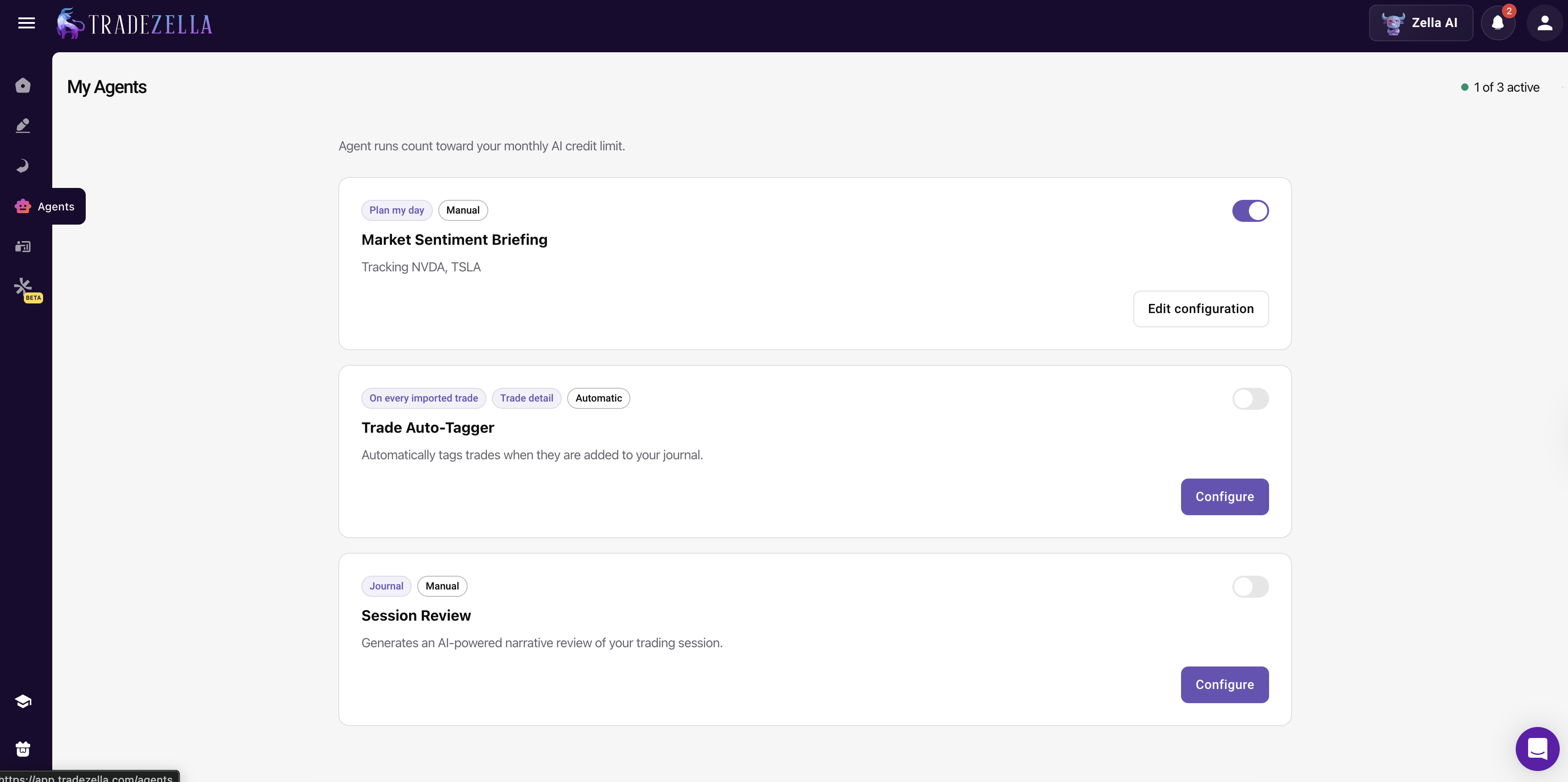
TradeZella Agents
It tags your trades automatically. You tell Zella AI's Auto Trade Tagger what to look for: "tag by sector," "tag trades above 2R," "tag whether I followed my plan," "tag the setup type." The agent applies those tags to every trade the moment it imports from your broker into TradeZella. No manual work. No forgetting to tag after a bad day. Clean, consistent data from Day 1. After 50 tagged trades, you can filter by any dimension and see exactly where your trading edge lives.
It reviews your sessions. At the end of your trading day, Zella AI's Session Review agent compares your morning plan against your actual results. It checks whether you followed your rules, flags deviations, identifies what went well, and journals the entire session. You do not write your own review. Zella AI writes it using your data. Even on the days you want to close your charts and forget the session happened, the review gets done.
It generates your plan. Before the market opens, Zella AI's Market Sentiment Briefing creates a personalized pre-market plan based on how you trade: your instruments, your style, what you look at. Not a generic market summary. Your plan, built from your configuration and your history.
It answers questions about your data. Ask Zella AI anything. "What is my win rate on breakout trades before 10:30 AM?" "Which Strategy had the highest profit factor last month?" "Am I sizing up after losses?" It answers with your actual numbers from TradeZella's 50+ analytics reports, not generic advice. It pushes back when your data contradicts your assumptions. And it remembers your preferences, your Strategies, your risk limits across every session.
It compounds over time.Zella AI with one month of your data is useful. With six months, it knows your behavioral patterns. With a year, it has a complete picture of who you are as a trader, what conditions bring out your best work, and what situations lead to your worst mistakes. No bot builds this kind of understanding because no bot looks at your trading from the inside.
For a deeper look at per-trade AI feedback, see our guide on AI trade analysis. For the full breakdown of how agents differ from assistants like ChatGPT, see our AI trading assistant vs agent comparison.
What Does This Look Like in Practice?
Here is a concrete example of how a bot and an agent handle the same trading day on a $50,000 account.
The Bot Day
You deploy a mean-reversion bot on ES futures. It takes 12 trades during the session. 7 winners, 5 losers. Net P&L: +$340. Sounds good. But you were not watching. You do not know that 3 of the winners were during a narrow range where the strategy thrives, and 4 of the 5 losers came during a trending breakout that the bot kept fading. The bot does not tell you this. It does not learn from it. Tomorrow it will do the exact same thing regardless of market conditions.
The Agent Day
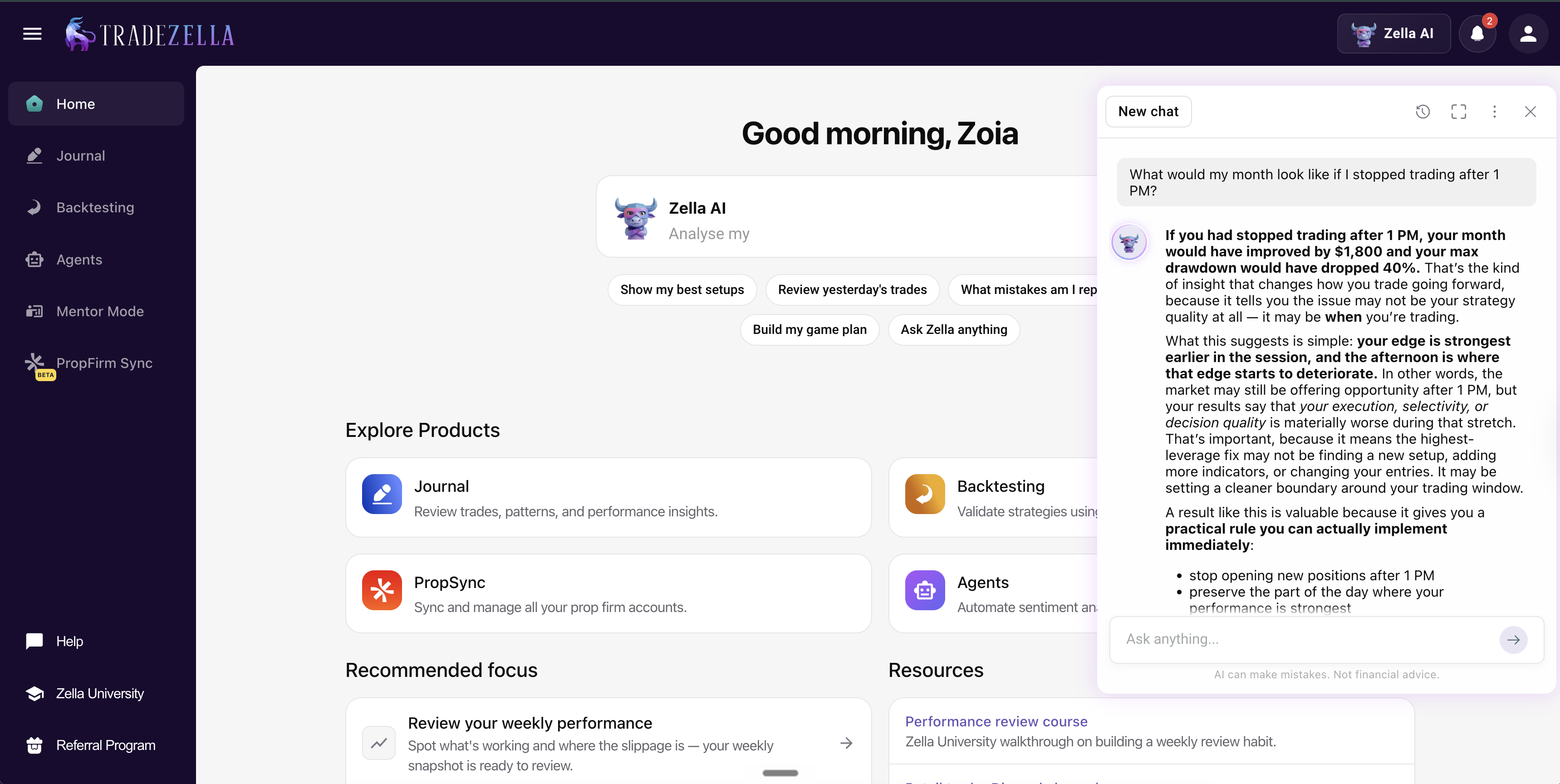
You trade manually. You take 6 trades. 4 winners, 2 losers. Net P&L: +$580. After the session, the AI agent like Zella AI tags every trade with your setup type, time of day, and market condition. The Session Review compares your morning plan against what you actually did. It flags that your two losing trades both came after 2 PM, consistent with a pattern the agent identified last month: your afternoon trades have a 38% win rate versus 64% in the morning. It journals the session with specific notes on each trade.
You open the agent and ask: "What would my month look like if I stopped trading after 1 PM?" It shows you: removing afternoon trades would have improved your monthly P&L by $1,800 and reduced your max drawdown by 40%. That insight is worth more than any bot's automated profits, because it makes every future session better.
Asking Zella Agent Question about Trading Data
The bot optimizes execution. The agent optimizes the trader.
Should You Use a Bot or an Agent?
This depends on your situation, your capital, and what problem you are actually trying to solve. Here is an honest framework:
A bot makes sense if:
You have a quantitative strategy with strict, testable rules that you have validated across multiple market regimes
You have enough capital that transaction costs and slippage do not eat your edge (typically $50,000+ for stock/futures strategies)
You have the technical skill to monitor, adjust, and shut off the bot when conditions change
You understand that "automated" does not mean "unattended" and you are prepared to supervise
Your edge is speed-based (arbitrage, HFT) where human execution is the bottleneck
An agent makes sense if:
You are a discretionary trader who makes decisions based on chart reading, setups, and market feel
You want to know which of your Strategies actually makes money and which is losing
You want your trades tagged, your sessions reviewed, and your journal written automatically
You want AI that answers questions about your actual data: "What is my edge? When do I trade best? What are my mistakes costing me?"
You want an AI that remembers your preferences, your risk limits, and your trading style across every session
You trade prop firm accounts and need compliance tracking, session review, and rule adherence monitoring
Your bottleneck is not execution speed. It is self-awareness, consistency, and knowing what to improve next.
Most retail traders fall into the second category. The dream of automated profits is appealing, but the reality is that 80%+ of retail bot strategies lose money within 6 months. The traders who consistently improve are the ones who understand their own data, and that is what agents are built for.
How to Evaluate Any AI Trading Product
Whether you are looking at a bot, an agent, or something marketed as "AI trading software," ask these five questions before spending money:
1. Does it work on YOUR data or generic data? A tool that analyzes your actual trades from your broker is more valuable than one that gives general market predictions. Your trading edge lives in your data, not in a generic model.
2. Does it take action or just give answers? ChatGPT can answer trading questions. But it cannot tag your trades, review your session, or journal your day. The difference between an AI trading coach and a chatbot is whether it does the work or just talks about it.
3. Does it have memory? An AI that forgets your conversation after each session cannot compound. An AI that remembers your risk limits, your Strategies, your preferences, and your behavioral patterns across months becomes exponentially more useful over time.
4. Does it know trading? General-purpose AI (ChatGPT, Claude, Gemini) has broad knowledge but no depth in trading-specific concepts like ICT setups, order flow, prop firm rules, or R-multiple tracking. A trading-specific AI has these skills built in. For a comparison of general AI vs trading-specific AI, see our best AI stock trading software guide.
5. Is the claim testable? "Our bot returns 30% per month" is not testable without live, audited results. "Our agent shows you which Strategy has the highest profit factor" is testable the moment you connect your broker and import 50 trades. Be skeptical of return claims. Be open to tools that show you your own data more clearly.
The best AI trading tools are the ones that make you better at something specific and measurable. Not the ones that promise the most impressive returns. For a full risk management framework to evaluate any trading tool, see our dedicated guide.
Key Takeaways
AI trading bots execute trades automatically. They work in institutional settings with deep capital, low latency, and quantitative strategies. For most retail traders, bots fail due to overfitting, slippage, regime changes, and the illusion that "automated" means "unattended."
AI trading agents do not place trades. They improve the trader by tagging every trade, reviewing every session, generating pre-market plans, answering questions about your data, and building memory across sessions.
The bottleneck for most retail traders is not execution speed. It is self-awareness: knowing which Strategies work, what time of day you trade best, and how much your mistakes cost. Agents solve that problem. Bots do not.
Bots optimize execution. Agents optimize the trader. Both have value. The question is which problem you actually have.
Before buying any AI trading product, ask: does it work on my data, does it take action, does it have memory, does it know trading, and is the claim testable?
AI trading bots work in specific contexts: institutional high-frequency trading with co-located servers, narrow automated strategies with substantial capital, and execution assistance for active traders. For most retail traders, bots fail because of overfitting to historical data, slippage between backtest and live execution, and the inability to adapt when market conditions change. The technology is real. The "passive income while you sleep" promise is not, for the vast majority of individual traders.
Are AI trading bots profitable?
Some are, in narrow conditions. Institutional bots at firms like Citadel and Renaissance Technologies are highly profitable, but they require infrastructure that costs millions per year. Retail bots can be profitable for traders who have a validated quantitative edge, enough capital to absorb transaction costs, and the skill to monitor and adjust the bot continuously. Most retail traders who deploy bots without these advantages lose money within 6 months.
What is the difference between an AI trading bot and an AI trading agent?
A bot executes trades for you. It connects to your broker and buys and sells based on rules or models without human input. An agent improves your trading by working on your data after each session. It tags your trades, reviews your sessions against your plan, generates pre-market briefings, answers questions about your actual performance, and remembers your preferences across sessions. A bot replaces the trader. An agent makes the trader better.
Can I use both a bot and an agent?
Yes. Some traders use a bot for execution (placing orders based on signals) and an agent for analysis (reviewing whether the strategy is working, tracking performance over time, and identifying when to adjust). The agent gives you the data to decide whether the bot should keep running, change parameters, or shut off. They solve different problems and can complement each other.
Is Zella AI a trading bot?
No. Zella AI is an AI trading agent, not a bot. It does not place trades or connect to your broker for execution. TradeZella (the platform) imports your trades from 500 plus brokers. Zella AI (the intelligence layer) works on that data: tagging every trade based on your rules, reviewing sessions against your plan, generating personalized pre-market briefings, and answering questions about your performance with memory across sessions. It improves how you trade. It does not trade for you.
What should I look for in an AI trading tool?
Five things: does it work on your actual data (not generic models), does it take action (tagging, reviewing, journaling, not just answering questions), does it have memory across sessions (so it gets smarter over time), does it have trading-specific skills (ICT setups, order flow, prop firm rules, R-multiple tracking), and is the claim testable (can you verify the value with your own data within a few weeks). Be skeptical of tools that promise specific return percentages. Be open to tools that make your own performance data more visible and actionable.
Do I need coding skills to use an AI trading agent?
No. Bots often require coding (Python, MQL, C#) to build, deploy, and maintain. AI trading agents like Zella AI are configured through natural language. You tell the Auto Trade Tagger what to tag in plain English: "tag by sector," "tag trades above 2R," "tag revenge trades." You configure the Market Sentiment Briefing by selecting your instruments and describing how you trade. No code. No scripts. No technical setup.