Backtesting for Beginners: How to Test Your Strategy Before Risking Real Money
Backtesting for Beginners: How to Test Your Strategy Before Risking Real Money
Backtesting lets you test a trading strategy on historical market data before you risk real money. This beginner's guide explains why every new trader should backtest first, how to run your first backtest step by step, what to look for in the results, and common mistakes that waste your time.
class SampleComponent extends React.Component {
  // using the experimental public class field syntax below. We can also attach
  // the contextType to the current class
  static contextType = ColorContext;
  render() {
    return <Button color={this.color} />
  }
}
Last Updated: July 06, 2026
Backtesting is how you find out whether a trading strategy works before your account balance tells you it does not. You replay historical market data, take trades following your rules, and measure the results over dozens of trades. If the strategy makes money over a large enough sample, you have something worth trading live. If it does not, you saved yourself real losses by discovering it on historical data instead of your real account.
Most beginner traders skip this step. They watch a YouTube video, learn a strategy, open a live account, and start trading the next day. Some get lucky for a week. Most do not. The ones who last are the ones who tested first. For a full definition and deeper explanation, see our guide on what is backtesting. For a complete beginner roadmap to trading, see our trading tutorial for beginners.
This guide is for you if you have never backtested before. It covers why backtesting matters more than most beginners realize, how to run your first backtest, what to look for in the results, mistakes that waste your time, and how to go from backtest to live trading without blowing up your account.
TL;DR
Backtesting lets you practice your strategy on real historical data without risking real money. It shows you whether your rules actually make money over 50 to 100 trades before you put your account on the line. Your first backtest should be simple: one strategy, one market, one timeframe. Track win rate and profit factor. If profit factor is above 1.3 after 50+ trades, forward test at small size. If not, adjust and retest. TradeZella auto-journals every backtested trade so you never have to manually log anything.
Why Should Beginners Backtest Before Going Live?
Here is what happens when you skip backtesting and go straight to live trading:
You take 3 trades. The first two lose. Now you are down $300 on a $5,000 account. You do not know if the strategy is broken or if 2 losses in a row is normal for this setup. You panic. You take a bigger position on the third trade to make it back. That is revenge trading. It loses too. Now you are down $600 and you abandon the strategy entirely. Maybe it was a bad strategy. Or maybe it has a 45% win rate that is profitable over 100 trades because winners are twice the size of losers. You will never know because you quit after 3 trades.
Now here is what happens when you backtest first:
Before risking a single dollar, you replay 3 months of historical data. You take 60 trades following your rules. You discover the strategy has a 44% win rate, a 1.5 profit factor, and a max losing streak of 7 trades. Now when you go live and lose 2 trades in a row, you do not panic. You know from your backtest that this is normal. You have seen it happen 8 times in 60 trades. You keep following the rules because you have data, not hope.
That is the difference backtesting makes. It replaces emotion with evidence. It turns "I think this strategy works" into "I know this strategy makes money over 60 trades with a 1.5 profit factor." For more on how emotions destroy trading accounts, see our guide on emotional trading.
Backtesting also saves you money. A beginner who goes live on a $5,000 account and loses 10% in the first month has lost $500 learning that their strategy does not work. A beginner who backtests for 2 weeks discovers the same thing for free. The historical data is the same. The lessons are the same. The only difference is whether you pay tuition to the market or to the chart.
What Do Beginner Need to Start Backtesting?
You need three things. That is it.
1. A strategy with written rules. Not "buy when it looks good." Written rules: what is the entry signal, where does the stop loss go, where is the target, how much do you risk per trade. If you cannot write the rules on a piece of paper, you cannot test them. For a framework, see our guide on how to create a trading plan.
2. A backtesting platform. You need software that replays historical market data bar by bar so you cannot see what comes next. This is the critical part. Scrolling through a chart and saying "I would have bought here" is not backtesting because you can already see the price went up. Real backtesting hides the future. TradeZella supports forex, futures, stocks, and crypto with 11+ years of historical data. For a comparison of platforms, see our best backtesting software guide.
3. Patience for 50 trades. A backtest with 5 or 10 trades tells you nothing. You need at least 50 trades for the results to be meaningful. That might take a few weeks of daily 1-hour backtesting sessions. There is no shortcut. If you rush it, you are guessing with extra steps.
How to Run Your First Backtest
Keep your first backtest simple. One strategy, one market, one timeframe. Here is the step-by-step process:
Step 1: Pick one strategy and write the rules down. Do not test 3 strategies at once. Pick one. Write the entry rule, the stop loss rule, the target rule, and the risk per trade (start with 1% of your account). Example: "Enter long when price breaks above the previous day's high with a stop below the previous day's low. Target is 2x my risk."
Step 2: Pick one market and one timeframe. If you want to trade NQ futures on the 5-minute chart, backtest NQ on the 5-minute chart. If you want to trade AAPL on the 15-minute chart, backtest AAPL on the 15-minute chart. Do not backtest on one market and trade another.
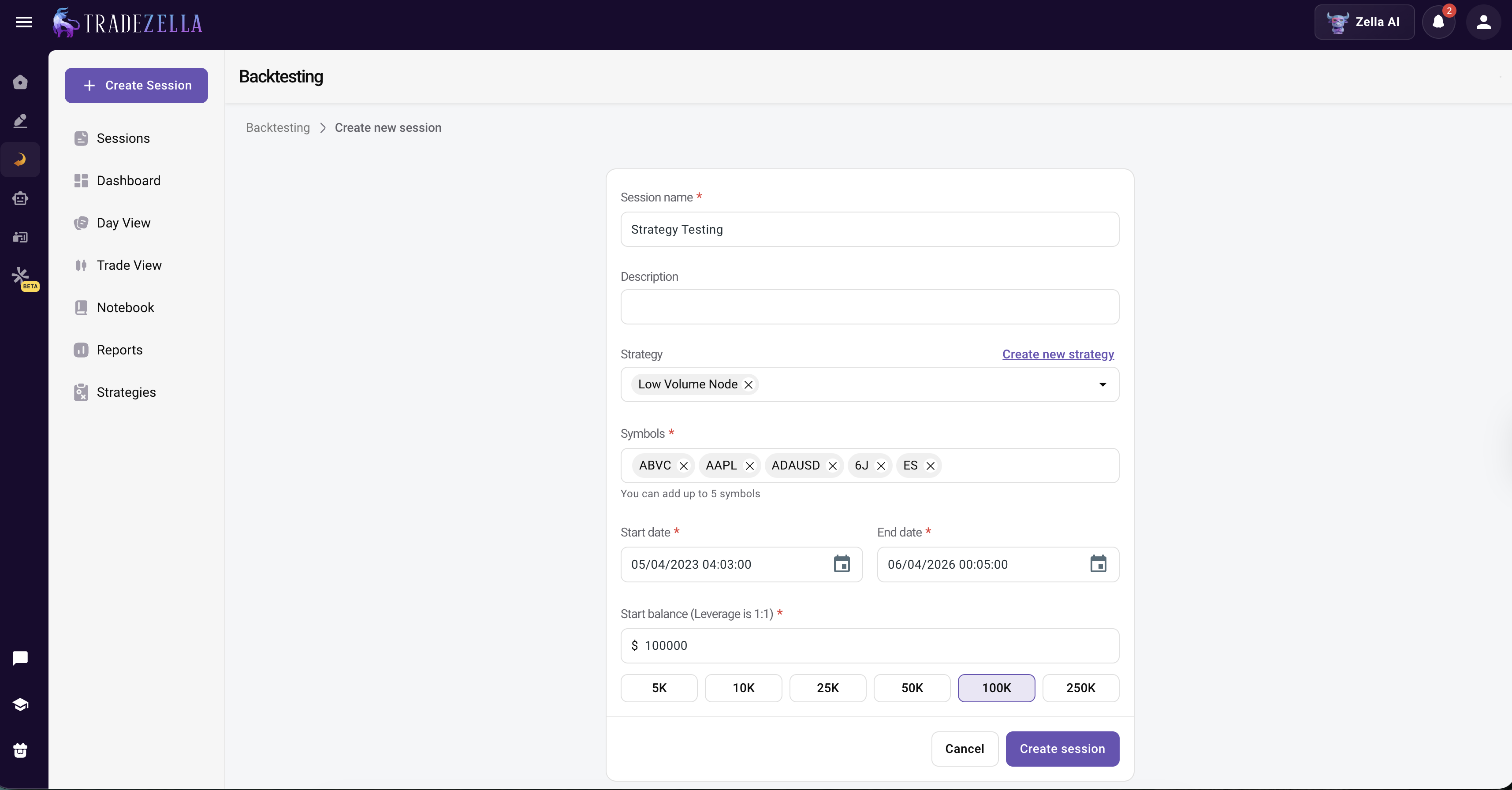
Step 3: Open a backtesting session. On TradeZella, create a new session, select your instrument, set your starting balance to match what you plan to trade with (even if it is $1,000 or $5,000), and start replaying. The chart unfolds bar by bar like a live market. You cannot see the future.
Step 4: Wait for your setup and take the trade. This is where discipline starts. If your rules say "enter on a breakout above the previous day's high," you wait. You do not take trades that almost fit your rules. You do not get bored and take random trades. You wait for the exact setup and execute it. If the setup does not appear, skip to the next day using the Go-To feature.
Step 5: Let the trade play out. Once you enter, let the trade hit your stop or your target. Do not move your stop further away because you are scared. Do not close early because you are up a little. Follow the rules you wrote down. The entire point of backtesting is to see what happens when you follow the rules consistently over many trades.
Step 6: Tag the trade and move on. TradeZella auto-journals every trade with entry, exit, P&L, and timestamps. Add a simple tag: did you follow your rules or not? Was it an A-setup (perfect) or a B-setup (close but not ideal)? This takes 10 seconds per trade. After 50 trades, these tags tell you exactly which setups make money and which do not. Zella AI Auto Trade Tagger can do this automatically based on rules you define.
TradeZella Backtesting Interface
Step 7: Repeat until you have 50 trades. At 3 to 5 trades per session and 1 hour per day, you can reach 50 trades in about 2 weeks. Do not analyze before 50 trades. Small samples lie.
What Should Beginners Look For in Backtest Results?
IMAGE: TradeZella analytics dashboard with beginner-friendly metrics highlighted
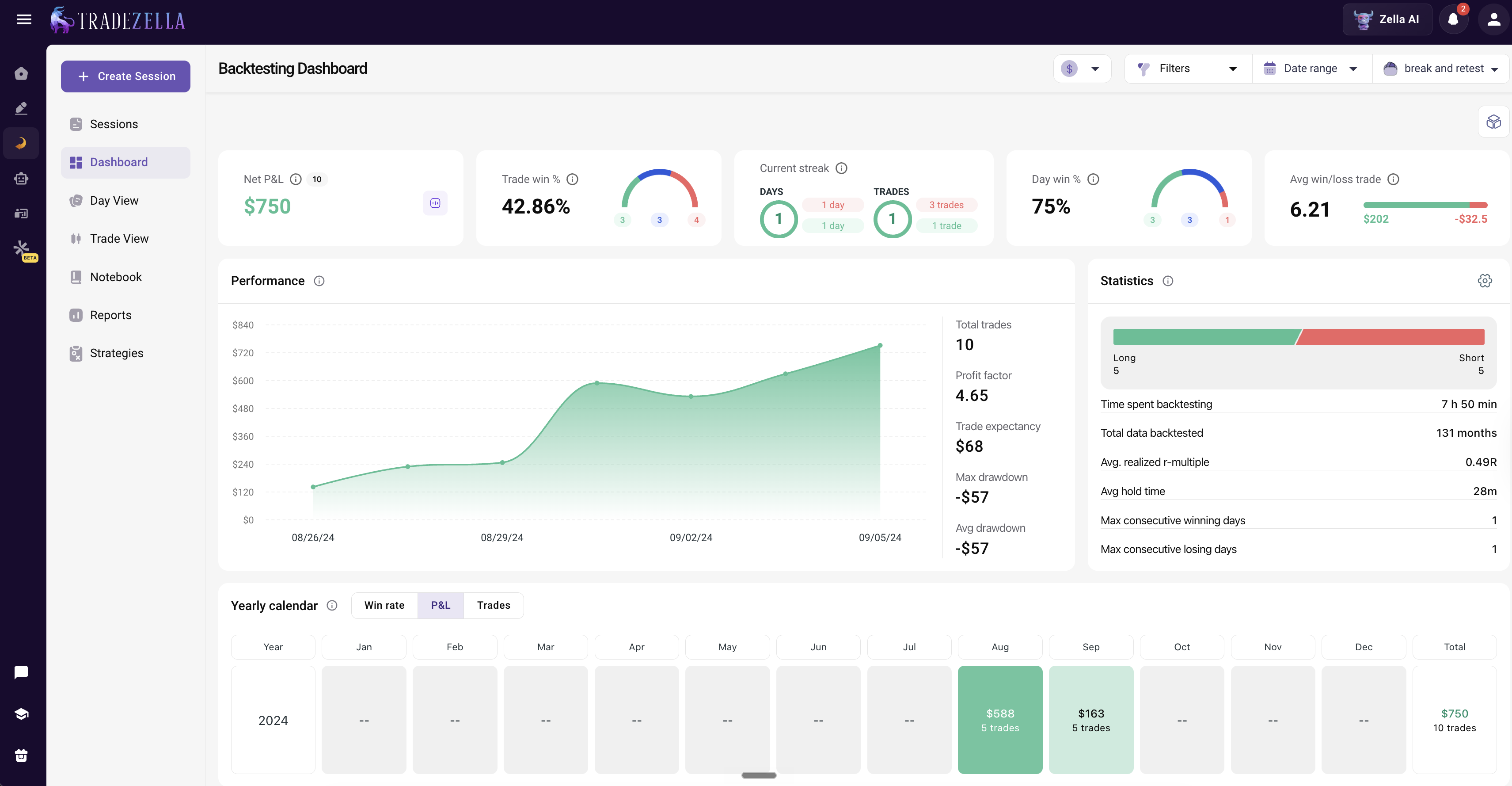
After 50 trades, open your results. As a beginner, focus on three numbers:
Profit factor. This is gross profit divided by gross loss. If your winners totaled $3,000 and your losers totaled $2,000, your profit factor is 1.5. Above 1.0 means you made money. Above 1.3 is solid. Below 1.0 means the strategy lost money. This is the single most important number because it combines win rate and win size into one metric.
Win rate. What percentage of your trades were winners. This number alone means nothing. A 30% win rate can be profitable if winners are 3x bigger than losers. A 70% win rate can lose money if losers are 3x bigger than winners. Always look at win rate together with average win vs average loss.
Max drawdown. The biggest peak-to-trough drop in your account during the backtest. If your $5,000 account dropped to $4,200 at the worst point, that is a $800 or 16% max drawdown. This tells you how bad it can get. If you cannot stomach a 16% drawdown emotionally, you need to risk less per trade or find a different strategy.
TradeZella Backtesting Dashboard
If your profit factor is above 1.3 after 50+ trades and your max drawdown is something you can live with, you have a strategy worth testing live. If the profit factor is below 1.0, the strategy loses money and needs to be adjusted or replaced. If it is between 1.0 and 1.3, it might be marginal. Collect more trades (up to 100) before deciding. For more on finding your trading edge, see our dedicated guide.
Common Beginner Backtesting Mistakes
These are the mistakes that make beginners waste weeks of backtesting and still lose money when they go live:
Looking ahead on the chart. If you scroll through a chart and pick trades knowing what happened next, you are not backtesting. You are cheating. Use a platform with bar replay that hides the future. This is non-negotiable.
Taking trades that do not fit your rules. You see something that looks "pretty good" even though it does not match your written rules. You take it anyway. Now your results are contaminated. Half the trades are your strategy. Half are impulse. The data is useless. Follow the rules or the backtest means nothing.
Quitting after 10 trades. You take 10 trades, 6 are losers, and you decide the strategy does not work. But 10 trades is noise. A fair coin can land tails 7 out of 10 times. That does not mean the coin is broken. You need 50+ trades to know. Anything less is a guess.
Changing rules mid-test. After 20 trades with a bad win rate, you tweak the entry rule. Now you are testing a different strategy but counting it as the same one. If you want to change rules, stop, note the change, and start a fresh 50-trade test with the new rules.
Testing on one market condition only. If you only test during a strong trend, you do not know what happens when the market chops. Test across at least 2 to 3 months of data so your backtest includes trending, ranging, and volatile conditions.
Not journaling. If you do not tag your trades, you cannot filter your results later. "What is my win rate on A-setups vs B-setups?" "Do I perform better in the morning or afternoon?" You cannot answer these questions without tags. TradeZella auto-journals every trade, and Zella AI tags them automatically, so this is handled for you. For more on journaling as a beginner, see our guide on the best trading journal for beginners.
For a full list of trading errors to watch for, see our trading mistakes guide.
How to Go from Backtest to Live Trading
A profitable backtest does not mean you should go live at full size tomorrow. The gap between backtesting and live trading is where most beginners lose money. Slippage, emotions, and execution speed all work differently when real money is on the line.
Here is the bridge:
1. Backtest (50+ trades). You just did this. You have a profit factor above 1.3. You know the max drawdown. You know the win rate. You know which setups are strongest.
2. Forward test (20 to 30 trades on demo or small size). Trade the same strategy on a demo account or with the smallest possible position size on a live account. Follow the exact same rules. The goal is to see whether your backtest results hold up when the market is moving in real time and you can feel the pressure. If your live results are within 15 to 20% of your backtest results after 20 to 30 trades, the strategy works.
3. Go live at reduced size (25% to 50% of your planned risk). If you plan to risk $200 per trade eventually, start at $50 to $100. Trade for another 20 to 30 trades. This phase tests whether you can follow your rules when real money is at stake, not just on demo.
4. Scale to full size. Once your live results at reduced size match your backtest within 15 to 20%, scale to your planned risk per trade. Now you are trading with data behind every decision.
TradeZella is the only platform where your backtested trades and your live trades exist in one place. Same analytics, same reports, same Strategy labels. Filter by "Backtest" vs "Live" and see the exact gap. If your backtest shows a 1.5 profit factor and your live shows 0.9, you know the problem is execution, not the strategy. That gap is where the real improvement happens.
For prop firm traders, this process is even more important. Backtest before paying the evaluation fee. If your strategy cannot pass in a backtest, it will not pass live. Use TradeZella's free trading calculators for position sizing and risk-reward math.
Why TradeZella Is Built for Beginners Who Want to Backtest
Most backtesting platforms are built for experienced traders. They assume you already know what tags to create, what metrics matter, and how to analyze 50 reports. TradeZella works for beginners because it does the heavy lifting for you:
Auto-journals every trade. You do not have to manually log anything. Every trade records entry, exit, P&L, and timestamps the moment you execute.
Zella AI tags your trades. Tell the Auto Trade Tagger what to look for in plain English: "tag by setup type," "tag whether I followed my rules," "tag the session." It applies tags automatically so you have clean data from Day 1 without manual work.
Go-To feature skips dead time. Jump directly to the Asian Session, London Session, New York Session, NY AM, NY PM, Silver Bullet London, or Next Day Open. You can also set custom session times. No fast-forwarding through overnight data.
Automatic position sizing. Set your risk percentage and TradeZella calculates the correct position size based on your stop distance. Your dollar risk stays the same on every trade.
Built-in ICT indicators. Fair Value Gap (FVG), Asian Session Range, HTF Bias, Key Levels, and Power of 3. No scripts, no third-party add-ons.
Simple analytics that grow with you. Start with profit factor, win rate, and max drawdown. As you get more experienced, use R-multiple tracking, Strategy comparison, time-of-day filtering, and tag analytics.
Backtest-to-live in one platform. When you go live, import trades from 500+ brokers. Your backtested Strategy and your live Strategy use the same analytics, same reports, same filters. See the gap and fix it.
Key Takeaways
Backtesting lets you test a strategy on historical data before risking real money. It is how you find out whether your rules work over 50+ trades instead of discovering it with your account balance.
Most beginners skip backtesting and go straight to live trading. They lose money, panic, revenge trade, and quit. Backtesting prevents this by giving you evidence that your strategy works before emotions enter the picture.
Your first backtest should be simple: one strategy, one market, one timeframe. Write your rules down. Replay historical data bar by bar. Take only trades that fit your rules exactly. Collect 50 trades before analyzing.
Focus on three metrics: profit factor (above 1.3 is solid), win rate (only matters with average win vs loss), and max drawdown (can you handle the worst stretch?).
Go from backtest to live in stages: backtest 50+ trades, forward test 20 to 30 on demo, go live at reduced size, then scale up when live matches backtest within 15 to 20%.
TradeZella auto-journals every backtested trade, Zella AI tags automatically, and your backtest and live data live in one platform so you can measure the gap and improve.
Frequently Asked Questions
Do I really need to backtest as a beginner?
Yes. Backtesting is how you find out whether a strategy works before risking real money. Going live without backtesting is like taking a driving test without ever practicing. You might get lucky, but the odds are against you. A 2-week backtest of 50 trades costs nothing and can save you hundreds or thousands in live losses.
What is the best backtesting platform for beginners?
The best backtesting platform for beginners hides future price action so you cannot cheat, is simple to use, and does the journaling for you. TradeZella is a strong fit because it does both manual and automated backtesting in one place. Beginners can start with bar replay, stepping through historical charts and placing trades by hand to build chart-reading skill, then use automated backtesting to describe rules in plain English and test them across more than 11 years of data in minutes. Every trade is auto-journaled and Zella AI tags it, so you get clean data from day one without manual logging. It focuses on the three metrics beginners need first, profit factor, win rate, and maximum drawdown, and grows with you as you add advanced analytics. Plans start at 35 dollars per month.
How many trades should I backtest?
At minimum 50 trades. Under 30 trades, the results are too noisy to trust. A coin can land tails 7 out of 10 times without being broken. You need enough trades for the pattern to emerge. If you take 3 to 5 trades per session and backtest 1 hour per day, you can reach 50 trades in about 2 weeks.
What is the most important metric in a backtest?
Profit factor. It is gross profit divided by gross loss. Above 1.0 means the strategy made money. Above 1.3 is solid. Below 1.0 means it lost money. Profit factor combines win rate and win size into one number, which makes it more useful than win rate alone.
Can I backtest for free?
Some platforms offer limited free backtesting. FX Replay has a free plan with limited sessions and forex pairs only. TradingView offers basic bar replay on daily charts for free. NinjaTrader's platform is free but requires C sharp coding. TradeZella starts at 35 dollars per month and includes auto-journaling, Zella AI, and analytics that free platforms do not offer.
What is the difference between backtesting and paper trading?
Backtesting replays historical data. You trade past price action that has already happened, but you cannot see the future during the test. Paper trading (forward testing) trades live market data in real time with simulated money. Backtesting is faster because you can replay months of data in hours. Paper trading is slower but tests real-time execution. The correct sequence is backtest first, then paper trade, then go live.
How long does it take to learn backtesting?
You can run your first backtest within 30 minutes of signing up for a platform like TradeZella. The interface is designed for beginners. Create a session, pick your instrument, and start replaying. The learning curve is not the software. It is the discipline: following your rules consistently, waiting for setups instead of forcing trades, and collecting enough data before drawing conclusions.
Should I backtest before trying a prop firm evaluation?
Absolutely. Prop firm evaluations cost 200 to 500 dollars per attempt. If your strategy cannot produce a positive profit factor over 50 backtested trades, it will not pass a live evaluation. Backtest first, validate the strategy works under the firm's drawdown rules, then pay for the evaluation with confidence.